Imprimir vista previa Cerrar

Mostrando 4485 resultados

Descripción archivística
FRAZ/33/407 · Unidad documental simple · 15 June 1937
Parte de Papers of Sir James Frazer

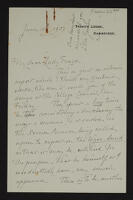
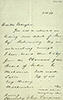
Trinity Lodge, Cambridge - Her husband has asked her to report on the College Council discussions of the Wyse Fund: the Statutes do not allow a double Fellowship being allocated, and no funds allowed for Beneficent purposes may be voted to a Fellow; she does hope 'that a successful plan will quietly be carried out by the user of The Wyse fund'.

EDDN/A/1/2 · Unidad documental simple · 2 July 1899
Parte de Papers of Sir Arthur Eddington

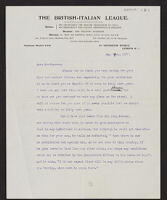
Transcript

Dalton Hall, Victoria Park, Manchester

2. VII. ’99

Dear Mrs. Eddington,

You will be interested in hearing some details of Stanley’s Preliminary. They are astonishing enough.—I have heard them today from the Chairman of the Board of Studies. In

Mechanics. Full marks
Latin. Top of all
Eng History [ditto]
Mathematics [ditto] & 60 marks above everybody else

leaving Chemistry & Eng. Language as the only subjects in which any one excelled him.

This is a marvellous record; whether he ought to know it I leave to you.

The great thing now is not to overload him; and to keep up his exercise: but I see no danger of going wrong in either respect.

In Physics ii at Easter I find he got 99 per cent. in the College Examination, making 199 out of 200. He has half the prize in Latin, the Prize in Practical Physics as well as theoretical; and the 2nd place in Math iii. A.

He will now, I trust, go in for a good physical athletic holiday. With my hearty congratulations

I remain
Yours sincerely
J. W. Graham

EDDN/A/2/2 · Unidad documental simple · 6 Sept. 1912
Parte de Papers of Sir Arthur Eddington

Transcript

1912 Sept 6
R.M.S.P. Arlanza {1}

My very dear Mother

There is an unexpected opportunity of sending a letter today, as we are calling at St Vincent to obtain a supply of fresh water; we could not get it at Madeira. After that it is no good writing until we reach Rio.

Last time I wrote was just after leaving Lisbon, since then we have had very pleasant weather, little wind, calm sea, sky rather overcast but with sunshine filtering through, and not unpleasantly warm, although we entered the tropics last night. We had a day at sea on Tuesday and reached Madeira about 11 the next morning. As we approached we passed a great many islands. Madeira is rather mountainous but a layer of clouds about some 3000 feet above the sea just cut their tops off, and remained all day. We were soon surrounded by lots of small boats selling basket chairs & embroidery—the two main products of Madeira—; also small boys wanting to dive for sixpences, some of them climbed to our highest decks and dived from there.

We had about 4 hours at Madeira and most of us did the regular excursion. Atkinson & Davidson did not come; but I went with the Unwins and Lady Grant. First we rode in chariots (there is no other word for them) drawn by a pair of bullocks[.] The streets are all cobbles and the vehicles are on wooden runners like sleighs; the bullocks gallop along finely. Then we went up the mountain Terreira da Lucca in a funicular railway, not quite to the top but 3300 feet up. The town (Funchal) is built in terraces on a steep slope. The abundance of vines laden with grapes was very remarkable, they grow on low pergolas. There were sugar canes[,] bamboos, palms, and beautiful blue hydrangias growing luxuriantly. Towards the top it was all pine forest. Just below the terminus we ran into cloud so lost the view; but as we had a fine view of the bay nearly all the way up, it did not so much matter. We had lunch at the top, and then came the exciting part—we tobogganed down the whole 3300 feet. There is a steep zigzag cobbled path down from the summit passing through the town; we go in a sort of basket toboggan holding 3 passengers, with with† two men running on each side with ropes to guide the toboggan and hold it back where necessary. They go at a great pace, {2} sometimes getting on and riding behind. It was much more exciting and alarming than I expected. We took about half-an-hour to get down. The sharp corners are particular[ly] exciting at first, because they always get up as much speed as possible to go round them (I suppose because swinging round checks the toboggan). After that came another bullock drive through the town to the launch, and so back to the steamer.

Now we have got to the main part of the journey, and shall be a week or more without any chance of landing. They are arranging some sports and I have entered for some of them. Atkinson is in for the tug of war and should be a tower of strength (and weight) for the “married” v “single”.

Captain Pope has been down to dinner twice, and is very pleasant and chatty. We are generally in the dining room half an hour longer than any-one else.

Tomorrow there is to be a celebration of the Anniversary of the Independence of Brazil. A Brazilian committee are arranging it.

I have not got much work done yet.

With very dear love,
ever your affectionate son
Stanley

—————

Letter-head of the Royal Mail Steam Packet Company. Numbered ‘2’ at the head in pencil.

{1} ‘R.M.S.P.’ is printed.

{2} Comma added in pencil.

† Sic.

EDDN/A/2/7 · Unidad documental simple · 7 Oct. 1912
Parte de Papers of Sir Arthur Eddington

Transcript

Passa Quatro
1912 Oct 7

My very dear Mother

We are getting near to the eclipse time now and our preparations are practically complete today. Nothing much remains but rehearsals & practices before the eclipse takes place. We have got two volunteers {1}, who are just the kind we wanted, young fellows whom we met and got to know on board the Arlanza. One of them Aguirre has been three years in England learning engineering and he is a great help; the other Andrews is of an English family but was born in Brazil and speaks rather broken English. The Brazilian government pays all their (and our) expenses here. They arrived here last Thursday {2}.

We are a very large party here now as there are four expeditions with their volunteer assistants and so on. We all have déjeuner together at the station and dinner at the hotel. Some of the later arrivals sleep out in other houses.

We are having a very pleasant time here though there is plenty of work to do. We (ie the Greenwich party) make tea at the camp every afternoon on a wood fire; and we have a great deal of fun. Yesterday (Sunday) we took a half-holiday (for the first time) and had a beautiful walk. We did not get very far as there was so much to stop and see. Aguirre was a good guide and able to tell us what the plants were. The bamboos growing in clumps are very graceful. The banana trees (in flower now) look very ragged and ugly. The castor oil plants and wild pineapples (not edible) are very abundant. The ants are very interesting here; the white ants’ nests being often taller than a man. We are not much troubled with insects and have seen no mosquitoes. We had coffee in the afternoon at a little wayside shop; it was quite an amusing experience.

Last night there was a cinematograph performance and nearly 20 of us went to it (the Brazilian government paying for us!!) The performance was not very interesting, but the village audience was decidedly so.

You would be amused to see us all riding down to the Fazenda (eclipse camp) on an engine. There were about 20 of us today clinging on in various places—the cow-catcher is the best seat.

I do not expect to reach England until Nov 9 and have given up thoughts of the earlier boat. I was very glad to have your letter of Sept 11.

The rooms at the hotel are very bare of furniture. I am writing this at the camp as there is practically no opportunity at the hotel. Dinner occupies most of the evening lasting from 7 to 9. It is a terribly complicated affair of about 12 courses, chiefly meats of various kinds.

We have had a few wet days last week but yesterday and today have been beautiful days.

With very dear love from
your affectionate son
Stanley

—————

Letter-head of the Royal Observatory, Greenwich. Numbered ‘7’ at the head in pencil.

{1} Olyntho Couto de Aguirre and Leslie Andrews. See the Report in MNRAS, lxxiii, 386.

{2} 3rd.