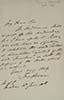
Transcript
R.M.S.P. Danube {1},
Oct 23.
My very dear Mother
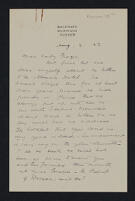
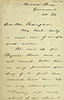
We are now on board the Danube and left for home at noon today, so I shall have to bring this letter with me; but so much has happened in the last week, that I must begin to write it down.
We were all terribly disappointed over the eclipse and were a rather depressed company for some days afterwards. Our numbers quickly melted away from Passa Quatro and by Monday, Morize, Stephanik, Worthington and Lee and most of the volunteers had gone. Atkinson who had been suffering from gout at times left for Rio on Sunday (at that time we expected to follow him in a day or two). {2} Lee & Worthington were detested by everyone and their departure was a great relief. Lee, I think, had taken this up as a sort of lever to advertise himself and get in with important people; he had somehow got round the British Consul who recommended him to us. We had rather a bad time from him at first, but had the satisfaction of seeing him completely checkmated. Further as soon as Aguirre came, we were independent of Lee; and could do without him.
The party that remained at Passa Quatro for the next week Oct 14–20 consisted of De Souza and his young wife, & Da Costa of the Brazilian Observatory, Kraliçek (Stephanik’s assistant), two ladies relatives of the innkeeper M. Rénier & several children (at these small places we are quite in the innkeepers family—however Rénier was a superior sort of man), besides our two volunteers Aguirre and Andrews, Davidson and myself. We were a rather young party, all under 30 except Da Costa and Davidson; M. Rénier was knocked up after his labours and was in bed most of the week. We had a very jolly time though of course the mixture of languages was troublesome.
The rain continued with very few fair intervals and practically no sunshine until Wednesday, and our packing was very slow owing to that. On Wednesday we were finished at last, and that afternoon which happily turned out fine, nearly all the packages (Brazilian, French, & ours) were removed in oxcarts & mulecarts to the side of the railway and put on the train late at night. We had nothing further to do with them; yesterday I heard that they had got as far as Cruzeiro—a distance of 20 miles! We have left them to be sent on by a later boat—I daresay they will reach Rio in a few weeks. Stephanik sailed today in a French boat, leaving his baggage to follow.
On Thursday (Oct 17) we were relieved of our cares and able to do what we pleased, and the next three glorious days we had a splendid time. The reason of our staying was really that De Souza was going to take us a trip further up-country to Cambuqueira; but it was always ‘amanha’ (tomorrow). Tuesday was the first day fixed for it then it became Wed, Thu, Fri, Sat and on Saturday it was finally given up. We liked De Souza very much; but he is typically Brazilian, and has got the ‘amanha’ as badly as all of them. As we enjoyed being at P. Quatro, it did not matter very much this continual putting of[f].
These three days we explored the neighbo[u]rhood in all directions. We never got very far as there was so much to see in the forests, and the sun was very hot indeed. Aguirre (although he has been in England for the last seven years) knew all the things of interest, and could tell us what all the plants birds & insects were. We saw beautiful butterflies[,] some of them very large—the hot weather brought them out—& a great variety of beetles. The ants were sometimes troublesome; they are all over the place, but they are particularly interesting. The leaf-cutting ants make regular highways about 4-inches broad, and you see a regular procession—along one side, the ants going out to forage, and on the other side those that are returning each carrying a leaf a great many times larger than itself. It looks like a procession of moving leaves. The ferns were very fine and in great variety; I am bringing home a few roots we collected in hopes they will travel alright. Most of the trees are full of orchids and parasitic plants and have great masses of creeper, etc hanging from them.
Twice we were able to bathe; but the rivers are not very good for it, being generally shallow. In the afternoons we got coffee at wayside vendas; generally the whole village looked on. They always wanted to give it us gratis. We occasionally could get good oranges; but it is not the right time of the year for much fruit, and as a matter of fact most of the fruit in Rio comes from England.
On Friday we decided on a horse-back expedition. Generally it was just our party of four that went out together, but this time Kraliçek came with us. Horses were ordered for 6∙30 a.m.; by this time I was used to Brazilian ways, and accordingly I got up at 8. There was then no sign of horses, but it was ascertained that they were being caught and might be expected about noon. Accordingly Aguirre Davidson & I had a good walk & arrived back very late for déjeuner at 1∙30. Ultimately the horses turned up at 3 o’clock & the cavalcade started. As three of us had not been on horseback before, very tame horses had been insisted on. Mine, which was 17 years old was very tame; and as it had a prejudice against going the right road, Aguirre (who is a good horseman) took it in exchange, and for the rest of the way I had a nice willing little horse, which gave me no trouble. We set off for the virgin forest about 8 miles distant up a mountain track. It was a lovely ride, with grand scenery. I think we had gone about 6 miles, when Aguirre’s horse (the very tame one) fell, and was evidently good for nothing more. It was a long time before we could make it get up; and then it could only be walked home. Aguirre managed to hire a mule, and we came slowly home by the moonlight & firefly-light; at a walking pace on account of the led horse. In spite of the accident it was a very pleasant ride indeed and though we did not actually reach virgin forest, we had some beautiful glades to pass through with fine mountain views.
On another occasion we passed a fazenda, where they made tobacco. The proprietor saw we were interested and showed us all about, gave us samples (which we afterwards found were worth at least 10/–). He even invited us to breakfast, but we did not accept. The tobacco is made in long ropes coiled on sticks; we often see the mules loaded with it going along the country-lanes. These mule trains are quite a pretty sight.
One night a fire-fly had got into my room, and woke me by flashing about. I had to get up & chase it before I could get to sleep. Davidson had a similar experience when he was changing plates at night, and had darkened the room. We have not seen any snakes; but have several times found large cast-off skins of snakes. I saw a large lizard (iguana) one day.
We left Passa Quatro on Sunday at eleven o’clock Kraliçek, Aguirre, Davidson & I. Andrews stayed on another two days. Da† Souza wanted us to stay till Monday as he was coming down ‘amanha’, but we were wise; he had not turned up when we left Rio this morning. We had quite a fine send-off—such leave-takings at the station[.] Old Rénier had recovered and gave us each the Brazilian embrace at parting; it consists of a hug with three pats on the back—I must demonstrate it sometime to you; it is quite the regular thing here.
It was a very hot day and the scenery was beautiful. The short run to Cruzeiro we had seen (under less favourable conditions) before; but the 5-hour journey from there to Rio was new, as we had passed it at night before. But the dust was terrible and the journey was most exhausting. By drinking black coffee at practically all the stopping places, and eating bananas in between whiles, we managed to survive. Like everybody else we lost our luggage at Cruzeiro; however it turned up at the hotel the next morning so no harm was done. We passed along the banks of the river Parahyba most of the way, and it was interesting seeing the rice & sugar cane growing. Banana trees are very abundant everywhere and look very untidy—they are the one piece of ugliness in this country—; the mangoes, palms (cocoanut and date), jacas and orange trees and better than all the bamboo clumps, are fine trees.
We found Atkinson at the Hotel Estrangeiros; he had had rather a bad time with gout, but was getting better. The next morning (Monday), we spent taking our passages in the Danube, & called at the Consulate, where I got your last letter—it seemed funny to find it was a reply to my letter describing Madeira {3}—that seems years ago. Davidson was not very well, so Aguirre and I went out alone in the afternoon. We went by the funicular to the top of the Corcovado (2200 feet) It is a beautiful ride up through forests, and at the top there was a magnificent view of Rio Harbour. Fortunately it was one of the clearest days we have had. At last I got a clear understanding of the geography of Rio, with its numerous Bays, and Nichteroy† on the opposite side. After coming down we walked up a zigzag path to Sylvestre, and then returned to the hotel by tram by a different route, which runs along an old Jesuit aqueduct.
In the evening Davidson and I went to dinner at Mrs Andrews’s—the mother of our younger volunteer.
Tuesday morning we started (Aguirre, Davidson & I) at 6 a m for the Botanical gardens; it was pleasantly cool then. We did not get back until 11∙30, so spent about 4 hours wandering round the gardens & taking some photographs. Mr & Mrs Willis (the former is Director of the gardens {4}) had been helping Worthington at Passa 4, so we paid them a short visit. With our visits to the gardens and the Brazilian forests I seem to have seen almost all the useful plants one has heard of. There are not very many flowers in the gardens; it is chiefly trees and shrubs. I carried away a souvenir in the shape of a dozen mosquitoe† bites over my face hands and legs. This is the only place in Rio, where there are any mosquitoes.
An Englishman Ihlot, whom we met at Passa 4 on the eclipse-day, was waiting for us at the hotel and after déjeuner carried us off in a motor to Quinta da Boa Vista—a park where there is the former Emperor’s palace, now a museum. The museum was not yet open (being in course of arrangement); but Aguirre had some influence there, and we were shown round and saw many Brazilian curiosities. We then returned to pay visits to the Foreign Minister & Observatory (to take leave and say polite things!). Ihlot met us again at the Observatory and we went down to the ferry for Nichteroy†. On the way we passed through the market, where our two guides plied us with all the weird outlandish fruits they could find. It was most interesting; the sapoti was a very nice fruit, looks on the outside just like a potato; the condessa a sort of pomegranete† (I think) was not so nice. It was perhaps fortunate that not many fruits are in season now, or I dont think we should have survived—as it is I have a mango and cocoa bean still to sample, which I put in my pocket. We finished up with a tumbler of caldo de canna—the fresh juice from crushed sugar cane. It was very nice.
We went on the steam-ferry to Nichteroy† about 4 miles across, and then by tram along the shore there. Here we had a lovely view of Rio from the other side, with the fine peaks of Sugar-loaf, Corcovado and Gavea, standing up finely against the sunset. This is really the best viewpoint in the harbour.
After dinner we just paid a short visit to Aguirre’s brother-in-law (with whom he was staying), who is now learning English and could speak a little. On returning we had a rather boring visit from Tigré†[,] another friend of ours—a poet and literary man[,] very excitable—and at last got to bed about midnight.
We had to start at 10 o’clock this morning for the boat so there was no time for anything except packing up, etc. The Observatory people motored us down to the quay and Dr Morize was there to see us off. It was a somewhat misty day for our last look at Rio harbour, but it was a fine sail out of it all the same.
Rio is said to be the finest city in the world, and that is probably true. Besides the advantage of its splendid situation, it is well laid out with fine parks and avenues and sea-front. It is now very healthy with the lowest death-rate of any city in the tropics—ten years ago it was a hotbed of yellow fever and malaria, but that has been entirely got rid of by exterminating the mosquitoes, which carry the diseases. Living here is I think even more expensive than I first thought; the average cost of things is about 4 times what it is in England (so the inhabitants say) but many things are much more expensive. Strawberry jam is a great delicacy, rare and expensive; you could offer your friends a spoonful like a sweet. Marmalade is 4/– a pound; ham 15/– a pound. A straw hat costs 16/–. Delivery of personal luggage for 3 of us from station to hotel (about 2 miles) cost £1. Most of these prices are what Rio people tell me they pay and are not those extorted from the stranger. (A gentleman on the Danube tells me he paid 5/4 for a half-pound of marmalade) The Brazilian government has treated us royally; we have had no hotel bills to pay or railway travelling expenses. It has been quite difficult to get rid of any of the filthy paper which serves for money in this country. All the same the little odds and ends and tips mount up, and I find I have managed to spend about £20 here. The government entertained all the volunteers in the same way as us.
Nov 2
We are just about to pass out of the tropics today and the weather is already much cooler, but we have had it much hotter so far than on the outward voyage. The Danube is rather an old boat but is quite a favourite as it is a fast boat and very steady. It is not much more than a third the size of the Arlanza. Very few people are travelling from Brazil at this time of the year so we are nearly empty I think there are only 20 first class passengers. I have a good sized cabin to myself, and am very glad to have plenty of room as the nights are very close and stifling. There is one passenger Meares a civil engineer who came out with us on the Arlanza; we see a good deal of him, also the Doctor and Captain. There are only two ladies on board—one American & one French. Nearly all the passengers are English—a great change from the Arlanza on which only 15 per cent were English.
We have been very comfortable and very lazy The weather has been beautifully fine (except the first two days, when it was overcast), and there has been a fresh breeze all the time; it is only in the cabins and saloon that it gets extremely hot. We did not go ashore at either Bahea or Pernambuco; at the former we did not ar[r]ive until 9 p.m., and we left at 6 a.m.; at the latter (where landing is more difficult) there was hardly time to go ashore. Yesterday we had the morning at St Vincent coaling, and I spent an hour or two on shore There is not very much to see except the negro population, who are very amusing. The fruit market was rather a pretty sight. At St. Vincent they only get rain once in three or four years; but they had had some just recently and the island was looking quite green. All their water and fruit are brought from a fertile island São Antonio 15 miles away; St Vincent simply exists, because it has such a splendid harbour.
Soon after leaving Pernambuco we passed an island Fernando Naronha† {5} where there is a Brazilian penal settlement and Marconi station. It has a most curious steep pinnacle of rock several hundred feet high. We passed very close to it, the Captain purposely altering the course a little to let us have a good view of it.
We have not seen any whales or sharks this voyage; but the flying fish have been very abundant. We also see a few porpoises from time to time. There is a good deal of phosphorescence in the water at nights; but it is not so striking as I have sometimes seen it.
Nov 7
We did not call at Madeira this time but went straight from St Vincent to Lisbon, about 5 days sail. We passed quite close to Palma the most westerly of the Canary Isles, and could make it out quite well although it was about 11 p.m and a very dark night. At Lisbon we were on shore from 10 a m to 2∙30 p.m., so had time for a good look round. We spent most of the time at Belem (½ hour ride by tram) where there is a magnificent monastery of St. Jeronymos. It is now used as an orphan-school. The cloisters are the finest part of it; but there are a great many interesting things to see there, including the tomb of Vasco da Gama. The church was built about 1520.
We had lunch in Lisbon, and reached the ship again with only a few minutes to spare. Our American Howell was very excited about the Presidential election, as he is a supporter of Woodrow Wilson. Howell is an international chess player, having played for America against England four or five times. He played a game blindfold against me last night and won.
Early this morning we called at Leixōes (for Oporto), but were only there for about an hour. Now we are sailing along quite close to the Portuguese coast, which looks very pretty. About a dozen more passengers have come on at Lisbon and Leixōes, so we are not so empty now.
The weather still continues fine and the sea smooth. At Lisbon we had a perfect day, cold in the shade, but with hot sunshine. Today for the first time, it is too cold to sit or stand about on deck, but it is clear and sunny.
We have now to call at Vigo and Cherbourg, and are due to reach Southampton on Saturday about noon, where I shall post this. I dont know yet when I shall get down to Weston but hope to come down about Thursday or Friday next week. Your last letters were dated Sept. 25 so I a[m] looking forward to hearing more recent new[s] of you {6}.
With very dear love from
your affectionate son
Stanley.
—————
Letter-head of the Royal Mail Steam Packet Company. Marked ‘9’. ‘Nichteroy’ should be spelt ‘Nictheroy’.
{1} ‘R.M.S.P.’ is printed.
{2} There is a vertical line in pencil in the margin by the rest of this paragraph.
{3} EDDN A2/2.
{4} Willis was Director of the Botanic Garden at Rio de Janeiro from 1912 to 1915.
{5} Fernando de Noronha, about 220 miles from the Brazilian coast.
{6} The paper is damaged, and parts of two words are missing.
† Sic.