Showing 9 results

Archivistische beschrijving
Letter from George Airy
Add. MS a/200/139 · Stuk · 2 Apr. 1859
Part of Additional Manuscripts a

Royal Observatory Greenwich - Sheepshanks Exhibition [see GA to WW, 30 Sept. 1856] can be divided into three parts: 1. Gravitational, 2. Geometrical Astronomy and 3. Theory and Practice of Observations. GA could do number 3, Mathison [William C. Mathison] number 2 and if Adams [John C. Adams] is around, he could do number 1. A Transit-Circle was first introduced in Greenwich, because 'a Mural Circle cannot carry a large object-glass. - But there are many distinct advantages. As a Transit, it is no better than a detached Transit, but as a Circle it holds its position much better than a Mural Circle: the same object is infallibly observed in both elements; and (probably for that reason) one observer with the Transit-Circle observes a greater number of objects than two with Transit and Mural Circle: and it saves the salary of one observer'.

O./6.6/16 · Stuk · 8 Nov. 1867
Part of Manuscripts in Wren Class O

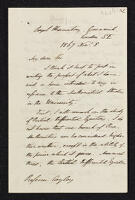
Royal Observatory, Greenwich, London S. E. - Thinks it 'best to put in writing the purport of what I have said or have intended to say in reference to the Mathematical Studies in the University'; comments first on the study of partial differential equations, which 'are very useful and therefore stand very high., as far as the Second Order. They apply... to the great problems of nature concerning time, and infinite division of matter, and space.. Beyond that Order they apply to nothing'.

Discusses 'what I may call the moral part' of mathematical studies: thinks a 'heavy responsibility' lies on those responsible for the course of education in the University to direct it 'in the way in which it will be most useful to the students' by 'disciplining their powers and habits' and 'giving them scientific knowledge of the highest and most accurate order (applying to the phenomena of nature) such as will be useful to them through life'; does not think that the 'mere personal taste of a teacher is sufficient justification for a special course' unless these aspects are taken into consideration.

Has for some years inspected the examination papers, and considers that except for the very best students there is currently 'a prodigious loss of time without any permanent good whatever', since only a very few such as Adams and Stokes retain their study of abstract analytical geometry. Believes that in contrast a 'careful selection of physical subjects would enable the University to communicate to its students a vast amount of information; of accurate kind and requiring the most logical treatment; but so bearing upon the natural phenomena which are constantly before us that it would be felt by every student to possess a real value' and therefore remain in the mind and 'raise the national character'.

Is 'old enough to remember the time of more geometrical processes' and believes that 'for the cultivation of accurate mental discipline they were far superior to the operations in vogue at the present day. There is no subject in the world more favourable to logical habit than the Differential Calculus in all its branches...'; thinks a return to study of it would be 'far more advantageous... than the simple applications to Pure Equations and Pure Algebraical Geometry now occupying so much attention'.

Letter from George Airy
Add. MS a/200/172 · Stuk · 13 Feb. 1862
Part of Additional Manuscripts a

Royal Observatory Greenwich - Further to Miss Sheepshanks supplementary grant of £2000 plus [see GA to WW, 15 Nov. 1860], John C. Adams 'considers that his status would be improved by having - a Transit Circle - a Chronographic Galvanic Apparatus - a system of sympathetic clocks - and a Telegraphic communication with the long lines of Telegraph. So I begged him to speak with you...I think the purposes suggested by Adams are all very good'.

Letter from George Airy
Add. MS a/200/175 · Stuk · 26 May 1862
Part of Additional Manuscripts a

Royal Observatory Greenwich - John C. Adams would be happy 'to have the present from Miss Sheepshanks communicated to the Observatory Syndicate' [see GA to WW, 13 Feb. 1862]. GA has drawn up the letter and if WW approve it, he should hand it to Adams.

Letter from George Airy
Add. MS a/200/181 · Stuk · 28 Apr. 1864
Part of Additional Manuscripts a

Royal Observatory Greenwich - GA understands that the Prince and Princess of Wales will be visiting Cambridge on the same day of the Visitation of the Royal Observatory. Presumably this means WW, James Challis, John C. Adams and George Stokes will not be able to attend, making the meeting a 'rather a lame one'.

O./6.6/43 · Stuk · [1874-1876?]
Part of Manuscripts in Wren Class O

Assemblage of figures in which the faces of various Cambridge personalities are spliced into incongruous scenes. The accompanying printed key explains that, for example Neptune in his chariot has the face of John Couch Adams, since 'The learned Professor was the first to discover the above mentioned planet; the Vice-Chancellor [1874-1876], Samuel Phear, 'did his best to suppress the "wooden spoon"' so his face is superimposed upon one. A scene of three figures balancing on a beam in front of the fountain in Trinity Great Court is labelled 'The Pantomime', and the figures are identified as 'The Author of Supernatural Religion [W. R. Cassels], 'Prof. Lightfoot' and 'Prof, Westcott', with a brief account of the controversy following the anonymous publication of that work in 1874. A tug of war competition is labelled 'Classics v. Mathematics'; a coxed four are labelled 'Ye Antient Mariners'.

Hard to decipher pencil annotations on back, which includes 'Bradford, Camb.' [probably the seller, see O.6.6/47].

Letter from John Herschel
Add. MS a/207/70 · Stuk · 29 Dec. 1846
Part of Additional Manuscripts a

Collingwood - JH gives his reasons why WW should not, as has been reported, pledge such a strong declaration of support for John C Adams's and the 'discovery' of Neptune over [Urbain J. J.] Le Verrier: If the results of the latter had not 'appeared I think it by no means improbable that Challis might actually never have turned a telescope to the heavens in search of it at all'.

Letter from George Airy
Add. MS a/200/73 · Stuk · 4 May 1849
Part of Additional Manuscripts a

Royal Observatory Greenwich - Adams [John C. Adams?] has invited GA to the Johnian dinner on Monday. Due to a long standing agreement GA has written to Sedgwick [Adam Sedgwick] to dine with him on the Tuesday, hence he has not put in an application for WW's hospitality.