Affichage de 15 résultats

Description archivistique
Add. MS b/52 · Pièce · 1772-1878
Fait partie de Additional Manuscripts b

A small group of papers which were passed to Maxwell's cousin Elizabeth Dunn's daughters Margaret and Lucy Dunn. This includes two pieces of James Clerk Maxwell juvenilia: a pen-and-ink drawing dated 1845 of two small figures in a boat on a pond signed JCM 1845, which carries a note on the verso that it was bequeathed by his cousin William Dyce Cay to his niece Isabel Dunn. A home made card reads "James Clerk Maxwell at home Saturday evening Seven o'clock" in a childish hand with a watercolour of the front door of 31 Heriot Row, Edinburgh. This card had been mounted on a stiff album card alongside a photograph of Maxwell as a young man holding a colour top, both now separated from the album card.

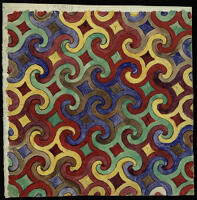
There are 18 sheets and cards of geometrical multicoloured designs, described by the donors as "Designs for his tops &c when a boy." These are watercolours and pen-and-ink or pencil, and are accompanied by one round colour top with designs on both sides of a stiff card and a string through the centre. There are two cut out round cards, and two sheets featuring rounds, and one of these has "Miss Cay" written at the top. The other sheets are of various geometrical designs of multiple colours and have pin pricks in them in various places; of these 7 have designs on two sides, and one of these has a drawing of light refracted in a glass and two doodles of a man and a woman on the verso. One of the designs is a cut out paper lattice.

A letter from James Clerk Maxwell to Lizzie [Elizabeth Cay, later Dunn] dated 27-28 May 1858 contains details of preparations of his wedding to Katherine Dewar on 2 June.

There are two printed items: a newspaper cutting referring briefly to Maxwell's Rede Lecture, "On the Telephone" at the Senate House in 1878, and a print of the birthplace of Sir Isaac Newton in Woolsthorpe, drawn by Samuel Sparrow, and engraved by T. Tinkler dated 1772.

Sans titre
Add. MS c/1/78 · Pièce · 23 Aug. 1853
Fait partie de Additional Manuscripts c

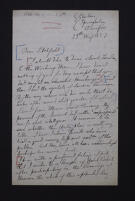
Bank ground, Coniston, Ambleside. At Coniston reading and resting; discusses the well-regulated family of Charles Benjamin Tayler and their scheme of education; thinks studying the “dark sciences” will repay investigation.

Sans titre
Add. MS c/1/80 · Pièce · 6 June 1855
Fait partie de Additional Manuscripts c

Trin. Coll. [Robert Henry] Pomeroy has formed a swimming club at Cambridge; has been busy with electrical reading this term and is working to come up with appropriate ideas, has been ‘sifting’ the theory of light and making everything stand upon experiments and definite assumptions, describes the difference between dogs eyes and human eyes.

Sans titre
Add. MS c/1/81 · Pièce · 28 Nov. 1855
Fait partie de Additional Manuscripts c

Trin. Coll. Gives a report of Robert Henry Pomeroy’s illness; is busy with questionists regularly now, is about to get out some optical things to show them; has heard nothing from Cheltenham, Moderator [William Henry] Besant is recovering the use of one side of his face.

Sans titre
Add. MS c/1/82 · Pièce · 4 June 1856
Fait partie de Additional Manuscripts c

Trinity. Discusses plans to visit London; is looking through papers for some things not to be burnt, notes some are soft and good for packing; will take the Northwestern route to the north, notes that “the transition state from a man into a Don must come at last and it must be painful.”

Sans titre
Add. MS c/1/83 · Pièce · 4 July 1856
Fait partie de Additional Manuscripts c

Glenlair. Talks of plans and the amount of work to do at Glenlair, is fitting up a colour weaving machine fit for transportation, his top for doing dynamics; is studying the problem of Saturn’s Rings.

Sans titre
Add. MS c/1/85 · Pièce · 18 August 1856
Fait partie de Additional Manuscripts c

18 India Street, Edinburgh. Describes his travels, including coming to the rescue of a woman afraid of some Wolverhampton revellers on the journey there, visits to family, mentions he was photographed four times at Peniciuk because of the light levels; J. F. MacLennan has been getting on with his “Law.”

Sans titre
Add. MS c/1/86 · Pièce · 27 May 1857
Fait partie de Additional Manuscripts c

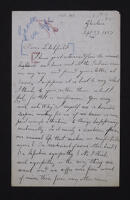
Gleinlair, Springholm, Dumfries. Describes a quiet life at Glenlair, and that he has not had a mathematical thought for a fortnight but is likely working subconsciously, shares news of friends and asks for more, notes how different his different his society is in Aberdeen.

Sans titre
Add. MS c/1/87 · Pièce · 23 Sept. 1856
Fait partie de Additional Manuscripts c

Glenlair – Reacts to news of Robert Henry Pomeroy’s death in the Indian rebellion and reflects at length on memory and grief; a little girl in one of his men’s houses has died; is at home for a month with his aunt Mrs [Isabella] Wedderburn.

Sans titre
Add. MS c/1/88 · Pièce · 15 Oct. 1857
Fait partie de Additional Manuscripts c

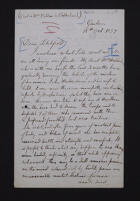
Glenlair. His aunt Mrs Wedderburn has learned of the murders of her cousin John Wedderburn and his wife and child in the Indian rebellion, and her son John and his wife in Moultan have had to disarm troops and dismiss others; is glad to have read the letter [Robert Henry Pomeroy’s last?]; reflects on Good and Evil; has almost finished with his work on Saturn’s Rings; illness continues in the house of the little girl who died.

Sans titre
Add. MS c/1/89 · Pièce · 7 Feb. 1858
Fait partie de Additional Manuscripts c

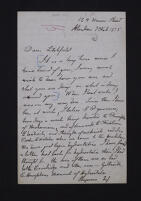
129 Union Street, Aberdeen. Describes his work in Aberdeen, has found better textbooks by Galbraith & Haughton; has got up a model to show the motions of the rings of satellites; shares what he has been reading; comments on the Senior Wranglers and Smith’s prize men, has a student that he hopes will stay out of a small college “where boating billiards beer &c are more immediate paths to distinction that the pursuit of wisdom either mathematical, classical or social.”

Sans titre
Add. MS c/1/90 · Pièce · 5 March 1858
Fait partie de Additional Manuscripts c

129 Union Street, Aberdeen. Is pleased with the position at Aberdeen; reflects on his marriage [to Katherine Mary Dewar]; answers Litchfield’s questions with what he describes as a "metaphysical screed;" he gives his opinion on Catholics; a section apparently about marriage has been cut out; sends a paper set for his class and reflects on the quality of answers to the questions.

Sans titre