Mostrar 90380 resultados

Descrição arquivística
4485 resultados com objetos digitais Mostrar resultados com objetos digitais
Stock of Macaulay's works
O./18.5/10 · Item · 15 Nov. 1858
Parte de Manuscripts in Wren Class O

Stock of various editions of Essays and [History of] England. Figures for sales from Jun. 1857-1858 and Jun. 1858-15 Nov. 1858 also recorded.

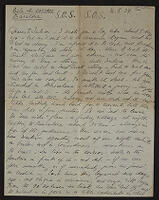
Letter from S. Wilton Rix to W. Aldis Wright
Add. MS b/74/5/10 · Item · 2 July 1887
Parte de Additional Manuscripts b

Beccles.—Responds to Wright’s article on the word ‘bouter’ in Notes and Queries, referring to domestic arrangements at his grandfather’s kitchen at Snettingham and his uncle's farmhouse at Redenhall.

—————

Transcript

Beccles
2 July 1887

My dear doctor

I observe your “Bouter” note in N & Q {1}.

Are you sure that the word is “no longer used”?.

It appears, in divers shapes, (as I dare say you know as well as I do) in the dictionaries {2}.

Cole—
Bouter—sieve

Walker—
Bolter—a sieve to separate meal from bran

Bailey—
Bolting-hutch }
Bunting-hutch } a chest or trough to sift meal in

Johnson—
Bolter—a sieve to separate meal from bran or husks or finer from coarser parts

Nuttall—
Bolting-hutch—a tub[?] {3} for bolted flour.
Bolting-mill—a machine for sifting meal.
Bolting-tub—a tub to sift meal in.

A bolter I always understood was a common, if not essential, appendage to a corn-mill. In its domestic form it became a ‘hutch’—and its top might serve as a table. Hence, naturally enough, ‘bolter-table’, or bolter,—boulter—bouter in that sense.

In the scene described by Mr Crabbe I take the men stood in the scullery waiting till the female servants at the bouter had finished their repast, either for want of room or from motives of delicacy & politeness!.

I well remember the bolting hutch in my grandfather’s kitchen at Snettingham—where it was confined to its primary use. In my uncle’s farm house at ‘Pied bridge’, Redenhall, {4} the arrangements were more bucolic. Dinner was served in the spacious kitchen—for the family at a plain walnut-tree table in the centre, & for ye farm men on a long heavy oak table placed under a side window. This was about 1812.

I do not think the maid-servants dined with the men,—I sho[ul]d say, after them. [There follows a plan of the room in question.]

All this is merely an excuse for bothering you with a letter, because we are anxious to know—if you can spare five minutes to tell us—that your convalescence is complete or progressing quite satisfactorily,—your left thumb all right & prison fare no longer requisite.

Excuse bad writing.

Ever very truly yours
S. Wilton Rix

W. Aldis Wright Esq LLD.

—————

Black-edged paper. The missing letters of a word abbreviated by a superscript letter have been supplied in square brackets.

{1} Notes and Queries, 2 July 1887, pp. 5-6. The note concerns a passage in the Life of Crabbe (cf. Everyman ed., pp. 137-8).

{2} The arrangement of the succeeding list has been adjusted slightly.

{3} The square brackets are in the MS.

{4} Comma supplied.

Telegram from Lord Reading to Edwin Montagu
MONT II/A/3/1/10 · Item · 14 Nov. 1921
Parte de Papers of Edwin Montagu, Part II

Malaviya has come to see him, urging that, when the Prince of Wales arrives, an announcement should be made that all remaining martial law prisoners will be released, and that the British Government will undertake to do its utmost for the restoration of Thrace and Smyrna to Turkey. Malaviya believes this would effect a marked change, and a conference could be called to discuss swaraj. Reading pointed out that, with regard to the prisoners, he had already done the utmost he could recommend. Malaviya suggested it might be politically expedient, and Reading asked for whom he was speaking, suspecting him of being optimistic as to Gandhi’s future action. Malaviya admitted it, but claimed to speak for most Indian people, and pointed out that he had persuaded Gandhi to mollify his statements regarding the people’s attitude on the Prince’s visit. But Reading was little impressed, pointing out that all Gandhi’s organs continued to advocate boycott, and that his few sentences in Young India were of little account compared with previous injunctions and resolutions. He believes Malaviya is anxious for the success of the visit, but is powerless in view of the political crowds surrounding Gandhi. Reading told him that his policy of conciliation had failed, and that Gandhi and his movement had become more violent. Malaviya objected that, though a resolution for civil disobedience had been passed, there was little enthusiasm for it outside the Committee and a few extremists, and claimed conciliation was working. He suggested holding a conference at which all the various parties would be represented, and asserted that Gandhi would attend. Reading asked for more precise proposals, and Malaviya said he would consider the matter with his friends. He believes Malaviya and Jinnah are working together, but does not know how far they represent Gandhi. Malaviya believes Gandhi intended to spend one or two months at a village in Gujarat organising civil disobedience, but this is doubtful.

(Typed.)

Letter from W. H. Thompson to Frederick Pollock
CLIF/A7/10 · Item · 28 Mar. 1881
Parte de Papers of W. K. Clifford

Trinity Lodge, Cambridge.—Explains why he has not yet subscribed for the relief of Clifford's widow, and asks Pollock to convey the enclosed sum to her anonymously.

(With an envelope.)

—————

Transcript

Trinity Lodge, Cambridge
28 Mar 1881

Dear Frederick Pollock

When your father asked me some time ago to subscribe to a Memorial or rather—for it was in his life time—a public Testimonial to Prof. Clifford, I declined to do so, for reasons which I still think valid. I think it was after his death that I said I would subscribe for the relief of his widow, for whom I feel a sincere compassion. If I have failed to do so, it was not because I had changed my mind in the matter, but simply because the Memorial was still designed {1} in honour of her husband & contained words to which I could not affix my name. I wish now to redeem whatever pledge I may have given, & beg that if you think the poor lady will accept the sum enclosed you will kindly convey it to her—without mentioning my name.

You will judge how far this is possible without offending her delicacy. It seemed to me possible that she might not disdain to receive a little additional help from one who had as much admiration for her late husband’s talents as he had disapproval of his philosophical opinions.

Believe me
Yours very truly
W. H Thompson

[Direction on envelope:] F. Pollock Esq | 48 Gt Cumberland Place | London | W

—————

The envelope was postmarked at Cambridge and London, W., on 28 March 1881, and has been marked ‘Master of Trinity | for L.C.’

{1} Reading uncertain.