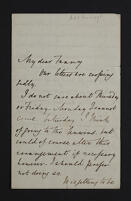
He misses Peter, and describes his experience of heat as a tactile experience and as close as he'll get to communion; wonders if most Catholic countries are hot and if the weather explains Scottish Presbyterianism; discusses the effects of budget restrictions, the need to define mental illness and ethical guidelines for behavior modification treatments; discusses 'No Man's Land', admires John Gielgud and Ralph Richardson; Elizabeth [Cavendish?] is back and rested, and he deems regular breaks necessary for her; reacts to Peter's story of a group therapy session.
Letters tipped into a paper-bound notebook labelled ‘Letters Book I’ on front:
Undated, ‘My dear Peter. What a pleasant surprise!’ 4 sheets. A lengthy narrative describes how Peter's gift reminds him of climbing Moricelli in Italy and finding shells there in a pool, similar to those Peter has sent; writes at length about his own story about an anchorite.
[1 Aug. 1944?], ‘Well Peter; here in London and finding it most exciting too’ 2 sheets. Life in London during bombing [Doodlebug Summer], and the attitude to death and reaction to bombing raids, lunchtime bombing of Kensington High St. Disagrees that modern war is not romantic.
Undated, ‘Saturday 1944’ 4 sheets. He meant Peter to understand that he was parodying Peter's style in his last letter, and is disappointed that Peter did not see this; has seen Ernest Milton in Macbeth, and discusses Wolfit in 3 Shakespeare plays; finds it is easy to be Shylockian; is disappointed in his (Denis') story, thinks he is too young yet, will put it away until he is older.
Envelope dated 23 Mar. 1945
Undated, Friday: 11th: 1944 1 sheet. Sends a volume of Italian short stories.
Undated, ‘Thursday. I feel very vicious this morning’ 1 sheet, with two pen-and-ink drawing of himself looking irate on verso. Asks him to write.
Undated, ‘Yes you are right!’ 5 sheets. Reflections on a quarrel they've had; has also been called up, asks for information on his medical, and hopes they can get assigned to the same camp.
11 Nov. 1944 79 Brook Green, London, W.6. 2 sheets, with pen-and-ink drawing at top and tail of letter. Has nothing to write, encloses a book by Forester which will teach Peter to write economically; praises Richard Goolden and Helen Pollack [Ellen Pollock?] in "To True To Be Good".
Rest blank
Includes profiles about both Peter and Anthony Shaffer, and Shaffer's article, "My three years in this grim and disgusting family business..." in the Evening Standard dated 14 Jan. 1972. There is also an entire issue of The Daily Mail for 9 June 1981, the Times 2 section of The Times for 18 May 2001, an entire issue of Theatregoer Magazine from 2001, and a letter from Derrick F. Mead of Peat Marwick dated 27 Feb. 1985 forwarding an article from The Sunday Telegraph magazine.
Programme for 'Mozart' with Irene Bordoni in the title role, book and lyrics by Sacha Guitry.
Thanks her for her letter. Thinks that his illness was due to something he ate. Declares that he enjoyed his visit to [London], and sent an account of the visit to [ ]. Reports that Mr Wheatley [his godfather] was very kind to the. Declares that he would like to see Miss Green [his former governess] if his mother can induce her to stay until he [and his brother William] come home. Refers to his mother's advice about his chess playing and assures her that he has not played more that five games 'since the beginning of the quarter...' Asks her to buy something for [his friend] Harry James out of his money. Explains how they were 'got into the 2nd class in German', and in relation to the play declares that they do not have to translate it themselves. Sends his love to all at home, 'including Elizabeth [Cooper]'.
With 'Memoranda of that Part of the Campaign 1794 comprized between the 22nd of May & the 25th July' and battle plans drawn by William Frederick of engagements between 17-30 Apr 1794.
Also a 'Memorandum concerning the Letters of W. F. Duke of Gloucester addressed to his father Wm Henry Duke of Gloucester during the Campaigns of 1794 & 1799', by his sister Princess Sophia Matilda, 28 Dec 1837. Sophia Matilda labelled and sealed the paper wrappers in which the files of letters were originally sent, and also the linen bag in which they were all contained.
The letters date from 1794, when Prince William was fighting in Flanders, 1799, during the campaign in Holland, and 1803-1804, when Prince William was on a tour in northern Europe, and are predominantly written by him to his father.
William Frederick (1776-1834), Prince, 2nd Duke of Gloucester and EdinburghLetters from Augusta Julia Babington, née Noel, to her father in law Thomas Babington.
Letter from C. S[?] B[abington?] to Mary Ellen Rose, née Parker. Letters from Catherine Babington, née Whitter, to her brother in law Thomas Babington. Letter from Charles Cardale Babington to his uncle Thomas Babington. Letters from Charles Edward Babington to his aunt Mary Parker, née Babington.
Letter from Charles Roos Babington to his sister Jean Babington; letters to his father Thomas Babington, and sister Mary Babington.
Letter from Elizabeth Babington, later Strange, to her uncle Thomas Babington. Letters from Frances Babington, née Sykes, to her sisters in law Maria Frances Babington (née Pratt) and Mary Parker (née Babington). This last includes a note from her husband Matthew Babington to his sister Mary.
This subseries contains drafts or other surviving evidence of some of Peter Shaffer's early works, such as photographs or a contract. Represented are the radio play 'Alexander the Corrector,' the mysteries The Woman in the Wardrobe, How Doth the Little Crocodile? and Before and After, and the screenplays 'Prodigal Father,' 'The Salt Land,' and 'The Balance of Terror.'
(Official.) The Governor of Bombay [Lloyd] has recommended that Gandhi should be prosecuted immediately, and has sought the Governor-General [Reading]’s approval. The Governor thinks the main charge should be based on certain articles by Gandhi, particularly ‘A Puzzle and its Solution’, the object of which is to create disaffection against, and so overthrow, the Government. In reply, the Government of India have signified their general agreement with this view, but as they believe that Gandhi’s next move must involve a more direct challenge to the Government than any hitherto attempted, and as they wish to avoid the idea that Gandhi is being prosecuted because he has made a conference impossible, they suggest that prosecution should be deferred till after 31 January, when Gandhi will probably institute civil disobedience. They also prefer that prosecution should be based on more recent statements than those mentioned by the Governor. No fresh reference need be made to them before prosecuting, if Gandhi embarks on an active campaign of civil disobedience.
(Carbon copy.)
(Carbon copy of A3/25/11.)
Part 1. Reports the contents of a letter received from Gandhi describing the circumstances of the resolution taken at Bardoli to embark on mass civil disobedience, and urging the Viceroy to free non-co-operators imprisoned for non-violent activities, declare a policy of non-interference in all non-violent activities, free the press from administrative control, and restore the recently-imposed fines and forfeitures; if the Viceroy complies within seven days, civil disobedience will be postponed.
(Typed.)
(Text as A3/31/1–2. Leaves from a larger document.)
Refers to Montagu’s telegram of the 7th. Has stopped Lloyd coming to him, since it is essential that he should be at Bombay when action is taken. Lloyd has been in Kathiawar, and his health appears to have improved.
(Typed.)
The Bombay Government will arrest Gandhi on 14 February, and Montagu can announce the arrest that afternoon. The Bombay lawyers have voted against taking action on the manifesto of 4 February or the Bardoli proceedings.
(Typed.)
(i) Refers to A3/46/3 and trusts that the Cabinet will understand his reasons for postpon-ing Gandhi’s arrest. The present situation is unclear, except that the resolutions show a great change in the non-co-operators’ attitude, which he attributes to a realisation of the danger and difficulties of carrying out civil disobedience. Reiterates his belief that civil disobedience is ‘the best battle-ground for us’, particularly this year, when the crops are good. Reports indicate dissension in non-co-operation ranks. His decision to postpone the arrest was influenced by a feeling that he could not risk the resignation of Sapru and other Indians, and that the division of the European and Indian elements in Council would be awkward at present, particularly with the Budget question before them. He has been advised that a general railway strike may take place when Gandhi’s arrest is announced, and that mill-hands in various centres will come out. Sapru says he will discover the real meaning of the latest move within two or three days, but believes that it means something ‘really good and lasting’ and that Indians generally regard it as a confession of failure by Gandhi.
(Typed. (ii) is a draft of A3/42/2.)
10 Downing Street, Whitehall, S.W.—Thanks him for visiting and cheering her up. Criticises the attitude of the young people around her, including Venetia. Suggests going for a drive on Friday.
24 Queen Anne’s Gate, S.W.— Thanks him for his letter explaining the position. He does not think the differentiation between cotton Customs and Excise Duties in India could ever be prevented, and as it has been done it does not matter. But he does not regard Interest and Sinking Fund of £100 million a year as a sufficient burden for India with her almost insignificant unproductive debt, and does not think India entitled to special consideration when compared with the burdens laid on other parts of the Empire. Points out that the increased pay of the Indian Army has been practically paid for by allowances for services abroad. Those who make cotton goods in India must, as a result of the differentiation, be allowed to increase the price of their goods. If the State protects any industry it ought to share in the profits, but the question with regard to cotton manufacture in India is very difficult. He wishes that it had been possible to make a policy for the whole Empire before dealing with it in India.
(Carbon copy.)
34 Portland Place, W.1.—Is sorry that what he said in the House should have disturbed Montagu in his travels. [He had apparently referred to criticisms of the India Office made by Montagu before he was made Secretary of State.] The reports Montagu received must have conveyed a different impression from the actual words of his speech. He admits that he was surprised that a man of Montagu’s calibre and experience should have criti-cised the India Office and the Indian Government so heavily, and believes that he would not now suggest that the Secretary of State should be more amenable to the Commons, which is a poor judge of Indian affairs. But he guarded himself against the suggestion that Montagu had any idea of becoming Secretary when he made the speech, and points out that it might be as-sumed from his appointment to that post not long afterwards that he had been sent there to give effect to the views he expressed. It was for this reason that the called the speech into question. Emphasises his desire to remain on friendly terms with Montagu and to co-operate with the Government. He has spent six months trying to assuage the situation in Ireland, but the old feuds have broken out again.
Sheets 16–22, 34–57, 76–108, 185–98, 296, 468[a], 469–84, 484a, 485–520, and 523–43. There are illustrations on sheets 106 (Umar Khayat Khan) and 107 (‘His Holiness’).
Transcript of notes by B. Young about Agnata, and her own beliefs written shortly before her death.
Gives details of J R M Butler's education to date.
On J. R. M. Butler's Greek poetry.
On the Princes' future education