
SRAF/I/107
·
File
·
1970
Part of Papers of Piero Sraffa
4485 results with digital objects
Show results with digital objects
MONT II/B/1/107
·
Item
·
[30] Apr. 1915
Part of Papers of Edwin Montagu, Part II
SRAF/D/3/12/107
·
File
·
Dec 1959
Part of Papers of Piero Sraffa
TRER/17/107
·
Item
·
[1915?]
Part of Papers of Robert Calverley Trevelyan and Elizabeth Trevelyan
Larkbeare, Cumnor Hill, Oxford. - Thanks Trevelyan for his letter; will be 'delighted' to come on Monday if he does not hear otherwise; will be at the National Liberal Club at half one.
TRER/13/107
·
Item
·
5 July [1906]
Part of Papers of Robert Calverley Trevelyan and Elizabeth Trevelyan
2, Cheyne Gardens, S. W. - A son [Theodore] was born half an hour ago; Janet is doing very well; George asks Bessie to let Bob know, since he is not sure of his address.
TRER/22/107
·
Item
·
27 Dec [1947]
Part of Papers of Robert Calverley Trevelyan and Elizabeth Trevelyan
The White Gates. - Has been reading through the '1947 Xmas book' ["From the Shiffolds"]: thinks it a 'very fine collection'; names the poems he particularly likes. Adeline wants him to tell Bob 'how much she likes "Dandelions"'. Bob may have heard that their friend Raynor has been given a hundred pounds by the Musician's Benevolent Fund. They send love to Bessie.
TRER/23/107
·
Item
·
31 Dec 1948
Part of Papers of Robert Calverley Trevelyan and Elizabeth Trevelyan
Fourways, Gomshall, Surrey. - Trevelyan's 'very lovely poems at Christmas' ["From the Shiffolds"] will be a 'lasting joy'; has never read a more beautiful 'In Memoriam' than his to Lowes Dickinson, who, to her 'lasting regret', she never met in person but has 'known him through his books' like many others. Dickinson is one of those who restores her 'faith in the nature of man', and it seems natural that he is the 'guardian angel' of Trevelyan's words. Knew C[lifford] A[llen], and Robert's poem 'strikes the note' which she responds to; realises how much she and Trevelyan have in common; also praises his translation of a Pindar fragment.
TRER/45/107
·
Item
·
[Nov or Dec 1885?]
Part of Papers of Robert Calverley Trevelyan and Elizabeth Trevelyan
Asks when Harrow breaks up, as Mr Arnold is going to invite [Nugent] Hicks or [Thomas James Chesshyre?] Tomlin to visit at the end of term. Beat Farnborough away this afternoon, one-nil'. Sends love to all. The train 'comes in at 10.27'. Is glad 'Mr [Charles?] Fenwick and Uncle Harry [Holland] have got in [to Parliament in the General Election].
SMIJ/1/107
·
Item
·
28 Dec. 1946
Part of Papers of James Smith
Downside Abbey, Stratton-on-the-Fosse, near Bath.—Hopes that Smith gets the Fribourg chair. Has had a bad cold, which has affected his sinuses and jaw. Is delighted that [Godfrey] Lienhardt is under instruction. Asks whether the other young man, who has written some impressive letters to Dom Sebastian, is called Ernst. ‘Downing must fairly swarm with Papists now. I wish that meant that Leavis was nearer the Church.’ Refers to Leavis’s reception of the article in La Vie intellectuelle and to Smith’s own evaluation of it. Has arranged for Smith to receive the [Downing] Review. Discusses J. C. Maxwell’s career and character. Dom Illtyd is thinking of sending Maxwell’s article to Leavis. ‘I hope the result won’t be a violent outburst from Queenie on the ineptitude of “Christian Discriminators”!’. Suggests Smith should contribute something on the ‘misdirection of research in medieval things’ he mentioned in his letter. Has found a number of Latin tags used by Skelton in Dom Aelred [Watkin]’s 1537 Sarum Prymer. Appreciates his remarks on the recusants. Invites him to stay.
MONK/C/1/107
·
Item
·
21 Jul 1846
Part of Papers of the Monk and Sanford families
Enjoying the Long Vacation in Cambridge, idleness banished from Cambridge, reading Thucydides and doing composition with Shilleto, weekly examinations in classics and mathematics
RAB/A/107
·
File
·
1925
Part of Papers of Lord Butler
RAB/B/8/107
·
Item
·
4 Oct. 1932
Part of Papers of Lord Butler
RAB/B/21/107
·
Item
·
24 Jul. 1953
Part of Papers of Lord Butler
RAB/E/11/2/107
·
Item
·
May 1959
Part of Papers of Lord Butler
Enclosing copy of A History of Lords and Commons Cricket
RAB/E/11/7/107
·
Item
·
17 Mar. 1959
Part of Papers of Lord Butler
RAB/E/9/107
·
Item
·
1 Apr. 1958
Part of Papers of Lord Butler
RAB/E/3/13/107
·
Item
·
5 Feb. 1940
Part of Papers of Lord Butler
RAB/B/27/107
·
Item
·
11 Jan. 1957
Part of Papers of Lord Butler
With carbon copy of letter from R. A. Butler to Sir Archie James, 18 Jan. 1957
RAB/B/29/107
·
Item
·
15 Oct. 1959
Part of Papers of Lord Butler
RAB/E/12/1/107
·
Item
·
25 Mar. 1960
Part of Papers of Lord Butler
SHAF/B/10/1/107
·
Item
·
25 Oct. [1974]
Part of Papers of Sir Peter Shaffer
He's done "a beautiful thing - so lovingly."
PETH/4/107
·
Item
·
13 Sept. 1961
Part of Pethick-Lawrence Papers
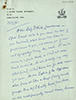
Transcript
Flat 5, 1 Hyde Park Street, W.2
13/9/61
Dear Lady Pethick Lawrence.…
I feel I must write to you about the loss of your husband, which must have been a great sorrow to you; & to assure you of our real sympathy during this week. To me it came as a great shock, as I had not even heard he was ill. He was probably my very oldest friend, & I had known him for well over 70 years. He was Captain of the Oppidans when I was at Eton & though (being much younger than he) I hardly knew him then, we did meet personally several times, because a) we both frequented the School Library, and b) we were both members of the Literary Society. Our real friendship began during the first decade of this century, as I was a great supporter of women’s suffrage & gave large sums to his collections, & also went to prison in 1914. Since then Emmeline & he were among my very dearest friends; we stayed with them when they lived in Holmwood—they stayed with us in Buckinghamshire—& more recently he frequently dined with us in town, & we used often to lunch at the House of Lords. I shall miss him more than I can say, & this week I have thought of little else. His was a very noble mind, & though he never was as far left as I am, it was always a joy & privilege to discuss real questions with him especially economics, which so few of the Labour Party leaders really understand. I was one of the original governors of the London School of Economics, which I helped Sidney Webb to found—so, as well as the Suffrage, we had all that in common.… I remember we dined together the night before he left for India on his great mission, & he said words that I shall never forget. “You & I have both fought for Freedom all our lives; to-morrow I am going to give Freedom to 400 million people.” Dear, dear Fred—his splendid brain, his modest retiring manner, his absolute integrity, were a combination that I have never met in anyone else. God rest his Soul! … Please forgive my unburdening my feelings to you for once
Yours sincerely & affectionately
Henry D. Harben
I need hardly say Miss Mulock joins me in all our feelings of sympathy & friendship to you.

PETH/8/107
·
Item
·
12 Apr. 1930
Part of Pethick-Lawrence Papers
Anwoth, Jan Smuts Avenue, Parktown, Johannesburg.—Praises her letters. Comments on the books she mentions, and agrees with her remarks on Italian pictures. She and May are very happy.

PETH/9/107
·
Item
·
1 Mar. 1910
Part of Pethick-Lawrence Papers
SMIH/76/107
·
Item
·
30 May 1916
Part of Papers of Sir Henry Babington Smith
SMIH/2/107
·
Item
·
11 Oct. [1889]
Part of Papers of Sir Henry Babington Smith
SMIH/74/107
·
Item
·
29 May 1895
Part of Papers of Sir Henry Babington Smith
CHIL/2/107
·
Item
·
[26 Mar. 1910]
Part of Papers of Erskine Childers
MAYR/B/8/107
·
Item
·
23 Sep 1817
Part of Mayor Papers
Religion at a low ebb in Norwich, preaching by Robert and others: Surrey Street, Norwich
O./10a.13/107
·
Part
·
15 Dec. 1879
Part of Manuscripts in Wren Class O
Bangalore