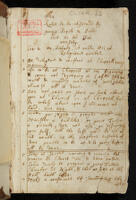
'J. O. Halliwell | 1837 and 1838 | Miscellanea' written in ink on front cover; scratch-marks below seem to have erased something else once written. Note on back: 'M. Museum. | B. Bodleian. | P. Camb. Pub. Lib. | S. Sion College. | R. Royal Society'. 'J. O. Halliwell | Anno 1837' written on inside front cover; 'Common-place notes' written in a different ink, as well as a verse - 'Ha, La! Syntax, O the fun!...', as well as a calculation and a note written with the book turned upside down.
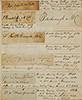
Extract from printed sales catalogue listing autograph letters and receipt for payment by Halliwell to Mr [?] Bowtell loose inside front cover.
The book was originally used as a ledger by an unknown owner between 1806-1807. Right edges of ff. 2-5 trimmed to form alphabetical index and the pages divided into quarters; the leaf with entries for letters T-Z. has been lost. Names such as John Till Allingham, Robert Mildred, David and Joseph Ricardo and Harry Sherer appear, although not always in the main body of the ledger since several leaves have been removed and others have cuttings pasted over the entries by Halliwell. ff. 8 and 16-40 are still present. For each pair of facing pages, a name appears at the top of the left hand page, with debits entered below, and credits on the facing page.
Free space around index entries used by Halliwell for journal entries, 1837 and 1838; these journal entries continue at intervals in the rest of the book. They include accounts of visits to the British Museum library, book sales, visits to 'Mr Davies' at Woolwich, comments on Halliwell's book on Samuel Morland's life and work, and a 'Row between Gown and Town' in Cambridge, 6 Nov. 1837.
ff. 6-11 are tipped in, and contain a list of authors, titles and dates (11th-14th cent.) Printed cutting on Edward Cocker, and extracts from booksellers' catalogues, pasted in at ff. 12-13; these include headings for sales of the last part of the 'Bibliotheca Heberiana' [Feb. 1837] and for 'Shakspeariana'
ff. 36A-61 are headed with the years 1550-1600; notes on authors and books published in those years are written below, but Halliwell seems to have given up on these and most are crossed through.
ff. 57A-57D are loose sheets with extracts from and letters printed in the Times, 1845-1846, re the legal case concerning suspicions that Halliwell had stolen books from Trinity College Library which subsequently found their way into the collections of the British Museum.
ff. 62-71: notes on Edward Cocker; 'Books without date'; 'Anecdota Mathematica'; translation of Archimedes Arenarius; lines in Latin from the Carmen de Algorismo by Alexander de Villa Dei [of Villedieu].
ff. 72-73: list of 'Old books purchased at Cambridge'; the two volumes listed on f. 73v are manuscripts.
ff. 74-80: pages headed with letters to create alphabetical index, though most locations are crossed through.
ff. 83-86: tipped in sheets with notes on books for sale, with catalogue numbers, under headings such as 'Literary Miscellanies' and 'Geometry Fortification &c'
f. 90v: Printed illustration coloured by hand, headed 'Fat Boy' and labelled by hand 'Twelfth Day 1838', pasted in here. Verse below the illustration: 'To rouse you up is quite in vain / For see, "the boy's asleep again!"'. Another couple of printed lines of verse pasted above: 'Unnoticed and unhonoured thou wilt creep / Through life a sluggard, drowsy and asleep'.
ff. 91-99: tipped in sheets, with an alphabetical index, largely of mathematical topics.
10 ff. from the back of the book in (ff. 101-105) used for 'A collection of quotations from the Classics and other authors relative to the Mathematics', dated from November 1836.