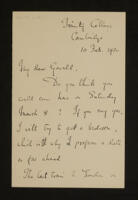
E. I. Coll. - Thanks WW for his latest piece on political economy ['Mathematical Exposition of Some of the Leading Doctrines in Mr Ricardo's 'Principles of Political Economy and Taxation'', 1831]: 'I have not been in the habit latterly of reading algebraic language, but as far as I can judge from a cursory perusal you appear to me to have accomplished very clearly and distinctly what you have proposed. The grand difficulty as you justly observe is in regard to the postulates; but it is still a matter of very great importance to be secure that no error creeps into the subsequent reasonings, and it must be allowed that Ricardo did not always draw correct conclusions from his premises. With regard to foreign trade and the level of the precious metals, I think you have correctly apprehended the doctrine of Ricardo on the subject which by the bye was mine, before it was his; and we used to have conversations on the subject after I had stated the general principle in a note to my pamphlet on rent 2 years before he published his work. You are aware I think from what you say latterly, that the effect alluded to does not depend merely on manufacturing skill, but on any causes which give to a particular country great relative advantages in its exportable commodities. These advantages are now possessed by the United States and are derived from the abundance of its exportable raw products. It seems obvious that no nation could maintain a higher money price of labour than those with which it was connected by commerce, unless from some facilities, agricultural, manufacturing, or colonial, it could buy the precious metals with less labour than its neighbours, various causes may tend to same prices - the scarcity of labourers[,] the greater rapidity of circulation, the influx of paper etc. but the exchanges will soon lower them again, if they cannot be maintained by some peculiar superiority, natural or acquired; and as white paper is exchangeable for gold an increased issue of paper cannot take place without a tendency from other causes to an influx of the precious metals. I do not know that an issue of paper, though it will tend to prevent such influx will materially alter the question in regard to prices. But certainly no specific conclusion can be drawn as to the increased quantity of the circulating medium, as it is not only difficult but absolutely impossible to say what is the quantity required for the circulation of any country, the whole being relative, and depending upon the exchanges with other counties'. TRM is gratified by the level WW and Richard Jones hold his work on Political Economy: 'I confess I felt that when I almost stood alone in my differences with Mr Ricardo [I] was compared to Dr Priestly amidst the new discoveries [of] chemistry, it would not finally be so. But I was hardly prepared to expect that in so short a time as has since elapsed, one of the questions in the political economy club should be 'whether any of the principles first advanced in Mr Ricardo's work are now acknowledged to be correct? My apprehension at present is that the tide is getting too strong against him; and I even think that Mr Jones is carried a little out of the right course by it. In his zeal to shew that Mr Ricardo is quite wrong, which he certainly is, in dwelling upon the diminished whims of agricultural capital as the sole cause of incurring rents, he seems indeed to deny the undoubted truth of the natural tendency to such diminished whims in a limited space, unless prevented by improvement in agriculture or manufactures. Were there no such tendency, and had not such a tendency frequently operated, no adequate reason can be given why the accumulating capitals of a new colony should not continue to be applied to the lands first occupied, or why the inhabitants of the Eastern states of America are now emigrating in such numbers to the Western. The tendency to diminished returns must be the general principle, though after wages and profits have in old countries been reduced to a certain point, the further increase of rents may as I have stated be almost wholly derived from improvements. But supposing wages and profits to have been once very high, as they are in prosperous new colonies, they must full in the progress of population and cultivation; and there is no proportion of the truth of which I feel a stronger conviction than that, if the real wages in any country are so ample as to occasion no difficulty whatever in supporting the largest family, and the rate of accumulation from high profits is such as to afford the means, for many years, of paying them wages, it is impossible that the country can go on and become fully peopled without a considerable fall both after wages and profits, which fall will of course go to rents. According to the observed laws of nature do not all plants and animals increase in a geometrical ratio unless interrupted by difficulties of some kind or other. Excuse this long letter written in a hurry. I go tomorrow morning. We shall be most happy to see you here'.