WW sends a proof sheet of some of JCH's hexameters [see WW to JCH, 13 Nov. 1836].
Reports that [E. M?] Young has asked his advice about standing for Benson's 'place' [as head of Wellington College?], and that he has advised him to stand, but has told him that he did not think him the ideal man. Refers to him as a 'safe' man. Adds that Young has asked him for a testimonial, but before writing Henry would like to know if there is any candidate whom Benson would prefer to Young. Refers to the fact that when Henry and Benson were last together, the latter mentioned [E. A.?] Abbott. Asks him if he would mind him saying that he [Abbott] would have Benson's support. Asks him to tell Minnie that he is 'always writing to her.'
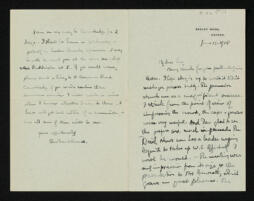
Writes on the death of Henry Sidgwick, which has come as a great shock, despite his being in some measure prepared. Besides the personal loss he feels, he grieves 'that so much work that can ill be spared has been left unfinished'. Refers to the debt he owes Henry, and to his gratefulness for his kindness, his wise guidance, intellectual stimulus, and his ideal of duty. Says he had no other friend in Cambridge who has done for him as much as Henry has done. Trusts that in returning to her work in Cambridge Nora will find occupation for her thoughts that will prevent her from dwelling too much on her loss, but fears that even in her work that loss will ever be forcing itself on her attention. Adds that his wife joins him in sending sympathy to Nora.
Keynes, John Neville (1852–1949) logician, economist, and university administratorPendleton, Manchester - Thanks WW for the present of his work and on looking over his paper on impact, EH offers a further explanation concerning his method used 'in seeking by an approximate mode for the inertia of the bar'. He is trying to find a near value of the inertia of a beam on impact: 'The inertia, I presume depends on the form of the curve, and its strict determination is above my feeble powers. The curve from impact is obviously in some degree serpentine, particularly where the beam is struck toward the ends. This was mentioned to me by Sir John Herschel at Cambridge. I had not however been able to discover any undulations in the form of the curve, under the small impacts in my experiments. The subject of impact I hope to inquire further into, but I feel I must skim upon the surface for want of more mathematical knowledge. Poisson I have heard has something fresh in the 2nd edition of his mechanics - I must get it'. WW expressed a wish to use some of EH's work on Beams and Chain Bridges in the new edition of his Treatise on Mechanics and he is welcome to do so. The paper on the performance of steam engines was a private communication to one of the secretaries to the Philosophical Society [Manchester], and is by an engineer called Edward Dixon, who is in the office with his brother the engineer of the Manchester end of the railway. They are willing to give as much information as they can: 'The short paper alluded to commences with a definition of 'Horse Power' as applied to Engines - shews the superiority of Engines over horses on Railways gives the amount of friction on them - and some calculations and facts as to the power of Engines to take loads up the small inclinations. The paper when modified and improved by the author, and some additional facts are added to it, will be sent to you to use what you please of it'.
54 Cours Napoléon, Ajaccio (Corse) - Has returned, was sorry to miss them in Paris, hopes J.G.F. is better, and that she is not bored in Cambridge.
28, Rue de la Tourelle, Boulogne sur Seine. - Has been at Nice with an attack of bronchitis after his father's departure for India. Thanks Trevelyan very much for inviting him to be his guest in Italy: would like this very much, but he has too much work to do, and he could not leave Reksusha [the dog] again so soon as the old Russian princess who took him last time, and her one servant who is 85, are terrified of him. He could come in the third week of January for about ten days if Trevelyan were still there then, as Professor Kalitinsky will be there. Very happy to hear of the success of "Meleager": performances are usually better than dress rehearsals. [Robert] Bridges has not sent his book, as he promised; asks Trevelyan to write with his impressions of it. Likes the title ["The Testament of Beauty"]: there 'is something sad & wise in it'.
Contains: "Poem (for Priscilla)" by Nicholas Moore; "Bibliophiles" by Olive Heseltine; poem, "Kingfisher in the Snow", by Eiluned Lewis; poems, "Landscape" and "We Have Cast Out Our Souls", by John Griffin; "P. R." and "Letters" by S. S. [Sylvia Sprigge]; poem, "Orchard Company", by D. Eardley Wilmot.
as from 50 Campden Hill Square W.8. - Congratulates Frazer.
Printed postcard informing of change of address to Monk's Walk Cottage, Much Marcle, Dymock, Gloucester. - Handwritten note rejoicing in the move: 'Cider & hops!'. Has been reading Moore's book.
High Biggin, Musley Hill, Ware, Herts. - Thanks them for their nice letter, sends a box from France with a copy of a specimen in the Louvre; despite the war, believes in the power of the mystery of love; is looking forward to reading Frazer's biography.
Seatoller, Borrowdale, Keswick. - Is sending this with B[essie]'s letter to say what a pleasant time they are having; Bessie is well, better than at Haslemere where it was 'so hot and thundery'; the countryside is beautiful and they both like it very much. Very sorry to hear Maria is still not well; hopes the warm weather will help. No-one else here 'except a few Cambridge men who are going to chase each other over the hills in a day or two' [the Man Hunt]; they are quiet and do not interfere. He and Bessie are just going for a walk after lunch. She is trying to make him pronounce 'Mrs Hansje Knipperdolletje', which she says is her name now; he finds it very difficult.
Hôtel de Londres, Cava dei Tirreni. - Arrived here at 9 pm, will stay the night and go to Ravello tomorrow; in the morning he is visiting Corpo di Cava, two miles from here in the hills, where he stayed for two months five years ago on his first visit abroad. Had two hours at Rome; saw Guido [Reni]'s "Aurora" which he thought 'beastly'. His time at Milan with the Frys was 'delightful'; wishes only that he had been better; they saw Bessie's photographs and liked them; encourages her to be photographed again. Hopes her time at the dentist will not be too bad. Got jealous of two Germans who travelled with him from Rome to Naples 'behaving as [he and Bessie] behaved between Gouda and Utrecht'. Originally enclosing [John] McTaggart's letter.
Welcombe, Stratford on Avon. - Hopes Robert caught the train and returned home in good time; he will have told Elizabeth about the party, which 'went off very pleasantly'. Mr Roosevelt is 'most amusing'; she liked him better than she expected. Sir George very happy and 'thinks it a great success'; she is glad he and Roosevelt got on and are 'now excellent friends'. They were glad to have Robert to help, and she had a good time with him on Sunday. Hopes the nurse Elizabeth has now is 'good & helpful' and that Mrs Catt has gone to rest. They leave Welcombe on Friday and unless the weather is awful will stay at the Ulleswater [sic] Hotel, Patterdale until 15 June before going to Wallington. Elizabeth, Julian and Robert will be welcome whenever they wish to come.
Palace Hotel, Rome. - Glad that Robert and Elizabeth are enjoying the castle [at Aulla, home of Aubrey and Lina Waterfield]. He and Caroline have had some pleasant expeditions: to Ostia in 'the American Ambassador's motor, a fearful joy'; to Castel Gandolfo and Nemi; and to Grottaferrata, where they saw an exhibition of medieval ecclesiastical objects in the old monastery and he had a fine walk around the castle into the valley of the Almo. But on an expedition to the Villa Livia, he fell and hurt himself, and brought on the worst attack of rheumatism he has ever had; this is his fourth day in bed. They are disappointed about Charles being left out, but he is 'behaving very well'. Was moved by the death of [Arthur] Humphreys-Owen, and even more by that of [Sir Richard] Jebb, about whom his feelings were 'rather ideal' since first seeing him as 'an elegant, rather black-looking, rather too carefully dressed freshman in [Herbert] Malkin's rooms'; Malkin reminded him this year that when he asked Sir George to meet Jebb, he cried '"What! Jebb? Oh, joy!!'. They intend to leave Rome on 28 December and to be in England by 4 January, but he must be well to travel.
34A Via Porta Pinciana, The Times, Roma - Is sorry he has had to cut short his holiday; has been busy with the riots at Palermo and a requiem mass to be given for heretics and Queen Victoria especially; reacts to Frazer's idea of Steed writing a book about the Vatican; discusses a book by a friend [Henry B. Brewster], 'L'ame païenne' in which he says the Pagan idea of a special deity for each phenomenon corresponds most closely to the state of human experience.
Announced that he has arrived in Cannes 'after a somewhat trying journey': the worst part being the Dover to Calais crossing which he found so rough that he was afraid to subsequently take the night train to Avignon 'for fear of being regularly knocked up'. Was glad to instead spend a morning in Paris, a town he 'love[s] above all towns', where he suffered the effects of a very cold North Wind. Refers to the tradition of selling étrennes [new year's gifts], which he does not wish to 'transplant' to Britain; it is bad enough having to give presents to friends when they marry. Reports that he spent some hours in the Louvre, and found that his feeling for Greuze had grown.
Travelled on to Avignon that night, where he encountered a snow-storm. Remarks that the Palace of the Popes 'looks much more like a great barrack which it now is than like a palace'. He stayed in Marseilles on Wednesday night, and the next morning saw the Mediterranean for the first time. Complains that it has rained every day since he arrived. Reports that Symonds 'does not look at all well, but says he is better', and has sprained an ankle. Mentions that Montagu Butler is there, and that he intends to see him soon and hopes to hear about Haileybury and A G Butler. Reports that [Roden] Noel 'left a wideawake' with them, and asks her to send it to him in London. Asks her to keep carefully any letters about his room or else [ ] belonging to him that she may find. Reports that he had 'a melancholy business at Hastings dividing the library [of his friend Cowell, who died the previous month]'; he could not take all the books and those he had taken will 'oblige him to line [his] room with bookcases'. Remarks that this 'complete break-up, extinction of a family is very sad.'
Material re Memorial Service, Trinity College, and London Mathematical Society Memorial Meeting.
With additional note to another of Macaulay's nieces, Jean.
Macaulay, Colin (1760-1836), general, biblical scholar, and abolitionist1 Brick Court, Middle Temple, London E.C. Dated 20 February 1915 - Discusses the proofs of ['The Northern Bantu'], particularly the point that the Bateso clans are exogamous with descent in the male line; the fund for the book is complete, the largest given by Robert Mond and his mother Mrs Ludwig Mond; Lilly is better but not recovered her strength.
13 Old Square, Linc : Inn - Disputes the idea that the fox was already established as a sacred animal in the time of Queen Anne, as mentioned in Frazer's Spectator pepers; accompanied by a note quoting Gawain on hunting.
Written from Botanic Garden, Oxford.
Broome, Betchworth, Surrey - BCB has just finished reading WW's introduction to his Elements of Morality when the Whewells's present arrived: 'It seems an important addition to my library'.