Showing 80617 results

Archival description
4377 results with digital objects Show results with digital objects
SHAF/B/16/3/9 · Item · [20th-21st cent.]
Part of Papers of Sir Peter Shaffer

Photocopy of typescript and manuscript drafts, much revised of scenes for the last act and a scene for the end of Act I[?]. This draft appears to be earlier than items 10 and 11.

SHAF/A/1/D/9 · Item · 24 Mar. 1981
Part of Papers of Sir Peter Shaffer

Met, Metropolitan Opera Association, Lincoln Center, New York, New York 10023 - Thanks him for his exhilarating letter; the rehearsals for 'Parade' were hair-raising on account of lack of time; has had a letter from Beverly [Sills], telling him how much more exciting it is to work in her theatre [the New York City Opera], and asking about [directing?] 'Alceste' in 1982, which he can't do; ends with a request that he 'explain Peter Hall's mind' to him someday.

MCKW/A/2/9 · Item · 7 Feb. 1911
Part of Papers of R. B. McKerrow

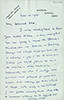
(Sheffield.)—Thanks him for his help with an article on Harvey. Adds further notes on Nashe and brief comments on other subjects.

(With an envelope, postmarked at Sheffield.)

—————

Transcript

7 Feb

Dear McKerrow,

It was very good of you to look at G. Harvey {1} again. I hope you did not go on purpose,—I am so sorry I did not tell you of all my wants at once.

Your corrections are in good time, as I have not received a proof of my N & Q paper. I am sorry to hear of your cold. & hope you are now all right.

Do vote for Cox. {2}

I have got ‘Grace Book Δ’ (a reviewer’s copy) just edited by Venn. It contains all degrees 1542–1589 & other University records. It will be a valuable book of reference—& save one from writing to the Registrary.

I have been reading part of Nashe again in connexion with my paper on Harvey—& send you a few notes on your notes. {3} (I am afraid, rather useless now)

Vol IV

p 154 l 8 for Erogonist, Ergonist

p 156 l 11 fr. bot. Was the Barnard so called from the proverb ‘Bernardus non vidit omnia’?

p 159 n. on 262. 5. Does not ‘book-beare’ mean ‘lectern’?

p 160 n. on 265. 28 Did Barnes write ‘Meg a Court’?

n. on 267 2,3. I suppose Nashe is parodying—‘Here beginneth the first Epistle to the Philippians &c’—but the expression is a clumsy joke if so

p 176 n. on 294. 23. I suppose you take Pistlepregmos as = dealer in Pistles, or Epistles.

p 181 n on 302 13. The louse had 6 feet I suppose like Harvey’s hexameters

p 182 n. on 305 24. Sailors, I am told still divide foreigners into ‘Dutchmen’ (Germans, Scandinavians &c) & ‘Dago’s’ (French, Spaniards &c)

p 183 n. on 305. 22. {4} I suppose Harvey is translating Summa Summarum.

p 189 n. on 313 23. ‘Matthew’ should be ‘Nathanael’—according to the Admissions to Fellowships in S. John’s Coll.

p 191. n. on 322. 31. Is this a certain explanation? Is there other ground for thinking that Nashe’s Lord was a Dudley?

316. n. on 29. 21. Is this to {5} Tho. Freigius? I dont know if he wrote a Paedagogus.

339 n. on 74. 18. Doctor Hum. Does not this refer to the Cambridge use of ‘hum’ as a sign of disapproval? [? scraping the feet—or making a noise with the voice] {6} Cp. Mead’s letter to Stuteville 27 June 1623 (Heywood & Wright’s Camb. University Transactions 315) ‘Mr Lucy ‥ was this week created Doctor ‥ with such distast of the regents that they hummed when he came in.’ {8}

n. on 76. 35. Is not Sir Edw. Dyer more likely? He was a Knight before Greville—but I dont know the dates

359 n. on 114. 16. Tennyson uses it in The Grandmother I think.

365. n. on 126. 31,2 See Pedantius l 194. {9}

Ever yours
G. C. Moore Smith

I am glad to hear your patient has got to Canada.

[Added on the back of the envelope:] Secker is going to print Tubbe. {10}

[Direction on envelope:] R. B. McKerrow Esq | 4 Phœnix Lodge Mansions | Brook Green | Hammersmith | London W

—————

The envelope, which has been marked ‘Notes on Nashe’, was postmarked at Sheffield S.D.S.O. at 1 p.m. on 7 February 1911, and at Paddington, W, at 7.15 p.m. the same day.

{1} Gabriel Harvey’s letter-book, in the British Library (MS. Sloane 93). Moore Smith’s paper ‘Gabriel Harvey’s Letter-Book’, which appeared in Notes and Queries on 3 April (11th series, iii. 261–3), included a number of corrections to the edition of the letter-book prepared for the Camden Society by E. J. L. Scott in 1884, prefaced by the following acknowledgement: ‘For some of the corrections below I am indebted to Mr. R. B. McKerrow, who was kind enough to look at the MS. for me after I had left London.’ The corrections supplied by McKerrow are dis-tinguished in the article by asterisks.

{2} Harold Cox, the Liberal candidate for the constituency of Cambridge University in the by-election held in this year.

{3} The succeeding notes relate to Nashe’s Strange Newes and Have With You to Saffron-Walden.

{4} ‘22’ is a mistake for ‘32’.

{5} Reading uncertain.

{6} The opening square bracket is original; the closing one has been substituted for a round one.

{7} Single inverted comma supplied in place of double inverted commas.

{9} Moore Smith had made this observation before in his letter of 13 November 1908 (MCKW A2/6).

{10} Moore Smith’s selection of the works of Henry Tubbe (d. 1655), a minor poet. In the event this work did not appear till 1915, when it was published by the Clarendon Press. Cf. MCKW A2/12–13.

Letter from John Herschel
Add. MS a/207/9 · Item · [25 Nov. 1823]
Part of Additional Manuscripts a

WW does not have to personally read his paper on Crystallography to the Royal Society, but should provide an abstract of it. If read and approved it should be published in the second part of the Society Transactions for 1824 ['A General Method of Calculating the Angles Made by Any Planes of Crystals, and the Laws According to which They are Formed', Phil. Trans., 1825]. A nephew (Henry White) of two old friends of JH's has entered Queen's College to be educated for a missionary. He has no introduction at College, and consequently could become a 'Fanatic instead of a reasonable dissemination of God's word and the gifts of civilisation'. Would WW call on him and take occasional care of his progress.

Add. MS a/727/9 · Item · [1910]
Part of Additional Manuscripts a

Brookthorpe, Gloucester. Thanks him for her kind words about the memoir; recalls the pride and pleasure F. W. Maitland took in being made an Honorary Fellow of Trinity; is sorry to hear of Professor Butcher's illness; thanks him for his kindness in entertaining Fredegond.

Add. MS b/37/9 · Item · c 1947-c 1955
Part of Additional Manuscripts b

Drumore, Blairgowrie, N.B. Dated June 23, 1906 - Frazer's letter [on his retirement] has touched him: his 'voice makes up for the thousands of dumb students whom one has bored, and to whom too often alas! one could give nothing to carry away'.

Add. MS a/204/9 · Item · 31 Mar. 1833
Part of Additional Manuscripts a

Edinburgh - JDF has lost no time in distributing WW's circulars. His main reason for writing is to suggest Edinburgh for the BAAS meeting next year. Edinburgh is not to be considered a University town: 'The University can do nothing, it has no status, no power , no funds'. While David Brewster promised to give the most entertaining course of lectures ever given at the University, JDF adheres 'to the very opposite principle' and will be striving 'to foster a spirit for sound physico-mathematical attainment at present nearly unknown in Scotland'. His lectures will be a 'cautious mixture of pure demonstration with experiment and collateral illustration'. However, JDF feels his labours will be wasted for want of an adequate textbook in theoretical mechanics: 'your mechanics has appeared to me far the best book I have met with for teaching from [The First Principles of Mechanics: With Historical and Practical Illustrations, 1832]...But for my purpose it is to long: it is on the whole rather too difficult, and in statics, too complete'. JDF would like WW to do an abridgement of it with less mathematics, coupled with some problems taken from WW's recent work on Dynamics [An Introduction to Dynamics Containing the Laws of Motion and the First Three Sections of the Principia, 1832]. The only work which approaches JDF's criteria is a textbook by Dr Jackson of St. Andrews University: 'but it is a little repulsive, and does not afford the means of passing over the more difficult parts'. John Leslie's 'book is incredibly bad, but its division into Statics and Dynamics renders it preferable to those which want it'.