
SRAF/A/4/12
·
Documento
·
1961–62
Parte de Papers of Piero Sraffa
4485 resultados com objetos digitais
Mostrar resultados com objetos digitais
SRAF/B/9/12
·
Item
·
post 1980
Parte de Papers of Piero Sraffa
Add. MS c/58/12
·
Item
·
23 Feb. 1901
Parte de Additional Manuscripts c
Highgarth, Gloucester - The letter he has is from Dr [Henry] Roth, who writes that he has found a tribe of aboriginal people who believe in parthenogenesis, and has a theory of the origin of taboo as the will of the strongest; was interested to read the new GB, suspects all martyrologies, including St Dasius; [Alfred] Haddon will make an excellent President for the Anthropological Institute, hopes he will not disdain the Folklore Society later on. A postscript discusses two items from GB, relating to the seclusion of the kings of Corea and concerning the Welsh verses in Vol. II, p. 178.
CORN/I/2/12
·
Item
·
n.d.
Parte de Papers of F. M. Cornford
CORN/I/4/12
·
Item
·
n.d.
Parte de Papers of F. M. Cornford
Stowe School - dislikes Tennyson and Browning, argument with school chaplain, poem "Ezekiel saw the Wheel".
[annotation by Frances Cornford "John first sent me his poetry as by 'a boy at Stowe' for criticism. Don't let on to the outside world that he writes it - or he'll never forgive me."]
RAB/D/6/12
·
Item
·
[1921]
Parte de Papers of Lord Butler
Paper read before the Royal Society of Arts
RAB/D/45/12
·
Item
·
24 Jun. 1943
Parte de Papers of Lord Butler
SYNG/D/12
·
Documento
·
1970, n.d.
Parte de Papers of Richard Synge
BROD/C/2/12
·
Documento
·
[1925]
Parte de Papers of C. D. Broad, Part I
RAB/B/15/12
·
Item
·
30 Oct. 1951
Parte de Papers of Lord Butler
With carbon copy of reply from R. A. Butler, 1 Nov. 1951.
HOUG/B/P/1/12
·
Item
·
5 Jun. 1818
Parte de Papers of Richard Monckton Milnes, Lord Houghton
Meeting to be held 'in Mr Harrison's Long Room' at eleven in the morning.
HOUG/D/D/40/12
·
Item
·
12 Aug. 1871
Parte de Papers of Richard Monckton Milnes, Lord Houghton
Embossed notepaper, Weston Park, Shifnal. - Delighted by speeches for the centenary of Sir Walter Scott; Houghton is mistaken in stating that there is now no Byron - writer recently heard the 'Bill' read in the old fourth form room at Harrow and a 'little blackheaded boy' responded to the title 'just as I was gazing at BYRON, which the poet had cut on the wall'; an actual descendant is Lord Wentworth, the eldest surviving son of Byron's only child.
HOUG/E/B/4/12
·
Item
·
31 Jan 1848
Parte de Papers of Richard Monckton Milnes, Lord Houghton
Castle House. - Unsatisfactory behaviour of Preston Seaton and Jefferson; unfair distribution of game and other election bribes; prejudice against Leatham; financial difficulties; friendliness of the Earl of Feversham etc. Adds postscript: discussion with Gully; Leatham injured by a fall during the frost; wife and family.
HOUG/D/A/5/12
·
Item
·
6 Feb. 1849
Parte de Papers of Richard Monckton Milnes, Lord Houghton
Colombo, 'Ratnapoora, last address'. - Thanks for Milnes' reply and the books, which must still be on their way up river; will draw up reminiscences when he has read Milnes' Keats; asks whether it was 'poor Jane Reynolds' who reported his death; contrast with unexpected deaths of others. Knows little of the MacCarthys. Will send books, which, 'as the biographer of Keats... [Milnes] ought to have'. Poem quoted by Milnes is one Keats copied in a letter from Oxford from a scare volume of poetry by Katherine Philips; Milnes might rebind it in honour of Keats and the writer. Bailey bought it at Thrale auction in 1816; also has a copy of the first edition of Endymion, which he reviewed in the Oxford Herald; has arranged for this review to be sent to Milnes; his other publications. Sir J. E. Tennant will vouch for the unpromising literary environment of Ceylon. Requests Moxon's edition of Keats.
'I extracted a sentence from one of Keats's letters to myself which sounds very melancholy... but which shows the just confidence he had in himself: "At one time or other I will do you a pleasure, and the poets a little justice; but it ought to be in a poem of greater moment than Endymion, I will do it some day". That day never came; but the fragment of Hyperion shows what he could have done, had his life been spared'.
HOUG/D/A/9/12
·
Item
·
[1840s?]
Parte de Papers of Richard Monckton Milnes, Lord Houghton
23 Berkeley Square. - Sends music to Milnes' words, which will have to be adapted from 'young lady's' version of the poem; house-hunting. Postscript: can see Miss Lawley 'walking down the street with the elastic jaunty step of a Bride elect!'
HOUG/B/Q/16/12
·
Item
·
25 Mar [1833]
Parte de Papers of Richard Monckton Milnes, Lord Houghton
With note from Caroline d'Andreis.
HOUG/2/12
·
Item
·
22 Oct. 1877
Parte de Papers of Richard Monckton Milnes, Lord Houghton
HOUG/A/A/5/12
·
Item
·
16 Jun. [1851]
Parte de Papers of Richard Monckton Milnes, Lord Houghton
1 Portugal Square - Congratulations on engagement.
Add. MS c/56/12
·
Item
·
2 Nov. 1920
Parte de Additional Manuscripts c
Aldeburgh - Is surprised to hear he has never been to Brussels; comments on the political situation, thinks the League of Nations, like Socialism can only succeed when human nature alters; worries about unrest in the East after the defeat of Russia by Japan; saw [W. H. R.] Rivers while he was at [A. C.] Haddon's, and mentioned his championship of Elliot Smith's theory of diffusion; gets much attention from spiritualists sending brochures, etc., has agreed to review a 'huge and repellent book' of exudations of 'psychic matter'; wishes Frazer could have noticed his book ['Magic in a Name'] in the 'Observer'.
HOUG/222/12
·
Item
Parte de Papers of Richard Monckton Milnes, Lord Houghton
HOUG/G/12
·
Item
·
1852-1854
Parte de Papers of Richard Monckton Milnes, Lord Houghton
HOUG/H/B/10/12
·
Item
·
[1863]
Parte de Papers of Richard Monckton Milnes, Lord Houghton
'Hallam Memorial Medal. The Medal executed by Mr L. Wyon from Mr. Theed's statue of Mr. Hallam, by order of the Committee, from the Surplus Funds remaining in my hands, will be ready for distributers to the Subscribers to the HALLAM MEMORIAL, on application to Mr. Murray, 50A, Albemarle Street, on and after October 26th ['1863' added by hand on one copy] by delivering this paper with the Subscriber's signature, in token of receipt. J. P. Boileau, Treasurer'.
Both copies inscribed to Lord Houghton.
HOUG/E/M/9/12
·
Item
·
10 Jun. 1848
Parte de Papers of Richard Monckton Milnes, Lord Houghton
42 St. Peter's Street, Canterbury. - Milnes' former kindness though previous appeal went unanswered; exhausted funds in travelling to Canterbury to take up a job in the theatre offered by 'Mr Mandeville'; he turned out to be the Charles Southwell convicted of blasphemy at Bristol and disappeared without paying his staff. Holmes is detained in Canterbury by his wife's contracting smallpox in an advanced stage of pregnancy; his own bilious complaint has been brought on by anxiety; now fears further infection and has no resources; will not trouble Milnes in future but entreats assistance now.
HOUG/E/M/12/12
·
Item
·
10 Jan. 1862
Parte de Papers of Richard Monckton Milnes, Lord Houghton
2 Stone Buildings, Lincoln's Inn. - Believes Milnes supports [H. R.] Luard in Registrary election; invites Milnes to a meeting of Luard's London Committee. Postscript: election is to be on Wednesday.
O./11a.4/8/12
·
Item
·
19 Feb. 1924
Parte de Manuscripts in Wren Class O
On printed headed notepaper of J. Burnaby, Junior Bursar, Trinity. Signed by Sydney C. Cockerell, [director of the Fitzwilliam Museum].
R./2.40A/12
·
Item
·
21 July 1932
Parte de Manuscripts in Wren Class R
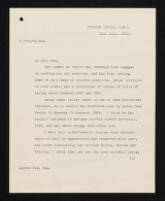
Foreign Office, S.W.1.—Presents to Trinity College a bill of lading for the shipping of Lord Byron’s furniture, discovered among the archives of the British Consul at Venice.
—————
Transcript
FOREIGN OFFICE, S.W.1.
21st July, 1932.
L 3720/43/402.
My dear Gow,
Our Consul at Venice has recently been engaged in sorting out old archives, and has been sending home to us a mass of expired passports, ships’ articles or crew lists, and a collection of copies of Bills of Lading dated between 1817 and 1823.
Among these latter there is one of some historical interest, as it covers the furniture sent by Byron from Venice to Ravenna in January, 1820. I think he had himself returned to Ravenna shortly before Christmas, 1819, and had these things sent after him.
I have been authorised to dispose this document where it will be appreciated and preserved with care, and after considering the British Museum, Harrow and Trinity, I think that you are the most suitable people to {1} have it, if you want it.
I enclose a translation of it so that you may see its nature {3}. I think the last item the “small child’s bed” is rather pathetic as it doubtless belonged to little Allegra, who had been ill just before they left Venice.
I do not know whether you will find it necessary to consult anybody else before accepting this offer. I presume your Council does not meet in the long vacation, nor your Library Committee, but you can doubtless speak to the Master or Vice-Master about it, and if you tell me that you would like it, I will send it by registered post or bring it with me some week-end when I come to Cambridge.
Yours ever,
Stephen Gaselee
Andrew Gow, Esq. {2}
I feel that if it went to Harrow it might set the boys asking “But why did the poet go from Venice to Ravenna?”
—————
Typed, except the signature and the postscript.
{1} Typed as a catchword at the foot of the first page and repeated at the beginning of the next.
{2} Typed at the foot of the first page.
{3} It is unclear whether the translation accompanied the bill from Venice, or whether it was made in England by Gaselee himself or someone else.
BUTJ/M/3/12
·
Série
·
1888
Parte de Papers of Sir James Butler (J. R. M. Butler)
TURN III/A/31/12
·
Item
·
30 Nov.–1 Dec. 1836
Parte de Correspondence of Dawson Turner, Sir Francis Palgrave, and Hudson Gurney
TURN III/A/3/12
·
Item
·
12 May 1834
Parte de Correspondence of Dawson Turner, Sir Francis Palgrave, and Hudson Gurney
(Two messages.)
TURN III/A/4/12
·
Item
·
5 Feb. 1839
Parte de Correspondence of Dawson Turner, Sir Francis Palgrave, and Hudson Gurney