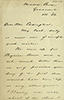
These papers are all manuscripts in Eddington’s hand, with the exception of B3/17, which is typed, and B3/12, which is a carbon copy of a typescript.
§ 76[a]. Angular momentum.
§ 74[a]. Polar coordinates.
§ 74[b]. The differential wave equation.
§ 75. The symbolic frame in relative space.
§ 76[b]. Reality conditions in relative space.
§ 77[a]. Relation of quantal and scale-free physics.
§ 77[b]. Relation of quantal and scale-free physics.
§ 78. The metastable states of hydrogen.
§ 79. Particle and wave properties.
§ 80. The internal wave equation.
(§ 76[a] was renumbered from 73, but the equations were not renumbered accordingly.)
Transcript
Meadow Brow, Grasmere.
VIII. ’02
Dear Mrs. Eddington,
My last duty is now one of simple good wishes.
The men up for Physics Hons. were a set much better than in any previous year. Any of the first three would have been top in any other year; & Stanley was well ahead of the others, & obtained over 80 per cent on the whole examination.
He will find a larger sphere and more competition at Cambridge; and I trust we shall hear he is bearing himself well under it.
With best wishes
I remain
Your friend sincerely
John W Graham
Transcript
Observatory, Cambridge
21 May 1936
Dr W. M. Smart’s application for the Chair of Regius Professor of Astronomy in the University of Glasgow has my warmest support. He is a man of established reputation in astronomical circles who would fill the office with distinction; and he has proved himself very successful as a lecturer and teacher. He would be much missed from this Observatory and from the University; but promotion to a professorial chair would be a fitting recognition of his work.
Dr Smart has been Chief Assistant in the Observatory and John Couch Adams Astronomer since 1921. There is only one other Assistant. The policy of the Observatory has been to avoid routine undertakings and to develop new methods. Two main lines of work have been developed during his tenure—an improved method of determining photographic proper motions of stars, and measurement of stellar magnitudes with a photo-electric cell. As regards the former it may, I think, be claimed that the Cambridge results set a new standard of accuracy for large series of proper motions. Photo-electric work is still confined to two or three observatories (Cambridge being the only British one). After a long struggle with pioneer difficulties the work is now proceeding with great success, and astonishing accuracy is obtained. A large share of the credit for these results is due to Dr Smart.
On the theoretical side his earlier work was in celestial mechanics. But in connection with the practical work above-mentioned his more recent interests have {1} been mainly in proper motions and other branches of stellar statistics, to which he is one of the most active contributors. He is a member of the Commission of the International Astronomical Union on Stellar Parallaxes and Proper Motions.
His teaching work covers elementary lectures on astronomy, advanced lectures on celestial mechanics and on stellar motions and a practical class at the observatory. Judging from the response of the students he is a stimulating lecturer. He normally supervises one or two research students.
An important part of his experience is his work as Secretary of the Royal Astronomical Society during the last five years. This brings him into touch with astronomers in all parts of the world, so that he is in full contact with all modern developments. It is perhaps not irrelevant to mention that he is Treasurer of the Royal Astronomical Society Dining Club—an office (of which the duties are by no means confined to the care of money) which is a tribute to his popularity with his colleagues.
To sum up:—He has shown himself able to make the most of the resources of a small observatory; he is well-known and esteemed internationally; he is successful with students; and is well used to administrative activity.
—————
The various cancelled words and passages in this letter have not been recorded, except for the mistaken deletion noted below.
{1} Struck through by mistake.
Chapter VI: Wave Vectors.
§ 54. The linear wave equations.
§ 55. Matrix representation of E-numbers.
§ 56. Factorisation of E-numbers.
§ 57. Wave vectors and tensors.
§ 58. Space tensors of the second rank.
§ 59. Angular momentum.
§ 60. Symbolic coefficients in ξ-space.
§ 61. The differential wave equation.
§ 62. The eigen-scale.
§ 63. Perturbation theory [title only].
Chapter VII: The Hydrogen Atom and the Neutron.
§ 63. Symmetric degeneracy.
§ 3∙1. The rigid-field convention.
§ 3∙2. Scale-free distributions.
§ 3∙3. Partition of the energy tensor.
§ 2∙1. The Bernoulli fluctuation.
§ 2∙2. The standard of length.
§ 2∙3. Non-uniform curvature of space.
§ 2∙4. The extraneous standard.
§ 2∙5. Pseudo-discrete wave functions.
(The title of § 2∙5 was altered from ‘Occupation factors’.)
§ 1. The conditions of observability.
§ 2. The Gaussian distribution.
§ 3. Relative distribution functions.
§ 4. Relative wave functions.
§ 5. The weight function.
§ 6. Uranoids.
§ 7. Spherical space.
§ 8. The zero-temperature uranoid.
§ 9. Primitive observables.
§ 10[a]. V3 and V4 particles [incomplete].
§ 10[b]. V3 and V4 particles.
§ 11. The Bernoulli fluctuation.
§ 12. The standard of length.
§ 13. Non-uniform curvature of space.
§ 14. The extraneous standard.
§ 15. Scale-free physics.
§ 16. Pseudo-discrete wave functions.
§ 17. Stabilised characteristics.
§ 18. Stabilisation of tensors.
§ 3∙1. Idempotent vectors.
§ 3∙2. Spectral sets of particles.
§ 3∙3. The linear wave equation.
§ 3∙4. Matrix representation of E-numbers.
§ 3∙5. Wave vectors and tensors.
§ 3∙6[a]. Space tensors and strain tensors of the second rank.
§ 3∙7[a]. Angular momentum.
§ 3∙8. The differential wave equation.
§ 3∙6[b]. The differential wave equation.
§ 3∙7[b]. Angular momentum.
§ 77. The metastable states of hydrogen.
§ 78. Deuterium and neutron.
§ 79. Mass of the neutron.
§ 80. Atomic mass of deuterium.
§ 81. Simple and double intracules.
§ 82. Atomic mass of helium.
§ 83. The separation constant of isobaric doublets.
§ 84. Nuclear spin.
§ 85. Mass of the mesotron.
§ 1. The conditions of observability.
§ 2. Correlation.
§ 3. The importance of systematic description.
§ 4. The uncertainty of the origin.
§ 5. Application to wave functions.
§ 6. Three-dimensional distributions.
§ 7. Extension to four dimensions.
§ 8. Curvature of space.
§ 9. Standard masses of the particles.
Transcript
Funchal, April 6
My very dear Mother
I think that our time here is nearly up. We are to go on by the steamer Portugal which is due here on Wednesday, April 9, and should reach Principe on the 23rd. It calls at two places in the Cape Verde Islands and then goes straight to Principe. We shall not be the only English on board as we know of two others going as far as St Vincent (in Cape Verde Is.). The Quelimane which we had thought at first would be our boat was due here on the 3rd but did not arrive till yesterday; it was going direct to St Thomé, only a hundred miles from Principe, but did not call at Principe.
Since my last letter I have had one other splendid walk on the hills. I went alone as it was too far for Cottingham. I started at 7∙45 and reached Terreira de Lucta (the terminus of the railway) by half past nine; I was walking as there was no train early enough. It was then an easier walk though still uphill over Poiso pass 4550 feet up; then steep downhill to Ribiera Frio. This is one of the famous view-points of the island. The Balçoã (or balcony) there is about 2800 feet above sea-level, and one looks up and down a splendid deep ravine, thickly wooded. It is the same ravine that I saw from Ariero Observatory; but here, being in the middle of it instead of at one end, one gets a much better view and better idea of its size and depth. I reached this place about 12∙15 and stayed there till near 2 o’clock. It was very fortunate I had made an early start, because by the time I left the mist had come up from the sea on the north of the island and completely filled the ravine, so that one could see nothing. When I got there it was quite clear except for a few clouds round two or three of the highest snow-covered peaks. The highest peaks are 6000 feet high. One got good views of the levadas (artificial aqueducts) cut in the sides of the precipitous cliffs, and part of the way the path was by the side of one of these levadas. I climbed back through the mist to Poiso; and then got into the sunshine again, and left the road striking over the hills to Pico da Silva more to the east, getting a good view of the coast at the east end of the island. I reached Funchal about 6∙30, coming down the last 2000 feet by a very steep road like a flight of steps. The walk was about 25 miles altogether.
A good many of the people staying at this hotel left by a boat last Sunday, and it seems more empty now. There are about 8 or 10 permanent residents, and in addition I think there are only three other visitors—Ash (an old gentleman who came with us on the Anselm), Mr Bickmore a new arrival, and Geoffrey Turner a boy of sixteen from Mumbles, who has come out here for six weeks after an illness. Since some of his fellow-passengers left last Sunday, he has come to sit at our table and generally goes about with us.
The weather this last week has been very showery but always with long intervals of bright sunshine. The inhabitants say it is exceptionally bad weather; but I only wish we had “bad weather” of this kind in England. It is, however, unsuitable for long walks and the clouds are fairly low on the mountains; but that does not matter as I have been to the chief points of interest that are at all accessible. Nearly every morning this last week I have spent bathing at the Ajuda a place on the coast rather more than a mile from here which Geoffrey showed us. It is about the only place for a bathe here unless one goes out in a boat. The sea is rather rough and the coast rocky; but here there is a more or less enclosed pool where one can get a good swim without being knocked about on the rocks by the waves. I have got tremendously sunburnt.
We generally go to the Casino for tea, though we have tried once or twice another restaurant. There is always a band there. Roulette is prohibited in Madeira; but the authorities pretend not to know that it goes on. Now and again they make a raid, but they always telephone up to say they are coming. One afternoon, I was wanting to come away and found the main doors, which lead out through the dancing saloon, fastened, and we had to come out by a back way; the reason was that the Chief of the Police had come up for the dancing, and he was supposed not to know what was going on the other side of the door.
I have scarcely ever been out after dinner, but last night I went with Geoffrey to a picture-palace. The chief film was the funeral of King Edward VII! It was rather curious seeing it after so many years. After about ¾ hour of pictures, there was a short play of which we naturally could understand nothing. Then some recitations (chiefly serious) and some songs (chiefly comic). One of the comic songs was very amusing though one could not understand the words. It was a very crowded house, and very interesting to watch the audience.
I had a talk this morning with the English Doctor an old gentleman who has gone in for science a good deal. He is brother-in-law to the late Lord Kelvin, and told me a lot of stories about him. Kelvin met his wife at Madeira—a Miss Blandy—the Blandys are the agents of most of the shipping companies here, and they saw after storing our instruments, here.
I expect my next letter will be from Cape Verde Islands. I shall be glad to be progressing again; but I have enjoyed the whole of my stay here immensely—it has been a splendid holiday
With very dear love from
your loving son
Stanley
—————
Numbered ‘4th’ at the head. Three passages have been marked off in pencil by a later hand.
In 1919 two expeditions were dispatched from Britain to observe a total eclipse of the sun, the object being to test Einstein’s general law of relativity by determining what effect, if any, is produced when the path of a ray of light crosses a gravitational field. One party, comprising A. C. D. Crommelin and C. Davidson, went to Sobral, a town in the north of Brazil; the other, comprising Eddington and E. T. Cottingham, went to Principe, a small island off the west coast of Africa. The present group of letters, written by Eddington to his mother and sister, contains an account of his part in the latter expedition.
The four observers left Liverpool together aboard the steamship Anselm on 8 March and arrived at Madeira on the 12th, where they parted. Crommelin and Davidson went on to Brazil aboard the Anselm, while Eddington and Davidson were obliged to stay at Madeira till 9 April, when they recommenced their journey aboard the Portugal. They arrived at S. Antonio in Principe on the 23rd. After inspecting various possible sites on the island, they settled on Roça Sundy, the headquarters of a plantation owned by Senhor Carneiro, and their baggage was transported there on the 28th. They spent a week preparing the equipment, before returning to S. Antonio for the week 6–13 May; they then went back to Sundy to continue their preparations. The eclipse took place on 29 May. On 12 June the observers left Principe on the steamship Zaire. After changing ships at Lisbon, they arrived at Liverpool on 14 July. A report of the expeditions was communicated to the Royal Society on 30 October and printed the following year (Philosophical Transactions A, vol. ccxx (1920), pp. 291–333). A draft by Eddington of the part of the report relating to the Principe expedition will be found at C1/3.
The note accompanying these papers (B4/8) begins as follows: ‘This card folder contains a small number of loose and partly unidentified sheets that were separated from the otherwise orderly arrangement of the Eddington papers that had been in the hands of Professor N. B. Slater.’ There follows a brief description of the three letters (B4/5–7) and the sheets in Eddington’s hand (B4/1–9). Eddington’s manuscripts have been listed as nine items. The first (B4/1) forms a sequence of four sheets numbered from 36 to 39, formerly stapled together, as Dewhirst’s note records. The first sheet was marked by Slater in red biro: ‘(Attached to MS §a).’, apparently referring to B3/1, which comprises thirty-five sheets, though the character represented by the section-mark is indistinct. The next three items also appear to form distinct sequences, possibly all from the same doc-ument: B4/2, comprising six sheets numbered from 3 to 8; B4/3, two sheets, of which the second, unnumbered, clearly follows the first, which is numbered 10; and B4/4, comprising two sheets numbered 12 and 13. The remaining five sheets have been listed singly (B4/5–9). The first two of these contain similar tables on the back. The folder, which was simply marked with a ringed ‘A’, has been discarded.
(See the general note on this file.)
Transcript
1912 Sept 15
R.M.S.P. Arlanza {1}
My very dear Mother
It is now the last day on the steamer, and we are to reach Rio at about 7 o’clock tonight; I do not think we shall land until tomorrow morning.
We did not go on shore either at Pernambuco or Bahia as they are neither of them very healthy places. At Pernambuco there is no real harbour and we anchor someway out at at† sea but Bahia is a magnificent bay. The land is very low all the way between them; and the coast (which we keep in sight) is monotonous, only there is a curious white sand all the way along which makes it look like chalk cliffs.
The most interesting thing is seeing the whales, which are quite numerous. You see them spouting frequently and sometimes catch a glimpse of the whale itself. We left Bahia on Friday, and yesterday (Saturday) the rain came down in torrents; it was the first time we had had anything more than the slightest showers. In the evening the rain stopped, and the wind got up, and we really pitched quite a lot it was quite pleasant for a change. Today is a perfect day again, clear, and with brilliant sunshine. It is quite cool again and I am wearing my usual English clothes.
I know all the Officers now pretty well; the Chief Officer is a very nice man and a great favourite with the passengers.
I had a letter from Rio at Pernambuco which was very satisfactory; Lee {2} has visited all possible sites. I rather think we shall go to Alfenas further inland than Christina but do not know yet. The Brazilian government is going to do us well. I have met several passengers who know the country well. They say we are sure to have fine weather, and the country is a regular health resort, where the inhabitants all live to be centenarians.
Some of the passengers bought little marmoset monkeys at Bahia; they are sweet little things that you could put in your pocket but I was not tempted to go in for one.
I will not add more as there is a fine bit of coast outside that I want to see and then I must get my packing done.
With very dear love from
your affectionate son
Stanley
—————
Letter-head of the Royal Mail Steam Packet Company. Numbered ‘4’ at the head in pencil.
{1} ‘R.M.S.P.’ is printed.
{2} ‘the Interpreter’ has been interlined above a caret, in an unidentified hand. The person referred to is T. N. Lee, an Englishman deputed by the Brazilian Government to as-sist the expedition. See The Observatory, xxxv (1912), 410.
† Sic.
§ 12. Complementary fields.
§ 13. The rigid-field convention.
§ 14. Separation of field and particle energy.
§ 15. Application of scale-free systems.
§ 16. The ‘top particle’.
§ 17. Standard carriers.
§ 18. Mass-ratio of the proton and electron.
§ 19. Rigid coordinates.
§ 20. The fine-structure constant.
§ 21. The inversion of energy.
§ 22. Mutual and self energy.
§ 23. Comparison particles.
University of Chicago, Yerkes Observatory, Wisconsin.—Summarises some recent work on the convection zone in stellar atmospheres.
§ 64. The EF-frame.
§ 65. Chirality of a double frame.
§ 66. The interchange operator.
§ 67. Duals.
§ 68. The CD-frame.
§ 69. Double vectors.
§ 70. Double phase space.
§ 71. Uranoid and aether.
§ 72. The Riemann-Christoffel tensor.
§ 73. The tensor identities.
§ 74. The contracted Riemann-Christoffel tensor.
§ 75. Interstates.
§ 76. Antisymmetrical wave functions.
(The chapter number has been altered in pencil to ‘VIII’.)
Transcript
Hotel dos Estrangeiros, Rio de Janeiro
Thursday | 1912 Sept 19
My very dear Mother
We are still here at Rio de Janeiro; it is a most beautiful place, the weather is fine and pleasant, but progress is very unsatisfactory. The great characteristic of Brazil is “amanhã” (“tomorrow”) and the delays and muddles of the people who are supposed to be helping us are most vexatious.
The Arlanza arrived in Rio soon after dusk on Sunday. In some ways it was a pity to miss the sail up Rio harbour in daylight but the lights were very beautiful. It is a wonderful harbour winding about, with numbers of islands and mountains everywhere. The Sugar-loaf (about 1200 ft) is an extraordinary steep cone. It has far surpassed my expectations.
We remained on board till the next morning, as I had a Marconigram to say that we should be met the next day. At 8 o’clock Dr Moritze† (the director of Rio observatory {1} [)] and Lee (the Englishman deputed to help us) came on board; {2} after arranging about the instruments, they took us off in a government launch. We were photographed by the newspapers on landing, and then whisked off in a motor-car to this Hotel. It is the swagger hotel though not up to much according to English standards. The Government is entertaining us here—very happily for us—money here has roughly 1/5 the value it has in England. I had to pay 2/8d for a cake of soap. Washing a dress-shirt costs 2/9d, an ordinary shirt 1/–. Carriage of our trunks up to the hotel (for three of us) cost 16/–; the tram-fare for say 1½ miles is 5d; a small bottle of ginger beer is 2/–; apples about ¼ each. The only things admitted into Brazil free of duty are human beings and they have to pay a duty of 2£ to get out again.
The currency here seems very funny[.] I am carrying about in my pocket now over 800,000 reis so am nearly a millionaire. 1000 reis = 1/4½ but its purchasing power is about 3d according to our standards. I am told that the salary of an engine-driver on a railway is (in English money) £900 a year.
We called on Sir William Haggard the British Minister {3} on Monday morning and in the afternoon went with him to be presented to the Minister for Foreign Affairs {4}. Sir William is quite a pleasant man, and we are to go lunch with him today.
They are very eager to entertain us well; but have not taken the least trouble to help us with our baggage. Instead of bringing it off in a special lighter as they undertook to do, they let it get all mixed with the other baggage and go to the custom-house[.] I have spent hours hunting round after it, and Lee is no use or help at all. It was all unloaded yesterday and I watched the process; but they only sent with me a man, who could talk no French or English, so it was very difficult doing anything. Now they tell me a case is missing (though I am sure it was all there yesterday) and I have to go—again with a man who talks nothing but Portuguese—to hunt it up. This has meant another day’s delay. {5}
I have decided to go to Passo Quatro; it is quite a good place and not so far away as Christina or Alfenas. Moritze† is to be there too; he is very pleasant[,] talks English (the worst English I ever heard) and is really doing his best for us I think. The chief objection to Passo Quatro is that all the ministers, ambassadors, reporters and tag rag and bobtail will be going there; but I think we shall not really be disturbed by them. I should have gone to Alfenas, if I could have depended on Lee, but the difficulties are too great when one has no real assistance. {5}
We have been made honorary members of the Club Central here, which is very convenient, as we are a good way from the main city at this Hotel.
The trees and gardens about here are very interesting and the palm-tree avenues in particular are beautiful. I do not think there is any chance of our sailing from here until Oct. 23 and I am looking forward to having a week’s sightseeing and so on before leaving.
We have got English news now up to Sept. 2.
Please keep these letters as I have no other record of events.
With very dear love from
your affectionate son
Stanley
Later (evening)
I had just finished this when the Portuguese gentleman came to go with me to the Customs-house but I was very glad to see with him Perrine of the Argentine expedition, who landed yesterday, and whom I have met in England. He was a great help to us. We motored to the Customs-house and there I found my baggage was all there—nothing missing—so the lost case was a false alarm, and saw it loaded on trucks to be taken to the Station—so we are really getting on.
There was just time to get to Sir William Haggard’s in time for lunch. The other guests were the American Ambassador {6}, Birch the Secretary of the British Legation, Lee, Worthington and another man. These with Lady Haggard & her daughter and our three selves made eleven. It was a very pleasant party; the Haggards & the American Ambassador are very genial and nice. The inevitable newspaper photographer turned up and we had to submit.
After leaving them we went on to the Botanical Gardens, and spent an hour or two there; they are just lovely. Very few flowers, but the trees are wonderful—magnificent avenues of palms, and tropical bushes of all sorts. We shall certainly visit them again.
We may get away tomorrow evening; but I expect it is more likely to be Saturday. There is a break of guage† on the railway at Cruxeiro and the baggage has to be changed over on to another waggon there.
Your loving son
Stanley
—————
Numbered ‘5’ at the head in pencil.
{1} Henrique Morize was Director of the Brazilian National Observatory at Rio de Janeiro from 1908 to 1930.
{2} A vertical line has been drawn in pencil in the margin, probably to mark the phrase ‘and Lee … came on board’.
{3} Sir William Haggard, brother of the novelist Rider Haggard, was British Envoy Extraordinary and Minister Plenipotentiary to Brazil from 1906 to 1914.
{4} Lauro Müller, who was Brazilian Minister of Foreign Affairs from 1912 to 1917.
{5} A vertical line has been drawn in pencil in the margin by this paragraph.
{6} Edwin V. Morgan, US Ambassador Extraordinary and Plenipotentiary to Brazil from 1912 to 1933.
† Sic.
(See the general note on this file.)
§ 24. The phase dimension.
§ 25. Interchange of suffixes.
§ 26. The two-particle transformation.
§ 27. Hydrocules.
§ 28. Separation of electrical energy.
§ 29. Current masses of the proton and electron.
§ 30. Molarly controlled charge.
§ 31. Secondary anchors.
§ 32. Calculated values of the microscopic constants.
§ 33. The Coulomb energy.
§ 2∙1. Sub-normalisation.
—— Symbolic occupation factors.
(The second section is unnumbered.)