Showing 81961 results

Archival description
4442 results with digital objects Show results with digital objects
HOUG/B/O/2/10 · Item · [1843?]
Part of Papers of Richard Monckton Milnes, Lord Houghton

Thornes House. - 'Here comes Punch, but alas! no Judy' - Mary [her sister in law?] has a bad sore throat, and there is a 'cry against my leaving the Greeks' [her children?]. She and Mary had 'resolved on rebellion had we been able to bring our combined forces into action, nobody will believe me that a long evening drive is good for my health', and she would have enjoyed Milnes's lecture. But she must 'submit' and wish him 'every sort of success' and sympathy for his efforts on behalf of 'your honourable Neighbours'.

NUMBER NOT USED
O./6.5/10 · Item
Part of Manuscripts in Wren Class O

Typed list of papers gives 'Newton's Principia' as the tenth item in the box; this was probably an MS draft or proof of Rouse Ball's 1893 paper, but an attached note lists it as not present on 20 Aug. 1964.

HOUG/E/M/2/10 · Item · 27 Jun. 1845
Part of Papers of Richard Monckton Milnes, Lord Houghton

Turks Islands. - Seeks recommendation for President Inglis' vacant office; personal service to this Colony has been publicly acknowledged. Rapid rise of Sir Charles MacCarthy, whose brother Felix is travelling to Europe to obtain promotion. Edward Everett's nomination as American Vice-President: 'He possesses almost too much ability for the office - for, strange to say, men of medium talents are preferred for the Executive chair in that great Republic'.

HOUG/A/B/6/10 · Item · 28 Nov. 1861
Part of Papers of Richard Monckton Milnes, Lord Houghton

Bawtry, Yorkshire. - Several 'families of respectability' have asked him to write and express the wishes of many inhabitants as to the proposed burial ground. Knows that various gentlemen are about to wait upon Milnes 'with the view of securing your influence and assistance in providing the new ground', and Wesson's friends are eager for the proposed ground should meet the needs of the parish. No doubt that a new ground is needed as soon as possible, but there are two schools of thought: one that the ground should be 'an extension of the Church yard, and in all respects a Church yard'; the other that a portion should be 'allotted for the use of those who do not belong to the Church of England'. This does not come from any hostility to the Church, but from a wish that their own ministers 'who visit them in trouble and sickness should perform over them the last offices of the Christian Religion'. Does not know why the practice generally adopted in other towns has not been followed in Bawtry; there has been an Independent Minister in the town since 1823, and he has occupied this position for the last twelve years. Thinks 'our Church friends in the instance are disposed to use their influence unfairly against us'. Relates an incidence three years ago in which a young girl whose mother belonged to the Baptist communion died, and 'the Father was refused the ordinary rites of sepulture over his child'; Wesson conducted a service in the house and then 'accompanied the friends of the child to the church yar, and quietly and silently we interred the body'. There are other families in Bawtry who belong to that communion; is 'sure no one could desire to witness a repetition of such a scene'.

HOUG/A/B/13/10 · Item · 5 Nov. 1872
Part of Papers of Richard Monckton Milnes, Lord Houghton

Clifford Street, Bond Street. For expenses incurred between 30 Oct.-5 Nov. 1872. Printed form filled in by hand, with entries for 'Fire and Lights', 'Baths', various items of food and drink, stationery etc.

Stamp noting the receipt of the balance pasted in at bottom and dated 5 Nov. 1872 over the top, with the signature of [?] Ellen Rogers.

CLIF/A4/10 · Item · 15 July 1876
Part of Papers of W. K. Clifford

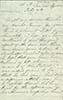
Malaga.—Lucy has been seasick. Discusses the religious situation in France, and deplores the effect of the Church on the character of the Spanish people. They have no definite news about the war.

—————

Transcript

Malaga.—Saturday 15th July—1876

My dearest Fred—You can’t think how glad we were to get our letters the other night. I thought my poor child would have gone crazy when we were kept rolling about in mid mediterranean and missed the boat from Almeria here. She got so weak from want of food and sickness that she fancied all sorts of things, and dreamt she had to leave the baby at 3 minutes to 9 on the 7th of July. The only thing she would touch at last was a couple of boiled eggs, because it seemed improbable that the filthy Spaniards could have got at the insides. The Pall Mall budget {1} was a great boon, and now an Englishman who feeds at the hotel has got me into the Círculo Malagueño for 8 days; it is a decent club and has a good many papers. I was amused at Greenwood’s remarks about Clémenceau and the religious irreconcileables—they are the pink of propriety and circumspection. He is no doubt right so far as he goes in calling it an “exaggeration” to attribute all our misfortunes to the Catholic Church; one might as well say the whole of our mortality comes from small-pox. But he is wrong in thinking that French liberals in the country are still to be “frightened” by statements of that sort; they are made daily, with more force and circumstance, by at least one paper in every town which is large enough to have a paper at all, and the Church is associated even in the minds of women with intrigues and conspiracies not merely against abstractions like liberty and the rights of man but against very present and concrete freedoms and conveniences of life. The “ordre moral” made itself thoroughly hated in its 3 years. There is some law which I don’t understand requiring authorization by the mayor of dancing at private parties exceeding a certain number. This authorization was given in the villages to friends of the clergy but refused to Republicans—and similar inconceivably petty tyrannies were practised everywhere. Hence the importance of the new municipal law. I believe that of 12 million adult men in France, 8 at least would have felt personal pleasure in kicking M. Buffet. At Avignon, a centre of reaction, I was buying a paper and asked if it was republican. “Ça sent beaucoup le clergé” said the old woman with a wry face and a shrug. “On n’observe plus que les fêtes du peuple” said the waiter at Marseilles when I asked if the band would play on ascension-day. The same thing holds throughout Algeria, except at Oran which is more than half Spanish. As for this country, I think it requires to be colonized by the white man. The savages would gradually die out in his presence. One sees here how God makes man through the instrumentality of his Holy Church, when He gets him all to Himself for some centuries. And a sickening sight it is. The mark of a degraded race is clear upon their faces; only the children have a look of honesty and intelligence, a fact which is also observed in the case of the negro, and is a case of Von Bär’s law that the development of the individual is an epitome of that of the race. It is instructive also to contrast the politeness fossilized in their language with the brutal coarseness of their present manners—of which I may sometime tell you what I will not soil paper with. I think it possible that one Spaniard may have told me the truth: he had lost so many teeth that he left out all his consonants, and I could not understand a word he said. When we went on board the Rosario at 11 p.m. the boatmen stood in the way to keep us from the ladder, and threatened us for the sake of another peseta over the regular charge. The steward tried to cheat me over the passage-money, but I appealed to the authorities who came on board at Malaga and got the money back. (There are many strangers here). Then he made another grab in the matter of our breakfasts, in the face of a tariff hung up in the cabin. It is tiring to have to think that every man you meet is ready to be your enemy out of pure cussedness. I don’t understand why one is expected to be polite and reticent about the distinction between the mixture of Hebrew piety and Roman universalism attributed to Jesus and Paul, and the ecclesiastical system which is only powerful over men’s lives in Spain, the middle and south of Italy, and Greece—countries where the population consists chiefly of habitual thieves and liars who are willing opportunely to become assassins for a small sum. I suppose it frightens people to be told that historical Xtianity as a social system invariably makes men wicked where it has full swing. Then I think the sooner they are well frightened the better. {2} We have no definite news here about the war. How would it do to add Hungary and German Austria to Germany, and make Austria into a Slav state with capital at Constantinople? The Hungarian freethinkers would balance the Austrian ultramontanes, and Russia would be well out of it. There is an Arab proverb that “where the Turk has trod the grass never grows”—but a good deal of ploughing and irrigation might efface his footsteps. Best love to Georgie & the little kid. I am now convinced that we are really the same person. À la libertad.

Thy
Willi

—————

{1} The Pall Mall Budget was a weekly paper, founded on 3 October 1868, containing a selection of articles from the Pall Mall Gazette. Cf. CLIF A4/14.

{2} ‘As for this country . . . the better.’ This passage has been marked off in pencil, square brackets being placed around the two sentences ‘One sees here how God … sight it is.’