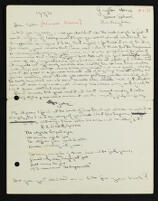
Folded sheet, 'Christmas Remembrance' and signature of Vishwanath Singh; on opposite page, image of cottage and hens.
'Greetings. Every Happiness, Every Blessing', signed by Vishwanath Singh.
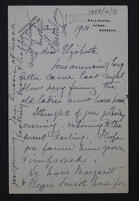
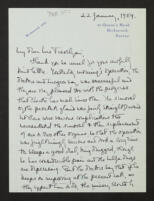
Wallington, Cambo, Morpeth. - Thanks Elizabeth for her long letter: 'the old ladies' must have been very funny. Hopes she found Julian well. Margaret and Reggie Smith are staying on their way north; he seems sensible and is going to travel to India and so on before 'settling down at the Bank'; Margaret 'has wonderful masses of red hair' which she wears in a strange style [a sketch illustrates this]. Hopes the weather will be good so they can have a picnic; Elizabeth and Robert were not fortunate with the weather for their visit, she loved seeing them and is glad they enjoyed themselves. Likes Robert's poem very much and so does Charlie. [Charles and Mary's] children came on Sunday, with 'little Steven Runciman'; Nora [Trevelyan?] has arrived 'so the Cambo "season" has commenced'. Hears there will be about six hundred people on the 'Liberal Excursion'; hopes they have good weather. Pantlin has gone with her cousin to the seaside. Mrs [Nora] Sidgwick is visiting next week. Hopes Mr Enticknap's journey home went well; she sees Gussie at work [in the gardens] 'looking busy and happy'.
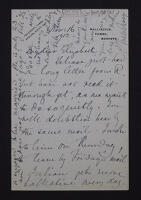
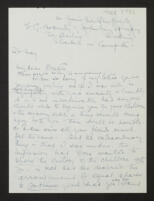
Wallington, Cambo, Morpeth. - They have just had a 'long letter from Robert' [in the East] but have not yet read it through; expects Elizabeth will also hear from him. Julian becomes ever more talkative. Miss [Charlotte?] Moberly has been to visit. The hounds are coming this morning; does not know whether Julian will get out as it is raining, but he will be able to see them in the yard from the window. She and Sir George are 'greatly distressed' about the 'shocking row' in the House [of Commons, on Home Rule]. Charlie was here on Thursday night; he has gone today with Mary to Alnwick to speak in the place of E[dward] Grey, who cannot leave London. Their children are coming today to see the hounds, then 'sleep and dine' at Wallington. Nora [Trevelyan] came to lunch and to say goodbye as she is leaving; she looked very shaky. Meta [Smith]'s eldest son Reginald is engaged; he is 23 and does not come of age till he is 25, so Meta will not have to leave Goldings till then. Mary is quite well now.
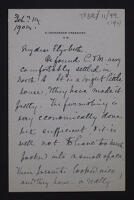
8, Grosvenor Crescent. - Found C[harles] and M[ary] settled at North Street, a 'bright little house' which they have made pretty, furnishing it 'economically' and suitably for a small space; their [wedding] presents looked nice, and they have an excellent book collection. Mary looks very contented, and 'Charlie's hair is curling as it has not done for a long time!'. One of the two small drawing-rooms has two pianos in; if they play them together their neighbours will think it noisy, but 'they are humble folk, & the children who swam in Westminster will come & listen in the street!'. George looks as if he needs a holiday; Caroline is glad the wedding is not far away, on 17 March. Janet looks very happy and says she is busy with her trousseau. Dorothy has returned and said to be 'much better for her journey'. Saw the H[enry] Y[ates] Thompsons yesterday; they start for Sicily tomorrow; Caroline will ask Mrs Cacciola [Florence Trevelyan] to let them see her garden. Asks whether Madame Grandmont [Bramine Hubrecht] would let them call on her; thinks she would like Dolly. Harry is telling people that Caroline and Sir George like their new daughters-in-law, but will not say 'either of them come up to Elizabeth in character or walking!'. Glad he has the right impression, though of course they will all have a 'separate place' in their hearts; Mary is good, sensible, and suits Charles, but 'needs a little polishing'.
If there are things at La Croix which would be suitable for a bazaar at Stratford, asks if Elizabeth could buy her two pounds worth; she can send them by post if she likes. Going today to see if they can find out about Aunt Margaret [Holland]'s health; fears it is her 'old trouble, clots'. Meta [Smith?] has reached Egypt; is said to be better. Very glad life at La Croix suits Robert's work. Caroline has found a cabinet at Stratford which she thinks will suit their new house; asks whether the work on that has begun yet.
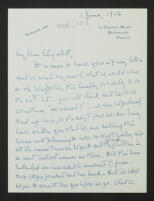
Monk's House, Rodmell, Lewes, Sussex. - Would not object to [Hsiao?] Chien using the 'extracts from the letters', and would like to look at the letters themselves 'sometime'. Is usually in London for a day or two a week, and would like to see Bob; as however he 'much prefer[s]' being in the country he 'pack[s] everything' he has to do in so tight that he rarely has time for anything else. Will let Bob know when he might be able to see him, but cannot do next week. Would like to come and see Bob and Bessie at the Shiffolds, but finds it 'very difficult to get away'; will let them know when it may be possible.
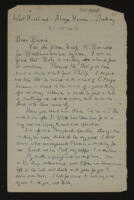
West Hackhurst, Abinger Hammer, Dorking. - Tells Bessie to 'keep the Boswell for Beethovenian cycles'; is glad that Bob is reading aloud from it. Pleased they had 'such a nice visit from [their grandson] Philip. I expect and hope that he cried on the chord of C because a chord is too much of a good thing at once, whereas a scale is just a lot of nothings-at-all in a row, and he could deal with them severally'.
Asks if she has heard how Hsiao Chen is; he wrote to Forster after Dr Bluth took him for an x-ray, and 'was hoping to avoid an operation'. Afraid Margaret's operation 'though not making her worse, did not do her any good'; does not know what arrangements Florence [Barger, her sister] is making for her. Understands that 'Evert and his Molly [Mollie Sinton, who married Evert Barger in Jan 1944]' are being very helpful.
His mother is 'fairly well and sends love'. Forster fears they have 'now left it too late and date in the year' for Bessie to visit; looks forward to coming to see her and Bob at the Shiffolds. Now has a copy of Trilling's monograph', and could lend it to her if she likes. It is 'an intelligent but almost overwhelmingly serious piece of work. It praises me for my seriousness; then censures me for my lack of seriousness... but when summing up it suggest that my very absence of seriousness may imply a seriousness far more serious than superficial seriousness'. Was 'rather difficult to know how to thank the author', but he is 'pleased with the book, and tried to say so'. His mother 'cannot read it for nuts [?]'. Has had 'several letters from America, and some tins of food'.
copy of poem by Ezra Pound which reminds John Cornford of Salaman's book
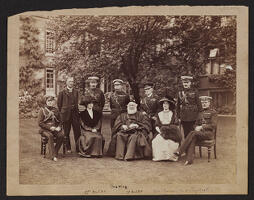
Photograph of King George V, H. Montagu Butler, Agnata Butler, Imogen Armitage Smith, and other men in uniform at the time of the King's review of the Cambridge alumni manoeuvres. Taken by Messrs. Stearn, Cambridge.
Metelliano. - Thanks Trevelyan for sending his "Plays": likes receiving this present 'from you and from England in such a moment of anguish'. Has finished translating G. M. Trevelyan's "British History in the Nineteenth Century" for Einaudi [see 5/88] and now must go over it; it will be with the publisher around the end of February. Has found work on it 'a relief'; likes the first part of the book better than the second and thinks the picture of 'old England' and the transistion due to the Industrial Revolution is 'masterful'. Discusses the notes he must add, particularly the quotations; asks if he could submit queries to Trevelyan, or directly to his brother, and outlines his thoughts on whether quotations should be translated [this section is marked with blue]. Saw Mary [Berenson] at I Tatti just after her return, cheerful though frail; B.B. [Berenson] and Nicky [Mariano] are now in Rome. Hopes Trevelyan is not anxious about Julian.
Beacon Hill School, Harting, Petersfield. - Was very glad to show Bessie's friends over the school and hear some news of her. Sees very few people, since the school 'takes up so much thought and time' and she does not dare leave it for too long or go far away. Always remembers the day they first met, since it was also the first time she met Bertie; they all thought then that the world would be better after the war. Supposes no-one will now see a 'cheerful and up-and-coming world' like the one she grew up in; at least they can take care of some young people. Having four children and a school makes her 'feel quite aged'. Asks if they see anything of Bertie these days.
41 Queen's Road, Richmond, Surrey. - Bertie's operation yesterday was successful, according to the doctors, and he has made good progress. There were some complications, so the operation was 'frighteningly serious and took a long time'. He will probably be in hospital for about three weeks. Will give him Bessie's letter to read when the 'haze of drugs and pain' has gone.
41 Queen's Road, Richmond, Surrey. - Is ashamed not to have written sooner: the summer "surpassed the most lurid imaginings of upsets and busy-ness' she could have had. Bertie has been incredibly busy with 'meetings and speeches, plans, discussions, articles and conferences both here and in Paris', while the difficulties with John led to 'a series of climaxes and horrors'. They took a house in North Wales in June, for the grandchildren and future holidays, having seen it once and fallen in love with it for its views; has had to work hard to furnish it and arrange for utilities. The children went in mid-July, and they joined them in mid-August 'for a glorious six weeks'. The 'nice Woods' [Alan and Mary], who are 'dears', brought news of Bessie. Is afraid they will not be able to get to the Shiffolds to see Bessie, but there are too many things Bertie must do; he is currently meeting the Austrian Socialist leader who is visiting the Austrian Embassy.
41 Queen's Road, Richmond, Surrey. - Wishes they could come to the Shiffolds, but 'as usual' they are too busy for the next few weeks; they are selling the house and preparing to move to North Wales, and also to put the children into a new school nearer there. They do hope to come and visit before they leave, hiring a car and also calling on Flora Russell at Albury. Have received a card for Mary [Fedden's] show at the Redfern Gallery and hope to get to it: have not seen her or Julian since the boatrace, and have never seen many of their paintings. Have not seen the Woods [Alan and Mary] since returning from Wales; is afraid they have had a difficult time but hope things are going better for them now. Encloses a blurb of a book of Bertie's ["Portraits from Memory and Other Essays"?] which she thinks may interest Elizabeth.
Plas Penrhyn, Penrhyn Deudraeth, Merioneth. - Bertie's throat is much improved, he has indeed had several operations under anaesthetic before. The Russells are very glad Elizabeth likes Bertie's BBC literary talks, and that she is well enough to go up to London for the day, even if it is to see the doctor. Wishes they could meet at Julian's Boat Race Party, but the Russells cannot go to town so soon, even if invited, and if Elizabeth is not they will have to make their own party. Had a very nice letter from Mary and Julian. Very good Elizabeth has an 'old companion' to help her to sort letters, which is a 'sad occupation' though she agrees it is 'bearable after a length of time'. Everything in Wales is very beautiful at the moment. Bertie is writing an article against the hydrogen bomb, having just finished a philosophical essay.
41 Queen's Road, Richmond, Surrey. - The Russells were sorry not to see Elizabeth at Julian and Mary's Boat Race Party; however, they enjoyed themselves and saw many old friends. Trying to sell the Richmond house; looking forward to going to the Welsh house for the children's holiday, as they hear the spring flowers are coming out and hope the Chinese geese are beginning to lay eggs. Bertie can get on with his work much better there than in Richmond. They will keep on the London flat and so hope a visit to the Shiffolds will be managed. The Woods have brought good news of Elizabeth; glad she coped with the cold spell. Bertie has been busy recently with the case of Morton Sobell; wonders if Elizabeth saw his letter in the "Manchester Guardian" last Monday [26 March]. The hope is to 'stir up opinion in this country' to force the U.S. authorities to act. The case, and others similar, provide 'a splendid quarry for Communist propaganda' which does 'much harm the world over'. Bertie has been getting letters asking him to take on their own case: a pity 'he is not a hydra and an octopus rolled into one, and with the energy of a hydrogen bomb to boot!'
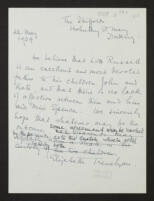
The Shiffolds, Holmbury St Mary, Dorking. - States the Trevelyans' belief that Russell is an 'excellent and most devoted father' to his children, and there is 'no lack of affection between them and him and Miss Spence'. Hopes that the arrangements made for the children's custody will satisfy both parents; this last statement is corrected from the hope that 'the parents may equally have a share in the custody of the two children'.
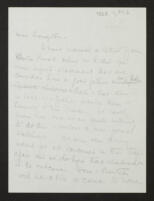
Has received a letter from Bertie Russell asking the Trevelyans to send a statement that they consider him to be a good father, and that there is no lack of affection between him, his children, and Miss Spence, to Llewelyn Davies. They hardly know her, but are prepared to do so, and encloses a more formal statement [see 5/291]. They are very sorry for all concerned, and hope that Dora and Bertie will come to an arrangement to share custody of John and Kate.
c/o G. Bottomley, The Sheiling, Silverdale nr Carnforth. - Is very sorry if her letter gave the impression that she was not in 'wholehearted sympathy' with Russell's anxiety over the divorce; it is 'inconceivable' to her that anyone should wish to deprive Russell of his children. She was under the impression that Dora wanted to share the custody of the children with Russell, having heard this through Ted Lloyd and C[lifford] Allen. Has not seen Dora for almost a year. The 'situation seems full of sadness' to her. Hopes that some solution will be reached; could not bear the thought of Russell being entirely separated from the children.
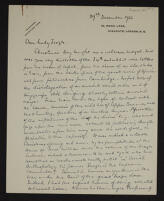
10, Wood Lane, Highgate, London, N.6. - On Christmas Day received a number of letters from Cambridge field workers, detailing disintegration of ancient social order in Nepal, hope of contact with the Lawa in Siam, and the importance of the divine king in Africa; has received the Frazer lectures volume and admires it: he says that caustic commentators declared the anthropologists did not understand Rivet's French but thought it beautiful, and the French students understood his French and thought his anthropology wonderful, whereas he enjoyed both.
Transcript
Hotel dos Estrangeiros, Rio de Janeiro
Thursday | 1912 Sept 19
My very dear Mother
We are still here at Rio de Janeiro; it is a most beautiful place, the weather is fine and pleasant, but progress is very unsatisfactory. The great characteristic of Brazil is “amanhã” (“tomorrow”) and the delays and muddles of the people who are supposed to be helping us are most vexatious.
The Arlanza arrived in Rio soon after dusk on Sunday. In some ways it was a pity to miss the sail up Rio harbour in daylight but the lights were very beautiful. It is a wonderful harbour winding about, with numbers of islands and mountains everywhere. The Sugar-loaf (about 1200 ft) is an extraordinary steep cone. It has far surpassed my expectations.
We remained on board till the next morning, as I had a Marconigram to say that we should be met the next day. At 8 o’clock Dr Moritze† (the director of Rio observatory {1} [)] and Lee (the Englishman deputed to help us) came on board; {2} after arranging about the instruments, they took us off in a government launch. We were photographed by the newspapers on landing, and then whisked off in a motor-car to this Hotel. It is the swagger hotel though not up to much according to English standards. The Government is entertaining us here—very happily for us—money here has roughly 1/5 the value it has in England. I had to pay 2/8d for a cake of soap. Washing a dress-shirt costs 2/9d, an ordinary shirt 1/–. Carriage of our trunks up to the hotel (for three of us) cost 16/–; the tram-fare for say 1½ miles is 5d; a small bottle of ginger beer is 2/–; apples about ¼ each. The only things admitted into Brazil free of duty are human beings and they have to pay a duty of 2£ to get out again.
The currency here seems very funny[.] I am carrying about in my pocket now over 800,000 reis so am nearly a millionaire. 1000 reis = 1/4½ but its purchasing power is about 3d according to our standards. I am told that the salary of an engine-driver on a railway is (in English money) £900 a year.
We called on Sir William Haggard the British Minister {3} on Monday morning and in the afternoon went with him to be presented to the Minister for Foreign Affairs {4}. Sir William is quite a pleasant man, and we are to go lunch with him today.
They are very eager to entertain us well; but have not taken the least trouble to help us with our baggage. Instead of bringing it off in a special lighter as they undertook to do, they let it get all mixed with the other baggage and go to the custom-house[.] I have spent hours hunting round after it, and Lee is no use or help at all. It was all unloaded yesterday and I watched the process; but they only sent with me a man, who could talk no French or English, so it was very difficult doing anything. Now they tell me a case is missing (though I am sure it was all there yesterday) and I have to go—again with a man who talks nothing but Portuguese—to hunt it up. This has meant another day’s delay. {5}
I have decided to go to Passo Quatro; it is quite a good place and not so far away as Christina or Alfenas. Moritze† is to be there too; he is very pleasant[,] talks English (the worst English I ever heard) and is really doing his best for us I think. The chief objection to Passo Quatro is that all the ministers, ambassadors, reporters and tag rag and bobtail will be going there; but I think we shall not really be disturbed by them. I should have gone to Alfenas, if I could have depended on Lee, but the difficulties are too great when one has no real assistance. {5}
We have been made honorary members of the Club Central here, which is very convenient, as we are a good way from the main city at this Hotel.
The trees and gardens about here are very interesting and the palm-tree avenues in particular are beautiful. I do not think there is any chance of our sailing from here until Oct. 23 and I am looking forward to having a week’s sightseeing and so on before leaving.
We have got English news now up to Sept. 2.
Please keep these letters as I have no other record of events.
With very dear love from
your affectionate son
Stanley
Later (evening)
I had just finished this when the Portuguese gentleman came to go with me to the Customs-house but I was very glad to see with him Perrine of the Argentine expedition, who landed yesterday, and whom I have met in England. He was a great help to us. We motored to the Customs-house and there I found my baggage was all there—nothing missing—so the lost case was a false alarm, and saw it loaded on trucks to be taken to the Station—so we are really getting on.
There was just time to get to Sir William Haggard’s in time for lunch. The other guests were the American Ambassador {6}, Birch the Secretary of the British Legation, Lee, Worthington and another man. These with Lady Haggard & her daughter and our three selves made eleven. It was a very pleasant party; the Haggards & the American Ambassador are very genial and nice. The inevitable newspaper photographer turned up and we had to submit.
After leaving them we went on to the Botanical Gardens, and spent an hour or two there; they are just lovely. Very few flowers, but the trees are wonderful—magnificent avenues of palms, and tropical bushes of all sorts. We shall certainly visit them again.
We may get away tomorrow evening; but I expect it is more likely to be Saturday. There is a break of guage† on the railway at Cruxeiro and the baggage has to be changed over on to another waggon there.
Your loving son
Stanley
—————
Numbered ‘5’ at the head in pencil.
{1} Henrique Morize was Director of the Brazilian National Observatory at Rio de Janeiro from 1908 to 1930.
{2} A vertical line has been drawn in pencil in the margin, probably to mark the phrase ‘and Lee … came on board’.
{3} Sir William Haggard, brother of the novelist Rider Haggard, was British Envoy Extraordinary and Minister Plenipotentiary to Brazil from 1906 to 1914.
{4} Lauro Müller, who was Brazilian Minister of Foreign Affairs from 1912 to 1917.
{5} A vertical line has been drawn in pencil in the margin by this paragraph.
{6} Edwin V. Morgan, US Ambassador Extraordinary and Plenipotentiary to Brazil from 1912 to 1933.
† Sic.

(Trinity College, Cambridge.)—Comments on Chandrasekhar’s summary of work on convection (A5/4), and relates an amusing incident connected with the recent visit of the Duchess of Kent.
(‘In Petty's list of his own writings … the entry “Verbum Sapienti, and the value of People” stands opposite the year 1665, and the internal evidence makes it probable that the booklet was written in the latter part of that year.’ (The Economic Writings of Sir William Petty, ed. C. H. Hull (1899), vol. i.))