

Zone d'identification
Cote
Titre
Date(s)
- 14 Feb. 1843 (Production)
Niveau de description
Étendue matérielle et support
8 pp.
Zone du contexte
Nom du producteur
Histoire archivistique
Source immédiate d'acquisition ou de transfert
Zone du contenu et de la structure
Portée et contenu
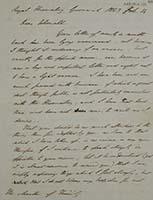
Royal Observatory Greenwich - He fully understands why Whewell should be so much attached to his own theory on tides. He strongly disagrees with Whewell 'that a fluid always tends to the condition of equilibrium and that this can be made in any way the base of a theory of motion. You would by this treat the theory of common waves (for instance) as that of water having a horizontal surface, and thus annihilate the waves altogether. Indeed I am rather surprised at this doctrine in general. When you come to particular cases, the inconsistency is remarkable. Perhaps the most curious of all the results of Laplace's theory (I mean of course with the unnatural assumption of uniform depth and no dry land) is that of the non-existence of diurnal tides; and this stands irreconcilable with your equilibrium deduction... The cases to which it will apply may be so exceedingly restricted as to be practically useless; (e.g. Laplace's uniform depth, or my canals); nevertheless the theory is so far right: the equilibrium theory could not be right under any restriction...When you say that Laplace's theory gives us no light which the equil. theory had not given before, it seems to me that there is a moral perversion; you think that success founded on false principles is at least as good as failure founded on true principles which are imperfect (in extent, not in truth). I must protest against such a judgement in toto'. He boils down Whewell's promotion of the equilibrium theory to the adverse effects Whewell thinks Laplace's theory would have on Cambridge students: 'I am free to say that the tone of my writings has been given by my vexation at seeing that you in every mathematical case and Lubbock in every case refer solely to the equilibrium theory'. He does not knock cotidal lines - 'they are the greatest advance yet made in systematically representing the observations of ocean tides, but I think them inapplicable in some cases: and especially when the well marked series of waves interfere'. He 'should be glad to lead on some attention to the theory of canal-waves with the conditions applicable to real rivers. First, I do not think that cotidal lines or mean levels can be made accurate till this is done, secondly, theory and observation can be compared to a very great extent here'. They (George and Richarda Airy) went to see a cliff blown down at Dover organised by the engineer, Cubitt. The Herschels also went [see The Illustrated London News, 4 February 1843].