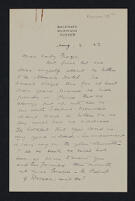
Barford, Churt, Farnham. - Bertie Russell has written to him about Trevelyan's tragedy ["Cecilia Gonzaga"], which he 'evidently enjoyed', saying that he quoted Murray as 'saying that blank verse was "played out"''; if someone had told Murray this when he had just finished a poem in blank verse, it 'would stick in [him] like a thorn!'. Is therefore writing quickly to say that all he meant was that he currently has a feeling that he does 'not know how blank verse ought to be written', and cannot write it himself without suspecting he is 'imitating some particular style - Tennysonian, Elizabethan, Swinburnian, Browningist'. Does not feel quite the same about heroic couplets, which 'after being ridden almost to death, has [sic] had a long time of neglect in which to get fresh again'. Blank verse is 'clearly best for a play'; sends best wishes to Trevelyan.
Agrees to continue to serve on the Political Honours Scrutiny Committee (see 3/100).
Correspondence.
Flood was based at the Institutt for Uorganisk Kjemi, Norges Tekniske Høgskole, Trondheim, Norway.
Re. Milman's memoir of Thomas Babington Macaulay.
Chemistry in Britain: Invitation to write obituary of Raphael Consden (declined). 1980.
CRC Press: Invitation to write section for CRC Handbook of Nutrition and Food. 1976.
Trade from Liverpool to India so bad that opportunities to send letters are few, birth of Henry Bickersteth Mayor, Edward Bickersteth travelling for Church MIssionary Society, Calcutta overstocked with English goods, have seen letters from Charlotte and Robert Mayor sent to others: Everton
18 Earl's Terrace, Kensington, London - Thanks him for letting them spend their honeymoon in his home.
Chronological continuation of the previous notebook [MS-101]. Contains some coded diary entries and at the front a note that on Wittgenstein’s death the volume should be sent to Leopoldine Wittgenstein and Bertrand Russell: 'Nach meinem Todfe an meine Mutter...'
Congratulations on engagement.
Typed copy. Chatby Camp, Alexandria. Has orders to embark.
(London Hospital, Whitechapel?).—Discusses Montagu’s appointment (as Chancellor of the Duchy of Lancaster). Hopes he will enjoy himself in Paris. Wants to see him when he returns.
—————
Transcript
Sunday Jan 31st 1915
You were right as far as dates go. I looked through my letters & I see that the first time it was mentioned was on Sunday 24th from Walmer {1}. Still I dont think that proves that it was entirely a plot of Lloyd Georges. I know the P.M has wanted to have you in for sometime. He’s very fond of you. He says in one letter “It is one of the few real pleasures one has to feel one can open the door, without any misgiving as to capacity or merit, to a really great friend”. I find I also did the old boy an injustice; {2} he never said he’d seen Mcnamara {3}. I do hope you’ll find there are some compensations for leaving the Treasury, tho’ of course neither I, nor anyone else wd think it strange for you to mind going. I am glad all the same because I am certain that you wont stick in the Duchy for long, & as I’m very ambitious for you(!) I welcome this step very greatly. But you mustnt let the P.M. put Addison in. It wd be too great an anti-climax.
I hope you’ll have a delicious time in Paris. I must see you when you come back & hear all about it. Perhaps Monday. Next time I have my day off I’m determined, if you can, to dine with you, get a “late pass” & try & win or lose a little money. Will you arrange that?
Yrs ever
Venetia
—————
Written in pencil, except for ‘real pleasures … door, with’, which is in ink. Probably written at the London Hospital, Whitechapel.
{1} The reference is to a letter from Asquith, dated 24 January. See H. H. Asquith: Letters to Venetia Stanley, No. 274.
{2} Semi-colon supplied.
{3} T. J. Macnamara, Parliamentary and Financial Secretary to the Admiralty.
Carbon copy of letter from R. A. Butler to Lord Evershed , 30 Jul. 1953
Written from Bonn.
The letter is 'addressed to the leading London newspapers' on behalf of various members of Cambridge University. Those to whom the fly-sheet is sent are requested to send their names at once to Henry Sidgwick if they concur the arguments set down in the letter. Explains that the Council of the Senate of Cambridge University, 'acting on the recommendation of the General Board of Studies, have proposed the appointment of a Syndicate to consider the expediency of allowing more widely than at present an alternative for either Greek or Latin in the Previous Examination' and that a number of residents 'have appealed to non-resident Members of the Senate to aid them in resisting all enquiry into this question.'
Sets out 'one or two reasons against this very unusual step'. Refers to the report of a Syndicate of eleven years previously, whose members included Dr Kennedy, the Professor of Greek, and which proposed the removal of the obligation on candidates for honours of studying both Latin and Greek on the grounds that the obligation of students to study both languages tends to exclude from the University a number of able students, educated in schools in which Greek is not taught.
States that since that time, with the development and extension of 'the "modern" system', about half the boys educated in the schools represented at the previous Headmaster's Conference 'are now taught only one classical language. Argues that with the obligation still in place, the University is prevented 'from receiving a number of boys thoroughly capable of profiting by academic study and training', while the time spent by other boys on both classical languages could better be spent on other subjects.
Asserts that the removal of the obligation, would not, as those who are attempting to block this move claim, result in an end to the study of Greek in all but the leading schools. Acknowledges the charms of Greek literature, 'its historic prestige, and its established position in the education of Europe', and claims that the teachers at Cambridge who desire this change 'certainly do not aim at the extinction' of the language. Refutes the argument that ignorance of Greek would injure all professions.
Adds that it is not proposed that the above considerations be taken as grounds for an immediate decision in favour of the proposed change, but merely as food for thought. Appeals to 'all open-minded Members of the Senate to assist...in defeating this attempt [to stop the proposed change].' Announces that voting will take place in the Senate-House on the following Thursday, 29 October at 2pm. The names of those on behalf of whom the letter is written are added at the end, added to which, in ink, appears the name of C.A.M. Fennell of Jesus College.
'Monetary reform in Turkey: The Commission's proposals'.
London Library - Captain Black has taken a ready furnished house at Hingham but intends to rent Donne's house at Mattishall, attitude of the people of Bury St Edmunds to his move to London
The electors of the Regius Professor of Divinity must look upon JCH's claims as weighty. WW will consider how to bring the question of separating the professorship from the living to the Trustees [see WW to CJH, 1 Nov. 1848]. He enjoyed his short stay at JCH's and had a good journey back to Cambridge.