
HOUG/220/102
·
Item
·
1851
Part of Papers of Richard Monckton Milnes, Lord Houghton
4485 results with digital objects
Show results with digital objects
MONK/B/102
·
Item
·
1 Aug 1846
Part of Papers of the Monk and Sanford families
TRER/9/102
·
Item
·
12 Jan - 13 Jan 1900
Part of Papers of Robert Calverley Trevelyan and Elizabeth Trevelyan
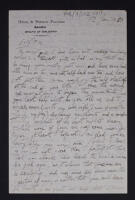
Hotel & Pension Palumbo, Ravello, Golfo di Salerno. - Has been 'out composing verses in a tempest'. Glad she is having happy dreams; suggests analyses for her one about the cicalas [9/26]. Quotes from Moore on sleep [Thomas Sturge Moore, "To An Early Spring Day"]. Sorry that her aunt's recovery is not speedier. Will send a letter to her tomorrow. Does not like Mrs Costelloe 'in many ways', but does not condemn her for 'refusing to live with Costelloe' who seems to have been 'almost impossible to live with', though she should not have been 'taken in' by him; thinks her and [Bernard] Berenson's relationship is 'as nice as those sort of relations can be'; discusses her influence on him. Supposes he will see Miss D. G. [Lina Duff Gordon] at Florence; explains the nature of their friendship further. He and Lina are on 'very good terms' again, and she likes his poem about her pet bat ["The Lady's Bat"], though it is not yet finished.
Continues the letter next day; has read most of the editor's letter in the paper sent by Bessie's uncle [in a Dutch paper, to the Duke of Devonshire, see 9/26]; thinks he is 'in the main right' but knows 'little of the facts, except what he has gathered from English writers who disapprove of the [Second Boer] war' such as Bryce, Hobson, Lecky and Courtney; since he has 'ornamented his columns with many not very apt quotations' Bob as a poet ought not to be too hard on him. Thinks he will spend two days with Berenson at Florence, since it is unlikely Mrs Costelloe will be back; has not yet heard from his mother about crossing with Bessie and the letter may not have reached her. Asks him his plans suit Bessie. Is torn between Venus and Apollo, and 'Apollo has all the nine young ladies [the Muses] on his side'.
CHIL/2/102
·
Item
·
4 Nov. 1908 [original]
Part of Papers of Erskine Childers
Headed 'Letter from Erskine Childers to Earl Roberts'.
CHIL/2/102
·
Item
·
2 Jul. 1903
Part of Papers of Erskine Childers
38 Berkeley Square, W. - Signed with Rosebery's monogram.
TURN III/A/8/102
·
Item
·
19 Jan. 1840
Part of Correspondence of Dawson Turner, Sir Francis Palgrave, and Hudson Gurney
Add. MS a/244/102
·
Item
·
16 July 1842
Part of Additional Manuscripts a
56 Green Street - thanks him for his present
DAVT/A/102
·
Item
·
1942
Part of Papers of Harold Davenport
O./10a.12/102
·
Part
·
13 Nov. [1878]
Part of Manuscripts in Wren Class O
Villa Syracusa, Torquay.
SMIH/91/102
·
Item
·
21 Oct. 1910
Part of Papers of Sir Henry Babington Smith
SMIH/95/102
·
Item
·
5 Dec 1911
Part of Papers of Sir Henry Babington Smith
CHIL/1/102
·
Item
·
7 Dec. 1910
Part of Papers of Erskine Childers
24 Bilton Road, Rugby. With note in Molly Childers' hand at top: 'To my mother'.
HOUG/36/102
·
Item
·
[1840 or later?]
Part of Papers of Richard Monckton Milnes, Lord Houghton
Has declined offer of Chancellorship of the Exchequer; proposed himself as Secretary at War but Perceval has written to invite Robert Pemberton Milnes to join government and cannot act until Milnes' preferred office is known. Understands importance of securing Milnes as a 'doubtful friend, who might be of essential service to our cause'; would willingly take a seat at the Treasury if denied War Office.
Copy in unidentified hand.
HOUG/41/102
·
Item
Part of Papers of Richard Monckton Milnes, Lord Houghton
HOUG/22/102
·
Item
·
18 Sept. 1865
Part of Papers of Richard Monckton Milnes, Lord Houghton
RBTN/A/7/102
·
Item
·
5 Jun 1930
Part of Papers of Sir Dennis Robertson
BELL/6/102
·
Item
·
[3 Feb 1937]
Part of Papers of Clive Bell

PETH/6/102
·
Item
·
1905?
Part of Pethick-Lawrence Papers
TAYL/A/102
·
File
Part of Papers of Sir Geoffrey Taylor (G. I. Taylor)
Includes letter to Julian from W.B.L. Trotter, 1914 and letters to Taylor from Julian, 1919, 1956-61. Press-cuttings, and order of Memorial Service after death of Julian Taylor, 1961.
Add. MS a/202/102
·
Item
·
5 Dec. 1845
Part of Additional Manuscripts a
7 Camden Street and Town - Asks him to write a notice of [Henry] Coddington to include in the Annual Report of the Astronomical Society. He is aiming for fuller biographies and worries 'that unless we can get all our Fellows to interest themselves, we stand a good chance of losing our existence. Every person who can be quoted as having done any work for us is strength just now, when Baily's [Francis Baily] loss has thrown us upon ourselves'.

Add. MS a/207/102
·
Item
·
22 Jan. 1862
Part of Additional Manuscripts a
Collingwood - Thanks WW for his Plato Vol. 3 [WW's trans. of Plato's Republic, 1861]. JH gives his reply to WW's observations on the beginning of JH's translation of the first book of Homer's 'Iliad' [see JH to WW, 12 Dec. 1861].
O./10a.13/102
·
Part
·
8 Dec. 1879
Part of Manuscripts in Wren Class O
8 Charles St [on embossed Athenaeum Club notepaper].
Add. MS a/206/102
·
Item
·
28 Mar. 1840
Part of Additional Manuscripts a
2 Brook Street - HH has received another of WW's proof sheets [The Philosophy of the Inductive Sciences, Founded upon their History, 2 vols., 1840]: 'I still think there is a little too much of foreign cast given to the subject [Physiology]'. He agrees with WW that Muller's [Johann Muller] physiology is the best work, but in drawing exclusively from foreign writers WW will 'weaken the repute and claims of the English physiological school, especially with those who are fresh to the subject'.

PETH/5/102
·
Item
·
19 June 1957
Part of Pethick-Lawrence Papers
India House.—The flu prevented her from conveying personally to the Pethick-Lawrences her brother (Nehru)’s invitation to India, but he will probably mention the matter himself when he comes to London in a few days’ time. Suggests arrangements for a meeting at India House.
Add. MS c/82/102
·
Item
·
12 June 1874
Part of Additional Manuscripts c
Presenting a book on Central Asia written in Germany.
CORN/I/4/102
·
Item
·
n.d.
Part of Papers of F. M. Cornford
difficulties with political work in a new place, finds teaching dull, feels her energy is wasted
RAB/B/33/2/102
·
Item
·
20 Oct. 1963
Part of Papers of Lord Butler
RAB/B/6/102
·
Item
·
31 May. 1929
Part of Papers of Lord Butler
RAB/B/8/102
·
Item
·
1 Oct. 1932
Part of Papers of Lord Butler
Enclosing letter from the London Electricity Supply Co. to Lord Gainford on electricity supplies in the Saffron Walden area. With carbon copy of letter from R. A. Butler to Lord Gainford, 4 Oct. 1932.