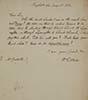
Hotel de Paris, Benares. - Found his father's letter here when they arrived yesterday, after almost two weeks at Chhatapur as the guests of the Maharajah, a 'very charming and cultivated man'. Stayed longer than planned since [Goldsworthy Lowes] Dickinson was unwell for a few days due to 'indifferent food'. Has been very interesting to observe the governance of a 'native state' which the Maharajah left entirely to the Diwan or chief minister, a Brahmin and a 'very enlightened and able man' who is engaged in reform; they befriended him and the rajah's private secretary who was also chief judge, 'a Moslem and a very fine type, from the Punjab' [M. Fazal i Haq?]. Unlike the Punjabi Muslims he had met, he wishes there could be friendship between Muslims and Hindus and believes it would be possible if both sides made 'certain concessions'.
They made several expeditions to see temples and palaces while there, and found the countryside more beautiful than anything else they have seen since leaving Bombay, so it perhaps does not matter that they did not as first planned go to Jaipur and Udaipur. Tomorrow they will 'go to see the pilgrims bathing and praying on the Ghats'; [originally] enclosing a photograph of one of the main ghats; the ruined palace in the foreground collapsed about twenty years ago; thinks the other photograph looks 'Italian'. Expects his father saw Benares when he was in India. They will probably go to Goya for two nights on 18 December, then on to Calcutta for a couple of weeks or more before going south to Madras; they may pay a short visit to Darjeeling. They have now given up the plan of going to Burma, for which there is not sufficient time. Bessie seems to have been happy in the Netherlands; expects she will have fetched Julian from Wallington by now; very glad to have had 'such good accounts of him' from her and his parents. Is writing with a champak [flower] bud on his table, whose 'odour perfades [sic] the room, and is worthy of its lyrical fame'.