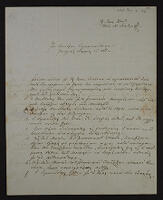
The Holy Mountain of Athos. - On the claims of Simonides to have written the Codex Sinaiticus.
With part translation by Wilkinson. Ends 'This much about Simonides, who I can tell you Sir is a liar and an impostor, witness his acts'.
The Holy Mountain of Athos. - On the claims of Simonides to have written the Codex Sinaiticus.
With part translation by Wilkinson. Ends 'This much about Simonides, who I can tell you Sir is a liar and an impostor, witness his acts'.
Poems, invitations, etc.
Everingham. - Delighted to accept invitation to Fryston, where he always feels 'less gagged about the Pope & Cardinal [Wiseman?]' than elsewhere; cannot second his friend Arthur Duncombe's nomination for the Riding on account of disgust at religious measures in Parliament. His deep opposition to the Ecclesiastical Titles Bill; ridiculous attempts of the Church of England to exert spiritual authority when it is merely a political engine. Glad to hear of Milnes' son Richard's happy match.
24 Ladbroke Gardens, Notting Hill, W. Dated 13 July, 1904 - Thanks him for his letter and continues the discussion of the belief in the tribal all father, including mention of the 'mungan-ngaur' among the Kurnai; regrets he did not discuss this matter with [Baldwin] Spencer and does not see why Frazer should excuse Spencer's letter; his daughter [Mary] has been helping him go over the proofs but is sure there will be something overlooked when they receive the revise; with a page with an addition to the text [of his book 'The Native Tribes of South East Australia'] about the all father.
West Melville, Northam, N. Devon. - Has been looking at the Christmas books Bob has sent them between 1944 and 1947 ["From the Shiffolds"]: feels sure they 'contain some of the best' of Bob's work, and is 'very glad indeed to have them'. It is a 'partial relief... to turn to poetry from the tremendous and shattering events' of the time, of which 'many people seem so unaware'. Thinks the world is at a crisis, but is 'not without hope'; has just read Jung's latest book of essays, "On Contemporary Events", which he is sure would interest Bob. Jung has a 'wide and deep vision'; believes he is right that 'the best we can do is to look for The Shadow in ourselves', though it is very 'easy to project it onto others'. Would like Bob to listen to his wireless talk on the [BBC] Third Programme on 17 January, about the books of Karen Blixen. She knows 'in her own intuitive manner almost as much about life, both conscious and unconscious, as does Jung by other methods'; he believes she is a 'genius', and no longer hesitates to 'make extravagant claims for her'.
Is envying Bob's classical scholarship particularly at the moment: has always wanted to write a novel about the first century and is now beginning work on it. Plans to 'start on Appolonia [sic'] before moving scene to Cyprus, Palestine, and the West African Coast, so will have to do 'quite a lot of reading' on background, geography, politics, and 'the relatedness of ideas, Neo-Platonism, Gnosticism, and Hebrew sects, with perhaps influence from Egypt coming in'. Bob will think him 'a very rash man, and ignorant to be so rash'; wishes he could 'drop in' for a talk with him. Sends best wishes to both Trevelyans.
Mill House, Westcott, Dorking. - Thanks his father for his letter [12/76], and the '[obituary] notice of the poor silent fogey [Sir Joseph Crosland]'. Remembers the fogeys, and the amusement they gave, very well, but not where they met them; has a 'vague recollection that it was at some English sea-side hotel, perhaps in Yorkshire', but it may well have been abroad. Expects Crosland 'felt very much out of place in the House, and may have been glad to be turned out'; he 'seemed a kindly old fogey', and Robert can 'well believe that, in the stately phrase of the Times, he was "generous to a degree"'.
His father's letter to Paul [Hubrecht] has just arrived and will be forwarded; thinks they [Paul and his brother Jan] both much enjoyed their visit to Wallington; Jan was here for two days, and they went over to the site on Sunday with him. The foundations [of Robert and Elizabeth's house] are about finished, and as far as can be judged the work seems very good; they will meet the architect there soon to make some plans about the garden, which will not be big but require thought as it is 'all on a slope'.
Has left [Turgenev's] Dmitri Roudine at Wallington; asks if it could be sent back to the library once his father has done with it. He and Bessie are both very well, and much enjoyed their time at Wallington 'in spite of the doubtful weather'; it was an 'additional pleasure to see Charles and Molly so happily settled'. Hopes his father is still getting on as well with his book; liked reading the two sections he gave him, and 'thought them everything that could be desired'. Bessie thanks both Robert's parents for their letters, and will 'write directly'; they both send their love.
Downside Abbey, Stratton-on-the-Fosse, near Bath.—Thanks him and his family for a pleasant weekend and describes his return journey. Sends postcards of the choir [at Downside]. Hopes he will find Victor White interesting. Suggests that Blackwell’s may have the numbers of Scrutiny he needs. Will pray that he gets a post which will keep him in Cambridge.
3 Essex Grove, Upper Norwood, S.E.19., 1er Janvier 1925, 3 heures du matin - Sends birthday wishes and congratulates Frazer on the news which he read in proofs the night before; congratulates Lady Frazer as well, as having been indispensable to him.
Five original poems by Frazer and two translations of poems by Heine. There are three copies of "Dreams": a manuscript in Lady Frazer's hand, a fair copy, and a typescript copy. There is a fair copy, corrected of "And the reapers bind their sheaves", a fair copy, corrected, and typescript of "Whispers of the Nile"; a typescript, corrected with the date of 11 June 1921 of "To My Wife"; a typescript with date 1936 of "The Keys of Janus' Temple", accompanied by an envelope; and fair copies, corrected, and typescript of a translation of two poems from Heine, "Du bist wie eine Blume" and "Wo?"
48 Croftdown Road, London - Asks his opinion on the use of 'cauda plena' and 'cauda vacua' in reference to a processional dragon mentioned in notes on a sermon preached on Rogation Monday in 1346.
RJ has just got a letter from John Herschel 'begging me to come to him at once and I am hurtling to change all arrangements and to be off in 1/2 an hour. I guess it is about South [James South] whom he allows to agitate him and I hope to calm him'. RJ gives some type errors he has spotted in the work WW has sent him ['The Elements of Morality, Including Polity'?] . RJ agrees 'with almost all your poor law practical views - You know I do not agree with you in thinking the state a moral agent unless very careful distinctions are drawn between our sense of moral obligations as members of a state and as individuals and it would be useless to embark in that controversy'. RJ can 'see nothing to find fault with except perhaps that you speak too confidently about the feudal element derived from the manners of the tribes - much of the feudal coloring has been thrown back I suspect by later writers'.
WW entirely agrees with JCH's reply to Milner on the subject of the application for a commission to inquire into the University: 'such an interference might do much harm but would not be likely to produce any good. As to Lyell [Charles Lyell], who is I believe one of the main movers in the business, I look upon him as the most bigoted of men in what relates to the Universities. You may judge of this from knowing that he holds the Universities to be entirely wrong in their arrangements, because the same persons lecture both in classics and in mathematics. This he has published in his Travels in America (by way of an appropriate channel) as the great evil of Cambridge and Oxford: and though I tried to set him right in my last book about our studies, he will not believe that the fad is otherwise'. WW has seen the first issue of 'Politics for the People' but does not yet 'catch the object or hopes of the conductors'.
Bolt Court. "Send me five pounds"
The Athenaeum Club - WW met Charles Babbage on the road to Cambridge: 'He is resolved to give his lectures sixth week, in as much as they are finished and just about to be published in the Encyc. Met. [Encyclopaedia Metropoliatana]. They will contain I conceive the views which you want from him of the economical laws of the division of labour &c. He will not make any great approximation to a conformity with established rules by thus delivering his lectures in what is practically vacation and without any notice.
'It is as you say quite a scandal that no ascent has been made for scientific purposes since that of Gay Lussac. Though I hope when you see my paper on Refraction you will admit that this problem is nearly put at rest, for I make observations of steam, vapour of Alcohol and confirm my law of the connexion between pressure and temperature, which is quite different from what has been supposed'. JWL has had a long discussion with the aeronaut Mr Green: 'It would not do to set about the thing with less than £1,500 [to make a balloon to investigate the atmosphere?]. JWL is annoyed at John Herschel for leaving out all notice of his work on lunar theory in his address to the Astronomical Society.
[Sent from Clifton]:- Announces that he has just arrived in Bristol, having left the Pauls the previous day. Reports that Mrs Paul asked after his mother. States that he enjoyed his visit there and in London. Remarks that Paul has got very nice children. Reports that Mrs Symonds has just had a little girl [Madge], but that he has been assured that he is not in the way. Refers to his mother's last letter in which she had discussed views on religious subjects. Believes that 'English religious society is going through a great crisis...and it will probably become impossible soon to conceal from any body the extent to which rationalistic views are held, and the extent of their deviation from traditional opinion.' Refers to the fact that the Ritualists 'are determined to burn altar lights after all.' Would like the Church 'to include the ritualists'. Reports that Noel has brought out a volume of poems, which he undertakes to send to her. Asks her to tell Arthur that he has 'nearly evolved both the major and the minor premiss [sic] of [their] practical syllogism', and that 13 February is the 'Ad Eundem day', and that he is to write to Reynolds.