Re memorial to Robert Burns
29 Eaton Place - Mr Hopkins' [William Hopkins] paper on cracks in the crust of the Earth's surface is a big disappointment: 'With respect to the hypothesis of a crust, in contact with an interior fluid it appears to me a state of things which could not subsist. Unless they be in contact and continue so, the fluid would exert no pressure against the crust. If they were once in contact the slightest irregularity in their expansibilities by heat would make this condition cease, and the higher tides, which would never amount to above a few feet, would never reach the crust'. JWL hopes WW will write something upon the tides as a whole.
Paris, 18, rue Cuvier - Thanks him for his nice note about his book on Charles Perraud; he doubtless knows that the Bishop de Nevers is suing him, saying that he published without his authorisation; regrets he cannot give him more information on Charles Perraud's 'Méditations'; has commenced a biography of Père Hyacinthe [Charles Loyson], but the problem with Perraud is impacting his ability to get permission to use documents.
Was 'made a walker alone' last Monday, as were Bramwell, [Frederick Pethick] Lawrence, Holt and Whitelaw; walked with Smith and Whitelaw today. Mr Viner has lent him "The Ladies in Parliament" [written by Robert's father]; thinks "Horace at Athens" is 'so funny'. They will have fun at Eastbourne at Easter. Is getting on well. Wrote to Grandpapa P[hilips] and to Archie this morning. They went to church this morning.
Wallington, Cambo, Morpeth. - Has had a 'good reply' from [Alfred George] Gardiner, who agrees with George, and 'has not only undertaken to edit Geoffrey [Winthrop Young] in future' but has instructed his subeditors to watch out for 'passing doubtful "atrocities"' [see also 14/96].
4 Avenue du Square, Villa Montmorency (XVIe) [on mourning paper] - Her husband Adolphe is pleased to subscribe to the bibliography, but he has not been a member [of the French parliament?] for some time and cannot command the librarian; looks forward to seeing her at her hotel.
Kings College Cambridge [headed notepaper). - Asks if she would be free on Thursday 9th; if so, would 'very much like' to visit for lunch, to see her and 'talk about our talks on the 20th [at the ceremony to mark the opening of Robert Trevelyan's memorial library at Birkbeck'. Fears he would have to return in the afternoon. If that is not convenient, perhaps it would suit her to meet another day in London.
Is doing a broadcast on Bayreuth, and 'must tidy up my script! Florence [Barger] has gone off to America!"
West Melville, Northam, Devon. - Thanks Bob for his poens [this year's "From the Shiffolds"], particularly the poem to Goldie [Lowes Dickinson]. Likes the 'questioning in them all, and what seems to be the answer in the translation of Menander 550', which is of course 'vague'. Feels himself that it is a mistake to look for 'a goal to be fulfilled in this time-space we live in', and that 'Good and evil are always about balanced', so that it is not possible to 'build the kingdom of Justice and happiness'; is tempted to write an essay on injustice being 'the inevitable fate of man'. Thinks he must come and stay at Peaslake in the spring, and visit Bob and Bessie, so they can discuss all this. He and Katharine are living quietly, and like their home. Is finding things difficult financially since his books are 'held up so long in the publishing process': was meant to have two books out this year, now one will appear in January, and he only has a date of 'the autumn' for the other. Is now trying to write a 'very long and ambitious novel' about the first century, doing lots of 'interesting reading'. Thinks he will take the first six lines of Bob's Menander translation as his epigraph, with the theme being 'Lux, post has tenebras: tunc omnibus omne patebit" [After these shadows, light: then everything will be revealed to all (Latin)]. Finds life very interesting, and hopes that as in the story of Lot there 'may be enough for us to escape the fate of Sodom'; even if not, believes 'Life is always victorious' eventually.
Concerns Of the Plurality of Worlds.
Accompanied by notes about Stephen.
New Castle, Penna. U.S.A. - Wishes him a happy birthday, writes admiringly of 'The Golden Bough'.
Does not wish to intrude upon Nora, but wishes her to know what a real personal sorrow she feels at the death of Henry Sidgwick. It was he more than any other person who made Cambridge what it was and is to her: 'a source of the best sort of inspiration', which she got from his lectures. Says that he made her love him personally, 'as well as almost reverence him.' Adds that her husband wishes Nora to know that he too 'had all this feeling for Dr. Sidgwick'.
Sanger, Anna Dorothea (1865-1955) wife of Charles Percy Sanger'Human Infection with Simian Foamy Viruses in Africa'.
Meeting No.15
Agenda, Minutes.
Meeting No.16, 28 March 1956.
Agenda (with ms. notes by Thomson), Minutes.
Meeting No.17, 31 July 1956.
Agenda, Minutes, 3 pp. typescript re work in progress at A.E.I.
Lacock Abbey, Chippenham - Talbot asks who to contact concerning membership to the British Association for the Advancement of Science, as the next meeting will be held near him. He is engaged in preparing a mathematical paper for the Royal Society, on the Integral Calculus, offering a solution to the problem of finding an algebraic sum of a series of integrals like ƒφ(X) αγ where φ is any function whatever of the rational polynomial X. He notes that George Jerrard has proposed a solution of algebraic equations of the 5th degree and recommends it be put to the test; and a solution in Gergonne's Annals by a Swedish officer of an equation that has no demonstration appended and therefore appears to have been ignored.
Account of visit to Coppenhall and Acton: Coppenhall
Collingwood - JH encloses a note he got from George Airy with a suggestion identical to the course JH 'had prepared to take having first written to the Sec. of the B. Assoc. to enquire with whom we are to communicate on their part'. If WW and Peacock approve he will write to Edward Sabine accordingly. Has WW any 'ideas' generally on magnetic observations: It strikes JH that a great deal of the existing machinery could be dispensed with and 'what we now need is in the nature of magnetic surveys, with a few fixed establishments to keep up connexion between the past and future'.
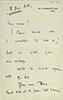
87 Clement’s Inn, W.C.—(8.30 a.m.) ‘I came back cos I wanted to see e! but so glad you are asleep. Will be back again about 9.45.… Don’t look at the papers till I come.’
Flamsteed House, Greenwich - GA has received a letter from his wife: 'With one day's roughness the voyage had been very smooth. They had scarcely any sickness, but Mrs Airy had suffered constant nausea; and they seem weary of the voyage' [see GA to WW, 20 November 1851].