
MONK/C/3/1
·
Pièce
·
29 Jan 1855
Fait partie de Papers of the Monk and Sanford families
4483 résultats avec objets numériques
Afficher les résultats avec des objets numériques
MONK/C/5/1
·
Pièce
·
23 May 1859
Fait partie de Papers of the Monk and Sanford families
MONK/C/7/1
·
Pièce
·
n.d.
Fait partie de Papers of the Monk and Sanford families
MONK/C/13/1
·
Pièce
·
7 Apr 1873
Fait partie de Papers of the Monk and Sanford families
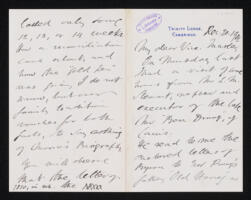
R./2.40A/1
·
Pièce
·
20 Dec. 1902
Fait partie de Manuscripts in Wren Class R
Trinity Lodge, Cambridge.—Encloses six letters (2–7) written by Lord Byron to Henry Drury, which have been bequeathed to the college by the son of the recipient.
—————
Transcript
Trinity Lodge, Cambridge
Dec. 20. 1902
My dear Vice-Master,
On Thursday last {1} I had a visit of some hours from Mr L. M. Stewart, nephew and executor of the late Mr “Ben Drury,” of Caius {2}.
He read to me the enclosed letters of Byron to Mr Drury’s father, “Old Harry” as he was called at Harrow, a Son of Dr Joseph Drury the Head Master.
He left out one sentence in one letter about the Turks, which he told me was disgusting {3}, and I have not seen it.
The letters date between 1807 {4}, when the Hours of Idleness were published, and 1815 soon after Byron’s Marriage.
As there are numerous references to my Father, it may be well just to point out that my Father succeeded Dr Drury at Easter, 1805, and that Byron left the School that summer, i.e. I suppose, at the end of July. Consequently, their relation as Master and Pupil lasted only some 12, 13, or 14 weeks. How a reconciliation came about, and how the “gold pen” was given, I do not know, but our family tradition vouches for both facts, to say nothing of Moore’s Biography.
You will observe that the letter of 1810, in wh. the {5} reference to the “gold pen” occurs, describes the famous swim from Sestos to Abydos, and adds—what I had either not known or forgotten—that the swimmer had made a previous attempt which failed.
May I ask you and Dr Sinker kindly to take Charge of the letters, which Mr Benjamin Drury bequeathed to our Library, and to consider where and in what form they may best be kept. The fact that they are a bequest should be specially recorded.
Perhaps it might also be recorded that Dr Joseph Drury, the Grandfather of the Testator, was himself a Trinity man. His Son, “Old Harry,” to whom Byron wrote the letters, was at Eton and King’s.
I am, my dear Vice-Master,
Most truly yours
H. Montagu Butler
—————
2 folded sheets.
{1} The 18th.
{2} Benjamin Drury’s sister Emily (1813–1902) married Stewart’s father, Lestock Wilson Stewart (1824–1876), an army doctor, in India in 1852.
{3} See the letter of 3 May 1810 (R.2.40A/4). Stewart may well have omitted more than one sentence.
{4} The earliest of the letters (R.2.40A/2) in fact dates from 13 January 1808, but it was misdated 1807.
{5} ‘1810’ struck through.
MONK/A/1
·
Série
·
1808–1855
Fait partie de Papers of the Monk and Sanford families
MONK/A/4/1
·
Pièce
·
16 Jul 1809
Fait partie de Papers of the Monk and Sanford families
HOUG/B/Q/42/1
·
Pièce
·
[n. d.]
Fait partie de Papers of Richard Monckton Milnes, Lord Houghton
TURN III/A/6/1
·
Pièce
·
1889 x 1890
Fait partie de Correspondence of Dawson Turner, Sir Francis Palgrave, and Hudson Gurney
Marked with the number ‘2’ and labelled by R. H. Inglis Palgrave as follows: ‘Letters, perhaps not so important as those in the other parcel, but also very useful in explaining the early history of the writer.’
TURN III/A/7/1
·
Pièce
·
29 Dec. 1833
Fait partie de Correspondence of Dawson Turner, Sir Francis Palgrave, and Hudson Gurney
TURN III/A/11/1
·
Pièce
·
1 Nov. 1851
Fait partie de Correspondence of Dawson Turner, Sir Francis Palgrave, and Hudson Gurney
TURN III/A/12/1
·
Pièce
·
25 Mar. 1845
Fait partie de Correspondence of Dawson Turner, Sir Francis Palgrave, and Hudson Gurney
TURN III/A/23/1
·
Pièce
·
17–22 Mar. 1838
Fait partie de Correspondence of Dawson Turner, Sir Francis Palgrave, and Hudson Gurney
TURN III/A/25/1
·
Pièce
·
10 Jan. 1835
Fait partie de Correspondence of Dawson Turner, Sir Francis Palgrave, and Hudson Gurney
TURN III/A/27/1
·
Pièce
·
9 June 1835
Fait partie de Correspondence of Dawson Turner, Sir Francis Palgrave, and Hudson Gurney
TURN III/A/28/1
·
Pièce
·
c. 27 Oct. 1851?
Fait partie de Correspondence of Dawson Turner, Sir Francis Palgrave, and Hudson Gurney
TURN III/A/30/1
·
Pièce
·
26 Jan. 1814
Fait partie de Correspondence of Dawson Turner, Sir Francis Palgrave, and Hudson Gurney
TURN III/A/31/1
·
Pièce
·
5–6 Oct. 1834
Fait partie de Correspondence of Dawson Turner, Sir Francis Palgrave, and Hudson Gurney
TURN III/A/35/1
·
Pièce
·
20 Jan. 1849
Fait partie de Correspondence of Dawson Turner, Sir Francis Palgrave, and Hudson Gurney
(A small cutting from the Overland Englishman is pasted inside.)
HOUG/D/C/3/9/1
·
Pièce
·
30 Nov. [1858?]
Fait partie de Papers of Richard Monckton Milnes, Lord Houghton
The Knoll. - Sending papers [no longer present] on behalf of her aunt Harriet, who cannot intervene with Government on behalf of John Saunders owing to previous refusal of a pension; will Milnes forward the papers and destroy letter to her aunt. Harriet Martineau's feeble health.
Enclosed: letter from Katherine Saunders to Harriet Martineau, [Nov. 1858?]. St. Mary's Grove, Richmond. - Financial struggles of her husband, who has been deprived of work on the Railway Guide; could Martineau induce Bulwer Lytton or Milnes to approach Lord Derby? Her husband gave a successful lecture at Leeds but was too exhausted to appear at Manchester; his play has been his only consolation amid many disappointments. Encloses copy [no longer present] of letter sent to Derby through Bulwer Lytton. (2 ff.)
BACH/C/1
·
Dossier
·
1946
Fait partie de Papers of G. K. Batchelor
GOW/A/3/1
·
Pièce
·
1962
Fait partie de Papers of A. S. F. Gow
GOW/B/1
·
Dossier
·
1933-1951
Fait partie de Papers of A. S. F. Gow
GOW/B/4/1
·
Pièce
·
1931
Fait partie de Papers of A. S. F. Gow
GOW/B/6/1
·
Pièce
·
[n.d.]
Fait partie de Papers of A. S. F. Gow
GOW/B/7/1
·
Pièce
·
1928?
Fait partie de Papers of A. S. F. Gow
GOW/B/8/1
·
Pièce
·
[1928?]
Fait partie de Papers of A. S. F. Gow
GOW/B/16/1
·
Pièce
·
1911
Fait partie de Papers of A. S. F. Gow
GOW/F/1/1
·
Pièce
·
1936
Fait partie de Papers of A. S. F. Gow
GOW/F/3/1
·
Pièce
·
9 Sept 1936
Fait partie de Papers of A. S. F. Gow
56 Bateman St, Cambridge. - Thanks Gow for sending the proofs of A. E. Housman: A Sketch