Showing 80095 results

Archival description
4320 results with digital objects Show results with digital objects
EDDN/A/2/1 · Item · 3 Sept. 1912
Part of Papers of Sir Arthur Eddington

Transcript

1912 Sept 3. 11.a.m.
R.M.S.P. Arlanza {1}

My very dear Mother,

We are now on our way between Lisbon and Madeira, and are due at the latter about noon tomorrow; after that the long period away from land begins. I did not hear from you at Lisbon, so fear that the mail must have gone before you posted. I hope you got on all right and are having better weather.

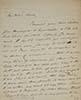
We have had glorious weather the whole way so far. Southampton {2} gave us a parting shower and then the sun came out brightly and has never deserted us since. We had a pretty view of the Needles and Isle of Wight and reached Cherbourg about 6 o’clock where we took on a lot of passengers. We sailed again about 10 o’clock. Before breakfast next morning we were passing Ushant and entered the Bay of Biscay. It was quite smooth, though not exactly glassy; very different from last time I crossed it. The day was bright but not hot. The next morning (Sunday) we were across the Bay[,] and passing C. Finisterre and the end of the Pyrenees the coast looked very pretty with the hills (not very high) well wooded and little villages by the shore. It was now very hot but there has always been a fresh wind. We called at Vigo but did not go ashore; however I visited it well with my opera glasses and took some photographs; the town itself is small, primitive, and not very interesting but the Estuary is fine. We go a little way up the river (I dont know its name) and there are some islands at the mouth which make it very pretty. We took on a tremendous crowd of Spanish emigrants here. They are packed close but seem very happy and lively.

I was up early on Monday morning for the sail up the Tagus to Lisbon. The misty morning light made it very delightful. We went ashore after breakfast (Davidson and J. Atkinson {3} did not land) and stayed until 4 o’clock. You hardly realise Lisbon is a capital city; it seems more a sort of market town. It was very interesting looking round[;] we spent most of the time (which passed very quickly) doing the markets and so on. We went round the Cathedral however, which has a fine high dome and saw many interesting things including the mummy of a saint. We lunched off fruit[—]grapes, apricots and figs[,] which were very nice and wonderfully cheap (very nice tasted {4} purple grapes at a penny a pound)[.] We sailed back to the ship in a sailing boat. We spent altogether 2685 reis which sounds ruinous but is about 9/6.

The ship did not sail till about midnight. Today is I think a little cooler and the sea is not so smooth; but our boat is not much disturbed by it. It is a lovely blue sea with brilliant sunshine.

I have a deck-chair up on the observation deck so get plenty of sun and air. I dont read much more than I did in Norway. This boat is just like the Avon {5} so I know my way about well and, as I told you, we have the same captain {6}.

We are at the Captain’s table but he is not coming to meals until we leave Madeira[.] The other occupants are Mr, Mrs & Miss Unwin; Mr. is some man of importance in S. Amer. but we dont know what. Atkinson tells me he (Unwin) is a radical speaker (A. being a Conservative orator). The only other occupant, my neighbour, is Lady Macpherson-Grant {7}. I am afraid she is going to be rather a bore. However we get plenty of fun with Atkinson. Atkinson who is 67 is a wonderful old chap, as hard as nails; he has been everywhere almost and seems to know everybody. He is always bubbling over with mischief. He is a barrister but has given up practising, breeds and runs racehorses, used to play cricket for Yorkshire, has invented a number of mechanical contrivances which have had great success and directs or manages a number of companies. He is a very keen educationalist on the Northampton County Council and was telling me about their scholarships “but . .” he said {8} “we have n’t done like Somerset yet, I always hold up Somerset to them; they got a Senior Wrangler”[.] I had to enlighten him, as he [had] no idea I was a Somerset Scholar {9}.

I had a good long talk with the Chief Officer last night who knew something of Christina. It seems to be a nice place and the climate and weather prospects first rate.

Of course, we eat tremendously, the meals being much like those on the Avon. I have my bath at 7∙30 so get a little exercise before breakfast at 9. Lunch is at 12∙30, tea at 4, and dinner at 7. They have rather more of a gymnasium here than on the Avon; one very good arrangement is an apparatus for rowing, it feels exactly like real rowing.

I shall have to send with this my best wishes for many happy returns of the day; 60 this time isn’t it? I shall have to give a joint birthday and Christmas present when I get back.

Please give my love to Uncle A. Aunt F. and Arthur; I hope you are not in trouble with the floods, but have heard no English news, whatever.

With very dear love to Winnie & yourself from your affectionate son
Stanley

—————

Letter-head of the Royal Mail Steam Packet Company.

{1} ‘R.M.S.P.’ is printed. The Arlanza, a sister-ship of the Titanic, was built in Belfast by Harland & Wolff for the Southampton–River Plate service. She was launched on 23 November 1911 and came into service in April the following year. She was capable of carrying 400 first-class, 230 second-class, and 760 third-class passengers.

{2} The ship left Southampton on Friday, 30 August.

{3} ‘(Assistant)’ has been added below ‘Davidson’ and ‘(Amateur Astron gone with them)’ above Atkinson, all in the same unidentified hand.

{4} A slip for ‘tasting’.

{5} The R.M.S.P. Avon, of 11,073 tons, was built in Belfast by Harland & Wolf in 1907.

{6} Captain Pope.

{7} Either Frances Elizabeth, the widow of Sir George Macpherson-Grant, 3rd Bt, or Mary (d. 1914), the wife of Sir John Macpherson-Grant, 4th Bt.

{8} This word, which is at the end of a line, is followed by superfluous inverted commas.

{9} Eddington won a Somerset County Council Scholarship in 1898. See Douglas, p. 4.

HOUG/E/M/20/1 · Item · 26 Dec. [1869]
Part of Papers of Richard Monckton Milnes, Lord Houghton

Palazzo Antonelli, Via Alessandrina [Rome]. - Thanks for book of Houghton's poetry; possible nomination of her son to one of the new posts, either in England or abroad. Postscript: encloses account [no longer present] of the 'Council Opening', jointly written by herself and her sister [Rachel], the usual correspondent of the paper.

EPST/D/1/1/1 · Item · May 1938–1983
Part of Papers of Sir Anthony Epstein

Five papers relevant to virus research, including the discovery of Burkitt's lymphoma by Denis Burkitt and a paper written by Peyton Rous, with a dedication to Sir Anthony written and signed by Rous. The original arrangement by Sir Anthony was retained.

O./11.12/1 · Part · 11 Sept. 1876
Part of Manuscripts in Wren Class O

19 Birchin Lane, London, E. C. - Everyone was pleased to see him when he came home 'which made it a little better coming back'; has just written to his sister sending the £1 so now everything is settled. The pictures of the 'Scandal' [FitzGerald and Joseph 'Posh' Fletcher's schooner] and FitzGerald's house 'have been very much admired'. Mr Wylie though he was looking much better. Thinks it would 'please Uncle Edward [Byles Cowell]' to hear how he has spent his holiday; will write and tell him.

Notes on German vocabulary in Edward FitzGerald's hand on the outside pages of the letter.

Add. MS b/74/12/1 · Item · 20 Nov. 1909
Part of Additional Manuscripts b

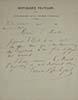
C/o Miss (Mary A.) Hollingworth, Leithen, Newnham Road, Bedford.—Asks him to write a testimonial to the Pitt Press in support of her system of ‘orthotype’ (‘a method of Printing Reform versus Spelling Reform’), and encloses related papers.

(With envelope. Undated. Postmarked 20 Nov. 1909.)

—————

Transcript

c/o of† Miss Hollingworth
Leithen, Newnham Road, Bedford

Dear Mr Wright,

The Pitt Press staff are now deciding whether they will publish my Orthotype Method or no. You will remember I asked your advice about it when we were staying at Dr Ginsburg’s. It is a method of Printing Reform versus Spelling Reform intended to save our international words such as “nation” “philosopher” {1} etc. from destruction at the hands of the Spelling Reformers. It is evident that if they succeed there will be no longer any English Language,—but an American, Anglo-Indian, Anglo-Chinese, Scotch, Irish, South British, {2} North British or Anglo-African—language etc. in these several countries. i.e. Our Empire will have no common language.

Could you send me a testimonial to the effect that you disapprove of the method of sacrificing what is permanent & international i e the spelling, to that which is local & transitory i.e. the sound, & that if a phonetic key is necessary for students & teachers you prefer Orthotype which does not alter the spelling. I enclose you a copy of a letter just received from W. St Clair Tisdall D.D. who is a well-known Orientalist & reputed to know 40 languages. You will see that he considers Orthotype indispensable.

I should be very grateful for a quick reply to the Pitt Press (the secretary has my manuscript) or to myself.

With very kind regards | Believe me
Yours sincerely
Anne Deane Butcher

[Direction on envelope:] Wm Aldis Wright Esq. L.L.D. | Trinity College | Cambridge

—————

The envelope was postmarked at Bedford on 20 November 1909.

{1} Opening inverted commas supplied.

{2} Comma supplied.

† Sic.

CLIF/A3/1 · Item · 1869
Part of Papers of W. K. Clifford

(Cambridge.)—Cannot get away from Cambridge before Friday. Alludes to various theological doctrines relating to the body of Christ.

(Undated. Marked ‘1869’.)

—————

Transcript

Union Society, Cambridge

Dear Fred

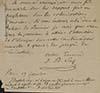
can’t fix it nohow to get a way† from Cambridge before Friday afternoon. Awfully sorry. The universe physical moral and spiritual has been execrated; in vain. I know “sicut in loco” {1} was condemned by the council of Trent; and think oculus saltem glorificatus {2} means only hyperæsthesia which is well known as a disease of the celestials. Will read S. Th. again on 1st opportunity. The Capernaite views {3} made it necessary to give distinct denials to several absurdly material doctrines, and the denials were afterwards made to mean more. Thus the refinement you mention of the harmless remark that “no man hath seen God at any time” into “the Divine essence is per se beyond human perceptive faculties”.

Yours ever
W.K.C.

—————

{1} Cf. Aquinas, Summa Theologica, III. 76. 5: ‘corpus Christi non est in hoc sacramento sicut in loco, sed per modum substantiae: eo scilicet modo quo substantia continetur a dimensionibus’ (‘the body of Christ is not in this sacrament as in a place, but in the manner of a substance, that is, in the manner in which a substance is contained by dimensions’).

{2} oculus saltem glorificatus. i.e. ‘the specially glorified eye.’ Cf. Summa Theologica, I. 12. 3: ‘Ergo oculus glorificatus potest videre Deum’ (‘Therefore the glorified eye can see God’).

{3} i.e. the views of those who believe in transubstantiation.

† Sic.

Add. MS c/93/124/1 · Part · 1 Dec 1868
Part of Additional Manuscripts c

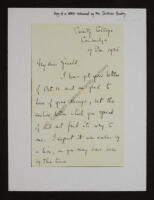
Claims that he is having difficulty in collecting 'the opinions and emendations of all interested in the welfare of the Univers[ity]. Mentions that he gave Mr Martineau a copy of Sidgwick's alterations, of which he approves and adds 'a suggestion of another'. Asks Sidgwick to look at it and return it to him with comments. Mentions that he has received Sidgwick's note and enclosure that morning, and assures him that he will introduce the corrections mentioned

Enfield, Edward (1811-1880), philanthropist
Add. MS c/104/44/1 · Part · [after Aug 1900?]
Part of Additional Manuscripts c

She and her family 'always considered Mr Sidgwick, when [they] were all young together, as the most lively, interested talker' they knew. Remembers a visit he made to them as an undergraduate [in 1858], when he stayed some time, 'joined in everything the family did, and... made everything he joined in more amusing'. He suggested they 'should get up Tableau vivants'', proposing 'Sleeping Beauty' for her, and saying that Miss Tawney - her sister-in-law - 'would do excellently for the beauty.'

Relates another incident during the same visit in which she went to the drawing room to help her mother receive some callers 'and saw at the other end of the room Mr. Sidgwick asleep in an easy chair, dressed in an Afghan costume of white felt belonging to [her] father, and wearing the fur cap belonging to it', with a sleeping kitten asleep on top. Declares that he was such a charming visitor, 'always amusing and always making himself at home with [them].'

Latham, Marianne Frances (1839-1926) née Bernard, mistress of Girton