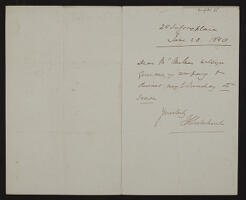
Including material on the Wiggin-Layton Committee and Report.
11: Contains sketch of loch near Helensburgh, Aug. 1839
26: On printed list, 'Works illustrative of the charges against Lord Palmerston', 1841
34-43: VACANT
46: Enclosing verses in another hand, 'Believe not that your inner eye...' [by Milnes]
78: Dictated to his wife Wilhelmina.
1: written after 10 Jul 1895, on letter from J. Forsyth to B. Franklin.
2: 5 Aug 1895, signature on medical certificate prepared by J. Forsyth, 1 Aug 1895
- 5 Aug 1895, with enclosure, J Forsyth to B. Franklin, 4 Aug 1895.
Printed items relating to three lectures given by Lilly Frazer: 6 copies of a printed booklet, 'Liverpool Teachers' Guild. Words of French Songs Illustrating Mrs. Groves' Lecture on French Nursery Rhymes. March 7, 1896' (Item 1), an advertisement for a lecture for the Yorkshire Ladies' Council of Education in Leeds, entitled 'The Use of the Phonograph in Teaching Foreign Languages' dated 7 March 1906 (Item 4), and a programme for a lecture at the Perse Grammar School in Cambridge on 'The French Tricolor', dated 13 March 1906 (Item 5). Items relating to plays staged by and/or written by Lilly Frazer include a printed advertisement of 'Les Femmes Savantes' of Molière performed by Mrs. J. G. Frazer's French Dramatic Society at the Perse Grammar School (Item 6), a mechanical copy of an invitation to 'Les Femmes Savantes' (Item 7); mechanical copies of two programmes featuring scenes from Molière (Items 8 and 9, of which there are 6 copies), with notes by Lilly Frazer on the versos; 5 copies of a printed advertisement of Trois Scènes de Mrs. J. G. Frazer, 'Avant la Soirée', 'Pendant la Soirée', and 'Après la Soirée' of 29 Jan. 1903 (Item 2), and a programme 'For the benefit of the distressed Breton fisherfolk' of scenes by Mrs. J. G. Frazer and A.D. (Item 3).
Includes cuttings from the Daily Worker, G. K.'s Weekly, Wimbledon Borough News, West Middlesex Gazette, News Chronicle, and Time and Tide, as well as copy letters from Layton and a letter from Frederick Pethick-Lawrence to Layton, 3 Jun. 1937.
On the front is stamped ‘ORIGINAL DOCUMENTS & PAPERS.’ The documents are accompanied by folded sheets of blue paper bearing descriptions of the documents, in which they were evidently kept before they were bound.
Sans titreOn the spine is stamped ‘DECLAMATIONES | — | TRIN. COLL. CANTAB. | TOM. | I. | 1799–1809’, and inside the front cover is written, ‘Declamationes in Coll. S.S. Trinitatis Cantabrigiae | habitae | Tomus. I. | 1799–1809’. The dates in these titles do not match those of the contents. The manuscripts in the volume appear to be autograph.
Sans titreIncludes letters by J. O. Halliwell, J. M. Heath about the August 1846 storm in Cambridge, H. Montagu Butler about a bust of Archdeacon Hare, Vernon Musgrave about a memorial to Archbishop Musgrave, with a draft from William Whewell to Vernon Musgrave.
Sans titreOn the fly-leaf are some lines of poetry partly pencilled and then inked over, partly in ink originally. On the fly-leaves at the other end are further fragments in ink and pencil, and one is headed: ‘Plan of a Poem. The Seasons. | Spring. The Visitation, &c.’ Other verses in pencil are on blank pages in the body of the volume, which consists of botanical notes, predominantly on fungi. At the other end is the date 23 Sept. 1793.
Sans titreMostly printed. Also including several pieces by Richard Shilleto.
Collected by William Hepworth Thompson?
A collection of some of the printed material and letters received by Whewell between 1819 to 1833, of which the materials relating to the Cambridge elections of 1829 and 1830 form a part.
Sans titreTwo letters relating to observations of tides.
Sans titreInforms her that they have posts there [in Keswick] occasionally, if she wishes to write. Writes a list of 'pros and cons' in relation to their accommodation. Concludes that on the whole 'it is the best situation in Borrowdale: and therefore in the English Lakes: and therefore, for short mountain walks, in the World'. Admits to not liking the scenery as much as he did three years previously, and thinks that neither does William, but concedes that the scenery is beautiful.
Reports that they have met Edmund Fisher and his wife, 'who is nice and prettyish'. Announces that he reviewed a poem called Ludibria Lunae in the Spectator. It is a satire on the efforts to emancipate women from their subjection, and he claims to have tried to be as stinging as he could, without showing that he had lost his temper. Announces that they expect [G. O.] Trevelyan soon, and that he is to be married on 24 September. Reports that William 'does not seem unwell particularly', but his sleeping has not improved as much as they had hoped. Sends his love to Edward and the children. Asks if she heard that F[rederic] Fisher was engaged to his Bishop's daughter [Agnes, daughter of the Bishop of London, John Jackson].
Announces that he is going to Cambridge 'on the 3rd', and is thinking of going to visit her for a night or two 'after the 11th and before the 18th if convenient.' Remarks that the Rugby news was a shock, and states that he ceases to advise acquiescence [a reference to the troubles with the head, Henry Hayman?]. Reports that Arthur was skating on the Downs.