
LAYT/3/1-9
·
Item
·
1939-1944
Part of Papers of Lord Layton
4485 results with digital objects
Show results with digital objects
LAYT/85/1-9
·
Item
·
Jan. 1921-Oct. 1933
Part of Papers of Lord Layton
MYER/22/1-9
·
Item
·
7 Feb. 1871-13 May 1873
Part of Myers Papers
SMIH/71/1-9
·
Item
·
[after 10 Jul 1895]-29 Mar 1913
Part of Papers of Sir Henry Babington Smith
1: written after 10 Jul 1895, on letter from J. Forsyth to B. Franklin.
2: 5 Aug 1895, signature on medical certificate prepared by J. Forsyth, 1 Aug 1895
- 5 Aug 1895, with enclosure, J Forsyth to B. Franklin, 4 Aug 1895.
Add. MS c/1/1-9
·
Item
·
Feb.-May 1835
Part of Additional Manuscripts c
LAYT/90/1-9
·
Item
·
May 1936-Feb. 1940
Part of Papers of Lord Layton
Includes cuttings from the Daily Worker, G. K.'s Weekly, Wimbledon Borough News, West Middlesex Gazette, News Chronicle, and Time and Tide, as well as copy letters from Layton and a letter from Frederick Pethick-Lawrence to Layton, 3 Jun. 1937.
LAYT/107/1-96
·
Item
·
Jul. 1948-Mar. 1950
Part of Papers of Lord Layton
LAYT/9/1-97
·
Item
·
1935-1959
Part of Papers of Lord Layton
LAYT/82/1-99
·
Item
·
Jan. 1946-Jul. 1953
Part of Papers of Lord Layton
R./1.1
·
Item
·
14th c.–19th c.
Part of Manuscripts in Wren Class R
On the front is stamped ‘ORIGINAL DOCUMENTS & PAPERS.’ The documents are accompanied by folded sheets of blue paper bearing descriptions of the documents, in which they were evidently kept before they were bound.
Sandars, Samuel (1837-1894), librarian and benefactor
BOAT/F/1/1.1-2
·
Item
·
1949-1963
Part of Trinity College Boat Club records
Minutes for May Balls from 1949 to 1963, with additional reports of meetings of the Joint May Balls Committee, and a few cuttings from newspapers mentioning the Trinity May Ball. Minutes are signed by Hon. Secretaries John A. N. Graham, Roger S. Money-Kyrle, Alan F. Niekirk, George Nissen, Malcolm Gomme-Duncan, Alan C. C. Vincent with assistance from Malcolm Davidson, Russell Carver, John R W. Pardey, Peter A. Drake, Ian N. Hardy, Willie Marsden, and Martin C. Clarke.
R./1.4
·
Item
·
1798-1805
Part of Manuscripts in Wren Class R
On the spine is stamped ‘DECLAMATIONES | — | TRIN. COLL. CANTAB. | TOM. | I. | 1799–1809’, and inside the front cover is written, ‘Declamationes in Coll. S.S. Trinitatis Cantabrigiae | habitae | Tomus. I. | 1799–1809’. The dates in these titles do not match those of the contents. The manuscripts in the volume appear to be autograph.
Renouard, John Henry (1758–1830), college teacher
R./1.61
·
Item
·
1846-1860
Part of Manuscripts in Wren Class R
Includes letters by J. O. Halliwell, J. M. Heath about the August 1846 storm in Cambridge, H. Montagu Butler about a bust of Archdeacon Hare, Vernon Musgrave about a memorial to Archbishop Musgrave, with a draft from William Whewell to Vernon Musgrave.
Wright, William Aldis (1831-1914), literary and biblical scholar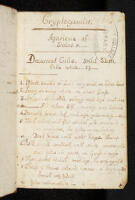
R./1.73
·
Item
·
18th c.
Part of Manuscripts in Wren Class R
On the fly-leaf are some lines of poetry partly pencilled and then inked over, partly in ink originally. On the fly-leaves at the other end are further fragments in ink and pencil, and one is headed: ‘Plan of a Poem. The Seasons. | Spring. The Visitation, &c.’ Other verses in pencil are on blank pages in the body of the volume, which consists of botanical notes, predominantly on fungi. At the other end is the date 23 Sept. 1793.
Crabbe, George (1754-1832), poet and Church of England clergyman
R./1.75
·
Item
·
1838-1872
Part of Manuscripts in Wren Class R
Mostly printed. Also including several pieces by Richard Shilleto.
Collected by William Hepworth Thompson?

R./1.76
·
File
·
1819-1833
Part of Manuscripts in Wren Class R
A collection of some of the printed material and letters received by Whewell between 1819 to 1833, of which the materials relating to the Cambridge elections of 1829 and 1830 form a part.
Whewell, William (1794-1866), college head and writer on the history and philosophy of science
R./1.84
·
File
·
1842, 1843
Part of Manuscripts in Wren Class R
Two letters relating to observations of tides.
Germar, Friedrich Heinrich (1776-1859) theologian
Add. MS c/100/1/1
·
Item
·
15 Aug [1869]
Part of Additional Manuscripts c
Informs her that they have posts there [in Keswick] occasionally, if she wishes to write. Writes a list of 'pros and cons' in relation to their accommodation. Concludes that on the whole 'it is the best situation in Borrowdale: and therefore in the English Lakes: and therefore, for short mountain walks, in the World'. Admits to not liking the scenery as much as he did three years previously, and thinks that neither does William, but concedes that the scenery is beautiful.
Reports that they have met Edmund Fisher and his wife, 'who is nice and prettyish'. Announces that he reviewed a poem called Ludibria Lunae in the Spectator. It is a satire on the efforts to emancipate women from their subjection, and he claims to have tried to be as stinging as he could, without showing that he had lost his temper. Announces that they expect [G. O.] Trevelyan soon, and that he is to be married on 24 September. Reports that William 'does not seem unwell particularly', but his sleeping has not improved as much as they had hoped. Sends his love to Edward and the children. Asks if she heard that F[rederic] Fisher was engaged to his Bishop's daughter [Agnes, daughter of the Bishop of London, John Jackson].
Add. MS c/100/1/2
·
Item
·
[1870-1873?]
Part of Additional Manuscripts c
Announces that he is going to Cambridge 'on the 3rd', and is thinking of going to visit her for a night or two 'after the 11th and before the 18th if convenient.' Remarks that the Rugby news was a shock, and states that he ceases to advise acquiescence [a reference to the troubles with the head, Henry Hayman?]. Reports that Arthur was skating on the Downs.
TRER/ADD/10
·
Item
·
[10 Mar 1937]
Part of Papers of Robert Calverley Trevelyan and Elizabeth Trevelyan
On headed notepaper for West Hackhurst, Abinger Hammer, Dorking, 'as from' Heytesbury House, Wiltshire [home of Siegfried Sassoon]. - Was about to ring her on 'a matter of slight public importance, when a private disaster overwhelmed' him: Agnes has given notice, as she 'doesn't like the cooking'. His mother has 'borne it better' than he has so far: he does not see how they can stay on at West Hackhurst. Will talk it over when he returns from the long weekend with Sassoon already arranged. If Bessie is 'driving alone' near his mother, knows she would like to see her. Must post this letter (in Dorking) and board the train.
Tells her to look at the Times, he thinks from last Saturday, announcing that the Dorking town councillors 'propose to cut a chalk cock on Box Hill in honour of the Coronation!'. Wonders if she could contact 'eg some V[aughan] Williamses, find out whether it is true, and join in a protest if it is'.
TRER/18/10
·
Item
·
17 July 1903
Part of Papers of Robert Calverley Trevelyan and Elizabeth Trevelyan
den Haag. - perhaps about a violin.
TRER/19/10
·
Item
·
24 May 1912
Part of Papers of Robert Calverley Trevelyan and Elizabeth Trevelyan
82 Woodstock Road, Oxford. - Has just returned from America and found Trevelyan's "Bride of Dionysus"; thanks him for sending it; remembers the pleasure he got from "Sisyphus" 'vividly'.
TRER/10/10
·
Item
·
17 Apr [1903]
Part of Papers of Robert Calverley Trevelyan and Elizabeth Trevelyan
Welcombe, Stratford upon Avon. - Amused by Elizabeth's letter, and glad Robert is returning so soon. Both Lord Welby and Lord Davey are 'very good talkers', and Lady Davey is 'charming' so their visit has been very pleasant; she tells Caroline that there is a house to be let at Fernhurst called "Ropes"; just built, by a Miss Coats, who now thinks there is 'not enough view & is going to build another'. Lady Davey also says that Blackdown Cottage is very damp and has no foundations; Mrs Frederic Harrison [Ethel Harrison] was 'very ill there with Rheumatic gout' and two people died in the house while they lived there. Likes to think of Elizabeth and Robert both at home again, 'with the good Enticknaps'. S[idney?] Colvin is not coming; she is glad as the 'row in Stratford seems to be growing, & he is in it' while they wish to keep out of it. Was very good to have Elizabeth to visit them; Sir George sends his love, and 'much appreciated' the letter from Robert.
TRER/13/10
·
Item
·
[Oct 1899]
Part of Papers of Robert Calverley Trevelyan and Elizabeth Trevelyan
6 Racknitz Strasse, Dresden. - Bob's letter reached here before he and Helen did, as Berlin kept them much longer than they expected; all the galleries closed at 3 pm so the officials could have their 'mittags essen' [sic]; not dining properly in the evening is the 'only really uncivilized thing they do'. Liked [Georg?] Gronau, whom B.B. [Bernard Berenson] introduced to him, and who took him to see a fine private collection of drawings and sculptures. Dresden is much nicer than Berlin, 'full of fantastic Barocheries and Rocochoneries'; the Gallery is huge but there are 'very few primitives & lots of Rubens & Corregio & 17th century people' whom Fry likes to 'look at lazily'. Helen 'won't come round' to Correggio and doesn't like [Raphael's] "Sistine Madonna"; to Fry's great surprise he finds it 'simply glorious', and 'Raphael painting almost like Titian'; wonders what he would have done had he lived. He and Helen 'never shall agree on Raphael Correggio & Rubens'; is 'almost annoyed' that he always likes the great artists. [Nathaniel] Wedd's "Quarterly" is very interesting; agrees with Bob that it is a shame 'to make it directly polemical', but he does not 'quite know these logrolled Oxford men'; in art he thinks 'most reputations are logrolled so one gets to think it the normal way'. Helen is asleep; they have both been unwell recently due to German food, but are getting well since they 'are in a young ladies Pension & are fed on pap'. Amusing about Miss V. d. H [Elizabeth Van der Hoeven] guessing; thinks she is good at that; is also 'frightened of her a little because she always seems to be observing more than she shows'.
TRER/14/10
·
Item
·
[16 Jul 1893]
Part of Papers of Robert Calverley Trevelyan and Elizabeth Trevelyan
8, Grosvenor Crescent, S.W. Lord's exeat. - Harrow were 'licked yesterday' [in the cricket match against Eton]. Spirits kept up by a 'very good lunch' with the Yates Thompsons; 'impossible to be depressed in the company of Dolly'. Went to the Royal Academy after the match, then went to see 'the Bastille taken' at Earl's Court; there were plenty of very pretty women, but he did not 'see any Turks'; he then took a 'water-toboggan' ride and went home. Wants to sends his pictures to Cambridge at the end of the term; asks what address at Trinity he should use; asks if Bob could put him up in Cambridge at the beginning of August to 'arrange business'; will go on 4 August to see Aunt Annie at Tunbridge Wells, and then to Wallington on Monday.
TRER/23/10
·
Item
·
19 Mar [1919]
Part of Papers of Robert Calverley Trevelyan and Elizabeth Trevelyan
For journey by train from Paris-St-Lazare to Le Havre.
TRER/24/10
·
Item
·
26 Feb 1931
Part of Papers of Robert Calverley Trevelyan and Elizabeth Trevelyan
Signed by Leonard Woolf for the Hogarth Press and by R. C. Trevelyan. Annotations by hand to clause 3, specifying a minimum commission of five pounds to be paid by the author to the publishers, and to clause 4, granting Trevelyan permission to include the work in any collected edition in future, as long as this is at least twelve months from the date of this agreement.
TRER/28/10
·
Item
·
1880s-1940s?
Part of Papers of Robert Calverley Trevelyan and Elizabeth Trevelyan
First page labelled 'R. C. Trevelyan. History'; some references from classical authors below appear to have been added at a later date. Essays by Trevelyan on: the nature of history and English history up to the Wars of the Roses [1r-7v]; the Tudors and Stuarts [8r-15r], with pencil corrections and annotations by 'RS' [a teacher?].
Book later used by Trevelyan for notes on Greek philosophy [perhaps at university?] and, from the other end of the book in, on New Testament Greek and Sophocles' "Oedipus at Colonus".
SMIJ/1/10
·
Item
·
17 Oct. 1940
Part of Papers of James Smith
[St Paul Seminary, St Paul, Minnesota.]—Is sorry he was unable to see Smith in New York, and apologises for appearing pessimistic about England. Today was the first registration for conscription, but he will not be able to declare himself as a conscientious objector till later, if at all. Is reading Stratmann’s 'The Church and War' and is trying to get hold of Gerald Vann’s book ['Morality and War']. Will send him the 'Catholic Worker'. Is expecting things to go well at the seminary, but a homecoming of old priests and a visit by the editor of the 'Irish Literary Review', ‘the worst sort of Bloomsbury man’, provoked personal crises. Recommends Berdyaev’s 'The Bourgeois Mind'. Is cheered by the contempt with which the other seminarians treat the compulsory course in education. Leavis’s article in September’s 'Scrutiny' shows that he is becoming increasingly discontent with his position of ‘standardless “strenuous centrality”’. Is praying for Leavis and for [F. W.] Bradbrook. Admits the justice of Queenie [Leavis]’s remarks on the ‘Catholic covert apologist’, as treated by Orwell, and refers to the cliquishness of the ‘Martindale–Ronald Knox group’. Asks for prayers in support of his desire to become a priest, and encourages Smith to consider the same step. Wilfrid is married and Dennis is consoling himself with gardening. Bewley now finds 'Scrutiny' even more justified than he did at Downing, but he would not want the ‘longingness’ with which he looks back to be fulfilled. Smith’s advice has helped him in his struggles with his attitude towards the Church. Is considering going into a third order with the Dominicans. Reiterates the archbishop’s plans for him [see 1/8]. Asks how long Smith will be in Venezuela, and suggests he consider joining the priesthood in America.
CORN/I/9/10
·
Item
·
[1937]
Part of Papers of F. M. Cornford