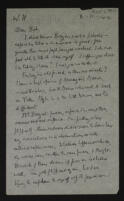
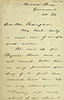
W[est] H[ackhurst]. - Does not know Binjori's [Abdul Rahman Bijnori?] works as he ought to, and does not feel able to take the chair; wishes Trevelyan would do it himself. Suggests asking someone from the East such as Narayana Menon, though perhaps he is too little known. Discusses [Elizabeth] Daryush's poems. George Thomson should have organised the [Apostles'] Dinner, but is going into hospital. Took tea with Chi'en [Xiao Qian]. Agrees that Silvia S. [Sylvia Sprigge?] is now far away.
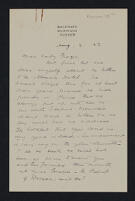
Metelliano. - Thanks Trevelyan for his "Collected Poems". Has been invited to translate his brother George's "British History in the Nineteenth Century" into Italian, though it is currently a secret as negotiations are still in progress; is reading the book now and feels the job will be enjoyable, if long and maybe hard. Has also been offered the chance of translating "Pericles", but does not feel prepared to cope with Shakespeare. Hears Mary [Berenson] is preparing herself for a journey to England and taking motor-rides; thinks this is only a psychological improvement, but that is a great deal. Does not yet know whether B.B. [Berenson] is going to Yugoslavia.
I Tatti, Settignano, Florence. - Encloses a sheet with his responses to Trevelyan's queries about his translation [of Leopardi], with a few points of his own; finds the translation 'quite excellent'. Thanks Trevelyan and his brother once more [re Morra's translation of G.M. Trevelyan's "British History in the Nineteenth Century, 1782-1901"]. Has almost finished copying out the translation; his publisher [Einaudi] is willing to give him another job of the same kind, and asks Trevelyan for some suggestions of books from last five years which he might suggest if necessary. These might be history, biography (Duff Cooper's "Talleyrand" has done well in Italy), travel or memoirs, not fiction. All fairly well at I Tatti; Mary [Berenson] is recovering from bronchitis and Nicky [Mariano] from flu; they all think of Trevelyan often.
Telegraph House, Harting, Petersfield. - Apologises for not thanking her sooner for the face-towels; 'sick-room routine' seemed to take up all her time when she was in bed, and she has been looking after Conrad for the last week which seems 'almost a whole-time job'; though now she is getting used to it and enjoying it. Is pleased because he seems to do better with her than the nurse. Sorry she was 'so distraught' when Bessie visited; the nurse was 'cross and rather negligent' because of something in her private life, but once she was soothed down they got on well. Found her 'stories of East End midwifery' fascinating, but her methods 'not quite adequate for Conrad'. Conrad's additional names are Sebastian, after Bach, and Robert.
41 Queen's Road, Richmond, Surrey. - Bertie's fever seems to have been caused by an infected stitch; he has no temperature tonight for the first time in a week. He had an x-ray to check whether the organs disturbed during his [prostate] operation were causing trouble, but everything was normal. He should be able to go home soon, and they are both very happy.
41 Queen's Road, Richmond, Surrey. - She and Bertie would like to come to the Shiffolds for the day, and ask if 9 June would suit, or perhaps some time the following week.
41 Queen's Road, Richmond, Surrey. - Good news that Bessie may be able to stay with them on one of her trips to London; suggests the best days. She is 'acting as Bertie's secretary' now and so is also very busy and unable to come to Dorking either; they are both very sorry. They have not yet had the report of the speeches at Birkbeck College [for the donation of R. C. Trevelyan's books to the library].
41 Queen's Road, Richmond, Surrey. - Thanks Bessie for her letters and postcard, and answers her questions: her book is "Wilfrid Scawen Blunt", and was published in 1939 when she was still Edith Finch; is sorry she does not have a copy to lend her. Agrees that the weather is very cold, though the Russells have not had to retire to bed to keep warm like Bessie; hopes she is not ill. They have not yet seen V[eronica] Wedgwood's book ["The King's Peace, 1637–1641", vol. 1 of "The Great Rebellion"]; liked her "William the Silent" very much, but they have been so busy to read much besides what must be read. They both have been very busy since Bertie's Christmas broadcast ["Man’s Peril from the Hydrogen Bomb.”]; she hopes his energy will hold out and that 'passionate sincerity' will bring about the proposal's success. Domestically, they are in chaos: the cook-general's husband is ill so she has been away since before Christmas, they have a little help from a char and from the grandchildren's governess. Their grandchildren [Felicity, Anne, and Lucy] are now in their sole care, 'since their parents first left them and then left each other'. John has been ill; he spends some of his time with his mother, and some with them; it has been 'really fierce and harrowing' for Bertie. They 'love the little girls dearly' however. Sorry the roads are so treacherous; would be lovely to see her when she can get to London again.
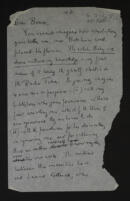
41 Queen's Road, Richmond, Surrey. - Originally some more leaflets [about Bertrand Russell's anti-nuclear proposal]. Bertie thinks he must concentrate on the Indians; perhaps Bessie could write to Queen Juliana. Does not know whether the proposal has been published in the Netherlands; thinks it has in Sweden and Denmark. Must have written 'very misleadingly about John' to give the impression that his mother has helped him: she 'has behaved quite frightfully'. The doctors thought that John might get better if given proper care, which was arranged for him; she persuaded him against their 'very pressing advice' to leave the hospital and live with her; John seems to be afraid of her. He comes 'wandering out here twice or thrice a week' but there is nothing they can do but wait till he gets worse. Their London char has now fallen ill, and the children's governess is now their 'mainstay'.
41 Queen's Road, Richmond, Surrey. - Lovely to have news straight from Bessie, rather than through [Alan and Mary] Wood, 'dears though they are'; it is kind of her to invite them for the Christmas holiday, but they are going to Wales with the three grandchildren as soon as they return from school; they have just heard that their 'daily' there has to go into hospital, so their domestic troubles will continue. Looks forward 'to cooking a turkey for 10 or 12 people in an oven into which it will not fit. Is glad Miss Jones is still living with Bessie and hopes she will be able to find someone to read to her 'who loves the country. The people who interrupted at the Central Hall meeting were an organised band called the "Royal Imperialists" whose stated concern is "to uphold the Empire"; very silly, but no more so than the article in this week's "Time and Tide" on India; 'amazing how many people...feel they can achieve great things by not looking at facts and merely calling everybody they don't like nasty names'; this includes the Russians, who are 'lying in India now'. Is very glad Julian and Mary are so happy, and about Julian's successful show.
Plas Penrhyn, Penrhyn Deudraeth, Merioneth [headed notepaper, but letter seems to be written from London]. - Bertie has had a thorough examination of his throat after weeks of trouble with it, and there is no cause for alarm; everyone is much relieved. Sorry they will not be able to visit the Shiffilds, but Bertie has much work to get done. Distressed that Elizabeth has had a lengthy infection, hopes it is now cleared up, and that they will be able to visit in the spring. The 'poor Woods' have been ill as well, Mary with a mysterious infection and Alan with nasal trouble which requires an operation. They have not seen John; fears he is no better. The grandchildren are very well, 'growing up to be nicer and nicer', and enjoy their new school. The Russells love living in Wales, though they would prefer more sun; the only thing Edith misses about Richmond is the Park. Glad to hear happy news of Mary, Julian, and Elizabeth's grandson; hopes to see them as well when they return to London.
54 Cours Napoléon, Ajaccio, Corse - In the letter of 30 October, he is resigned to the fact that they will find a collaborator for Sir James and have their own requirements; refers to the reception of Lilly Frazer’s books at the local school; writes of Madeleine, recovering from typhoid fever, and her brother, who has just received a doctorate in law. In the letter of 29 Nov. he has agreed to organise the surveys for Varagnac for the Encyclopedie Françoise. In the letter of 12 Nov., he is glad to hear they will be at their club until the end of the year; thinks the translation by Madame Roth is ingenious, but it is hard to match the quality of Sir James’ verse. The achievement of 'The Fear of the Dead' is difficult if one cannot reread the documentation and though Frazer has a good memory he should have someone help who can find what he needs and read it to him. All three letters contain news of Martine [Giamarchi, a great niece].
54 Cours Napoléon, Ajaccio (Corse), Easter Monday - Thanks her for the photographs; reacts to her news that they are thinking of getting a bigger place, and that Sir James can work 5 hours a day; discusses arrangements to visit Paris in May; Martine [Giamarchi, a great niece]loves to read what Lilly sends; his nephew has retired and they will be going to Cannelle earlier; will be attending a wedding of the daughter of old friends and relatives.
54 Cours Napoléon, Ajaccio, Corse – Enjoyed the pages of the 'Times' and the coverage of the royal trip to Canada; saves such things for Martine [Giamarchi, a great niece] in 20 years; his old friend Albert Rivaud, whose father he knew, is elected to Lévy-Bruhl's chair at l'Académie des Sciences Morales et Politiques, and in congratulating him mentioned that he knew her, and thanked him for being one of the first to admire 'Le Rameau d'or'; he was visited by two young English women, Miss Joan Quartley and Miss Gwenyth Wilkins, who saw the Frazers' portraits and were proud of the honoured position their countrymen had in his house.
Bateman's, Burwash, Sussex - Her letters haven't reached him, hasn't stayed at the Meurice Hotel for years; the booklet is an improvement on the yellow 'volumette'; wishes they could be at home to receive them and François Ceccaldi later in the month.
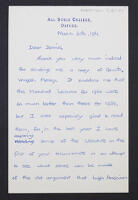
W[est] H[ackhurst]. - Is signing the card 'After some indecision... with a slight modification of its text'; though there are 'some weighty arguments against it', he feels it is 'a good thing to testify to the possession of compassion and a heart, when one has or things one has them. Everyone is or is pretending to be so hard'.
After he visited Bessie, 'a cloud, then no bigger than a man's hand, turned into the shape of an aeroplane', and now it really seems he will fly to India in ten days for a [P.E.N. ] conference of writers at Jaipur. Can 'hardly believe it, and of course there may be last minute hitches'. Hsiao Ch'ien has lent him a 'wonderful cane suitcase', which he can 'carry with one finger' when empty. Is only meant to be away for two months, and the household 'hopes to limp through' in his absence, with the help of Florence [Barger], Aunt Rosalie and others. Agnes [Dowland] 'has been very sweet about it, her only objection being that I am sure to crash'.
His only companion will be Ould, the secretary of P.E.N., who is 'pleasant and easy to get on with'; they hope to fly via Karachi to Delhi, where Forster will stay with friends [including Ahmed Ali], then to Jaipur for the conference, then he thinks to Calcutta and Bombay. He may of course 'be turned off the plane at the last moment if a V.I.P. (official phrase for Very Important Person) wants my seat'. Looks forward to going, 'despite the unhappiness and the politics which I am certain to find there'; will be 'such a change', though he fears he will be 'in a daze for at least a fortnight, and lose Chi'en's suitcase during it, with all my clothes therein'.
[No signature - incomplete?]
W[est] H[ackhurst]. - Bessie ‘cannot imagine how consoling’ her letter was, ‘nor Bob how well placed his flounce. The whole thing was done without my knowledge [the adaptation and broadcast of his story The Eternal Moment], and the first news he had of it was ‘the ghastly sketch in the Radio Times’. As she may imagine, ‘rows are in progress’: with his publishers, who gave permission without consulting him, as they are bound to do by the terms of the contract; and with the producer [Howard Rose] ‘for his discourtesy in ignoring me, and for supposing that an author doesn’t know anything [crossed through] can’t help over his own book’.
The contrast between ‘this insensitive hack’ and Leonard Cottrell, producer of The Celestial Omnibus, is ‘extraordinary’; Cottrell consulted him throughout, and invited him to Manchester for the rehearsal. Will let her see the letters if she likes. Is ‘taking it all to the Society of Authors’, and then will ‘ask for an interview with someone in the B.B.C., as this sort of thing must be stopped’. Notes that they acted legally [in obtaining permission from his publishers].
Looks forward to visiting soon. The cold has been ‘terrible’, and they are ‘still not feeling the better for it’. Chi’en was ‘nice’, but Forster criticises his English: ‘I once ventured to Chi’en that his lectures were becoming difficult to follow. He beamed and continues to deteriorate. Something is wrong with the Chinese after all, I fancy’. Went to Cambridge last week ‘to speak to Indians’; did not see Bertie [Bertrand Russell], but his lectures ‘continue a huge success, and the other dons are most critical: - jealousy partly, partly the uneasy knowledge that he upholds humanism in a community which has betrayed it’. His mother sends her love.
W[est] H[ackhurst] (Postmarked Abinger Hammer, addressed to ‘Mrs Trevelyan, The Shiffolds, Holmbury St Mary, Dorking’) . - Thanks Bessie and Bob for their 'kind letters' and for [Hasan Shahid] Suhrawardy's address; thinks he only met Suhrawardy once, at the Shiffolds. Expects to stay in Calcutta, probably in November.
Now looks as if he leave London on Thursday for an 'airport near Poole. All very odd'. Is 'looking forward to it - with occasional tremors'. Has 'been inoculated against 3 sorts of typhoid, cholera, smallpox', and Chi'en has lent him 'a lovely light suitcase'; asks if he has mentioned that before. Sends love, and says that air-letter is best if she writes [to India].
A postscript in another hand gives Forster's address to the beginning of December as c/o Thomas Cook, Queensway, New Delhi.
Transcript
Meadow Brow, Grasmere.
VIII. ’02
Dear Mrs. Eddington,
My last duty is now one of simple good wishes.
The men up for Physics Hons. were a set much better than in any previous year. Any of the first three would have been top in any other year; & Stanley was well ahead of the others, & obtained over 80 per cent on the whole examination.
He will find a larger sphere and more competition at Cambridge; and I trust we shall hear he is bearing himself well under it.
With best wishes
I remain
Your friend sincerely
John W Graham
Transcript
1912 Sept 11
R.M.S.P. Arlanza {1}
My very dear Mother
We are getting near Pernambuco now. The time at sea has passed very rapidly and pleasantly and I shall be very sorry when the voyage is over. The slightly overcast skies which we had about Madeira have given place to continual bright sunshine, but there has been a strong refreshing breeze always. Most of the regular travellers on this route say they have never known it so fresh and cool all the way. The only time I find it really hot is when I come down from the deck at night to the cabin; then for an hour or so it seems very close and I usually read for an hour to get cool again before going to sleep. The dining saloon, decks, & smoking rooms are beautifully cool. Of course I am wearing the thinnest things possible.
We did not land at St Vincent but were surrounded by boats (as at Madeira)[.] These were all occupied by negroes; the little nigger boys were very amusing[;] I tried to photograph them. I saw a shark whilst we were at anchor. We see lots of flying fish, regular shoals of them, skimming from wave to wave. Most of them are very small[,] almost like butterflies. They look very pretty in the sunlight.
I have got to know some of the southern stars now but they are poor compared with the northern ones. The Southern Cross is not visible yet[;] it is the wrong time of the year for it. The Chief Officer took me up on to “Monkey Island” above the Bridge where one gets a good clear view of the sky.
One day is much like another and I hardly keep account of time. We have had Sports, Games, Fancy Dress ball, etc. I went in for several of the Competitions—including spar-boxing (with the pillow), life-belt race, Are you there?, deck quoits, threading the needle (with Lady Grant holding the needle), but did not have much success, except at chess. I got to the Final Round at Chess, and had to play quite a young opponent for the final. We drew one game and he won the replay. They had a specially good dinner to celebrate the 90th Anniversary of the Independence of Brazil, and some speeches (chiefly in Portuguese)[,] also a dance which did not interest me.
Of course I know a good many people by now. One man that we see a great deal of is Major Caroll (an Irishman)[;] he is a very nice fellow. The Captain comes down to dinner generally; although he is said to be the most popular man in the service I dont care much for him. He seems generally grumbly—a pig-headed old man I think; though I have no doubt as a Captain he is very good indeed. Lady Grant also is a tiresome old lady, with an enormous appetite. The Unwins are quite nice people.
We pass a great number of ships chiefly tramp steamers. The Avon passed us quite close a few days ago and I saw it. We had one little excitement yesterday as a tramp steamer required a Doctor (a man having got an iron splinter in his eye) so we stopped whilst he was brought on board and attended to.
We crossed the Equator about 3 o’clock yesterday afternoon but there were no traditional observances; everyone (at the time[)] was excited about a tug-of-war Married v Single. Atkinson pulled in it as well as Davidson & I. The “married” were ever so much heavier than we were, and pulled us over easily.
It is curious having no letters or English news of any sort. We have not even had the daily Marconigram since leaving Lisbon—have heard nothing whatever. I hope you are getting on well.
We expected to be in the Doldrums the last three days—a region of calm close air with rain—but instead of that we have had delightful fresh weather[;] it is most unusual just here.
With very dear love from
your affectionate son
Stanley
I hope Winnie is having a got {2} time at Lynton[.]
—————
Letter-head of the Royal Mail Steam Packet Company. Numbered ‘3’ at the head in pencil.
{1} ‘R.M.S.P.’ is printed.
{2} A slip for ‘good’.
Transcript
Passa Quatro
1912 Oct 13
My very dear Mother
I almost forgot how far I carried our adventures in my last letter, but I think it was somewhere about Monday last {1}. We had a number of rehearsals on Monday and Tuesday & on Wednesday morning and had got able to do everything quite smoothly. Besides Aguirre and Andrews we had another gentleman M. Seux {2} who lives in the neighbourhood, who was to count seconds for us during totality. Monday was a glorious day, Tuesday good, Wednesday started overcast, and at noon rain began. We regarded this as a very hopeful sign; as hitherto the rainstorms have been short and have cleared the air beautifully. On Thursday morning we were up soon after five-o’clock and went down in heavy rain to load the photographic plate carriers. At eight o’clock we were beginning to get hopeless, but of course went on with the preparations up to the last moment.
About 7∙30 the special train arrived from Rio bringing the President (Marshal Hermes) the Foreign Minister (Dr Lauro Müller) and their wives, the American Ambassador and about thirty other gentlemen. They were received with bands, rockets and crackers—crackers is the regular Brazilian way of demonstrating. Most of the people came and looked round the camp but it was too wet for the President. The American Ambassador sheltered in our shed where our cases are; we like him very much. The rain became heavier as totality drew near; it was not until 5 minutes before totality that the darkness increased noticeably, then it came on very rapidly. It was extremely dark for the time of totality—one could just see one’s watch with difficulty As soon as it was over it grew lighter very quickly.
The owner of the Fazenda, where we were, gave a banquet to the President and his party after the eclipse. Dr Morize, M. Stephanik (leader of the French expedn) and I were invited. M. Stephanik was not able to go. I was next to Morize during the meal, three places away from the President. Fortunately the Secretary to the American embassy was opposite me, so I had someone to talk English to. There were one or two speeches afterwards; but they did not concern us and I had only a very vague notion of what they were about, as they were in Portuguese. After the banquet we were photographed in a group outside the Fazenda in pouring rain—this was the beginning of heaps of newspaper photographs. I have been in eleven different groups. (One photographer caught the Greenwich Expedition at tea (at the camp) I have seen the negative it is very good and amusing.)
The rain continued without stopping all Thursday and until Friday about 4 o’clock. The passage through mud & pools of the Presidential party to the train was very amusing. In the evening we had a feast at this hotel; there were about forty present—our numbers had gradually increased night by night. I had to make a short speech in reply to a toast, and of course thank Dr Morize & compliment him.
On Friday we had lunch at the Fazenda with Sr Hess—the whole of the expeditions with their volunteers. It was very pleasant there, as there were several gentleman friends of his who could speak English well. About 4 o’clock Aguirre[,] Andrews, Davidson, one of Hess’s friends & I went up a hill (in Hess’s property). Quite unexpectedly it cleared up beautifully when we reached the top, and we had a glorious view of sun & clouds on the distant mountains.
Yesterday Saturday we spent the whole day packing and got on well (It had been too wet to do anything before). The sun was very hot in the afternoon. Towards evening there was a most extraordinary sight—the ants began flying. We have two large white ants nests in our field, and these were swarming with the small ants driving away the winged ones. These winged ants were flying off—about 50 a minute to found fresh colonies They are large creatures like dragon-flies. Besides these hundreds of winged garden ants about the size of tiger-moths were flying over the camp; dozens pitched on our canvas huts, and I expect we packed up a great many of them. Just as we were ready to go home a thunderstorm came on. It was a regular tropical deluge and we were kept about 2 hours waiting at the shed The fireflies were very brilliant in spite of the rain and the lightning (though distant) was very vivid. It was really like fairy land (or the last scene in Peter Pan) and quite enjoyable waiting there. We managed to slither home through mud & lakes about 8 o’clock.
We are a small family now. I think we shall not hurry back to Rio but see a little of this neighbourhood. Lee & Worthington are gone, which is a great relief to everybody. We may go to Rio on Wednesday. We sail on Wednesday week—it was impossible to get the baggage down to Rio in time for the earlier boat. {4}
We have a good deal of fun here in spite of everyone being dejected at the result of so much labour. Stephanik & De Souza (Morize’s assistant) are very nice fellows, and Aguirre has been a tremendous help to us, and is a splendid companion here. Atkinson (though he has had an attack of gout) keeps us very lively and is a great favourite everywhere.
The photographs {5} are some of Davidson’s
With very dear love, ever
your affectionate son
Stanley.
The posts here are very irregular I got Winnie’s letter on Tuesday morning and yours on Thursday just after the eclipse. If you see an article in the Times it will be mine—but as the eclipse was a failure they may not print it.
—————
Numbered ‘8’ at the head in pencil.
{1} 7th.
{2} Pierre Seux. See the Report in MNRAS, lxxiii, 386.
{3} Marshal Hermes Rodrigues da Fonseca, President of Brazil from 1910–14.
{4} The last two sentences have been marked with a vertical line in pencil in the margin.
{5} These photographs presumably accompanied the letter, but are no longer with it.
Transcript
R.M.S.P. Danube {1},
Oct 23.
My very dear Mother
We are now on board the Danube and left for home at noon today, so I shall have to bring this letter with me; but so much has happened in the last week, that I must begin to write it down.
We were all terribly disappointed over the eclipse and were a rather depressed company for some days afterwards. Our numbers quickly melted away from Passa Quatro and by Monday, Morize, Stephanik, Worthington and Lee and most of the volunteers had gone. Atkinson who had been suffering from gout at times left for Rio on Sunday (at that time we expected to follow him in a day or two). {2} Lee & Worthington were detested by everyone and their departure was a great relief. Lee, I think, had taken this up as a sort of lever to advertise himself and get in with important people; he had somehow got round the British Consul who recommended him to us. We had rather a bad time from him at first, but had the satisfaction of seeing him completely checkmated. Further as soon as Aguirre came, we were independent of Lee; and could do without him.
The party that remained at Passa Quatro for the next week Oct 14–20 consisted of De Souza and his young wife, & Da Costa of the Brazilian Observatory, Kraliçek (Stephanik’s assistant), two ladies relatives of the innkeeper M. Rénier & several children (at these small places we are quite in the innkeepers family—however Rénier was a superior sort of man), besides our two volunteers Aguirre and Andrews, Davidson and myself. We were a rather young party, all under 30 except Da Costa and Davidson; M. Rénier was knocked up after his labours and was in bed most of the week. We had a very jolly time though of course the mixture of languages was troublesome.
The rain continued with very few fair intervals and practically no sunshine until Wednesday, and our packing was very slow owing to that. On Wednesday we were finished at last, and that afternoon which happily turned out fine, nearly all the packages (Brazilian, French, & ours) were removed in oxcarts & mulecarts to the side of the railway and put on the train late at night. We had nothing further to do with them; yesterday I heard that they had got as far as Cruzeiro—a distance of 20 miles! We have left them to be sent on by a later boat—I daresay they will reach Rio in a few weeks. Stephanik sailed today in a French boat, leaving his baggage to follow.
On Thursday (Oct 17) we were relieved of our cares and able to do what we pleased, and the next three glorious days we had a splendid time. The reason of our staying was really that De Souza was going to take us a trip further up-country to Cambuqueira; but it was always ‘amanha’ (tomorrow). Tuesday was the first day fixed for it then it became Wed, Thu, Fri, Sat and on Saturday it was finally given up. We liked De Souza very much; but he is typically Brazilian, and has got the ‘amanha’ as badly as all of them. As we enjoyed being at P. Quatro, it did not matter very much this continual putting of[f].
These three days we explored the neighbo[u]rhood in all directions. We never got very far as there was so much to see in the forests, and the sun was very hot indeed. Aguirre (although he has been in England for the last seven years) knew all the things of interest, and could tell us what all the plants birds & insects were. We saw beautiful butterflies[,] some of them very large—the hot weather brought them out—& a great variety of beetles. The ants were sometimes troublesome; they are all over the place, but they are particularly interesting. The leaf-cutting ants make regular highways about 4-inches broad, and you see a regular procession—along one side, the ants going out to forage, and on the other side those that are returning each carrying a leaf a great many times larger than itself. It looks like a procession of moving leaves. The ferns were very fine and in great variety; I am bringing home a few roots we collected in hopes they will travel alright. Most of the trees are full of orchids and parasitic plants and have great masses of creeper, etc hanging from them.
Twice we were able to bathe; but the rivers are not very good for it, being generally shallow. In the afternoons we got coffee at wayside vendas; generally the whole village looked on. They always wanted to give it us gratis. We occasionally could get good oranges; but it is not the right time of the year for much fruit, and as a matter of fact most of the fruit in Rio comes from England.
On Friday we decided on a horse-back expedition. Generally it was just our party of four that went out together, but this time Kraliçek came with us. Horses were ordered for 6∙30 a.m.; by this time I was used to Brazilian ways, and accordingly I got up at 8. There was then no sign of horses, but it was ascertained that they were being caught and might be expected about noon. Accordingly Aguirre Davidson & I had a good walk & arrived back very late for déjeuner at 1∙30. Ultimately the horses turned up at 3 o’clock & the cavalcade started. As three of us had not been on horseback before, very tame horses had been insisted on. Mine, which was 17 years old was very tame; and as it had a prejudice against going the right road, Aguirre (who is a good horseman) took it in exchange, and for the rest of the way I had a nice willing little horse, which gave me no trouble. We set off for the virgin forest about 8 miles distant up a mountain track. It was a lovely ride, with grand scenery. I think we had gone about 6 miles, when Aguirre’s horse (the very tame one) fell, and was evidently good for nothing more. It was a long time before we could make it get up; and then it could only be walked home. Aguirre managed to hire a mule, and we came slowly home by the moonlight & firefly-light; at a walking pace on account of the led horse. In spite of the accident it was a very pleasant ride indeed and though we did not actually reach virgin forest, we had some beautiful glades to pass through with fine mountain views.
On another occasion we passed a fazenda, where they made tobacco. The proprietor saw we were interested and showed us all about, gave us samples (which we afterwards found were worth at least 10/–). He even invited us to breakfast, but we did not accept. The tobacco is made in long ropes coiled on sticks; we often see the mules loaded with it going along the country-lanes. These mule trains are quite a pretty sight.
One night a fire-fly had got into my room, and woke me by flashing about. I had to get up & chase it before I could get to sleep. Davidson had a similar experience when he was changing plates at night, and had darkened the room. We have not seen any snakes; but have several times found large cast-off skins of snakes. I saw a large lizard (iguana) one day.
We left Passa Quatro on Sunday at eleven o’clock Kraliçek, Aguirre, Davidson & I. Andrews stayed on another two days. Da† Souza wanted us to stay till Monday as he was coming down ‘amanha’, but we were wise; he had not turned up when we left Rio this morning. We had quite a fine send-off—such leave-takings at the station[.] Old Rénier had recovered and gave us each the Brazilian embrace at parting; it consists of a hug with three pats on the back—I must demonstrate it sometime to you; it is quite the regular thing here.
It was a very hot day and the scenery was beautiful. The short run to Cruzeiro we had seen (under less favourable conditions) before; but the 5-hour journey from there to Rio was new, as we had passed it at night before. But the dust was terrible and the journey was most exhausting. By drinking black coffee at practically all the stopping places, and eating bananas in between whiles, we managed to survive. Like everybody else we lost our luggage at Cruzeiro; however it turned up at the hotel the next morning so no harm was done. We passed along the banks of the river Parahyba most of the way, and it was interesting seeing the rice & sugar cane growing. Banana trees are very abundant everywhere and look very untidy—they are the one piece of ugliness in this country—; the mangoes, palms (cocoanut and date), jacas and orange trees and better than all the bamboo clumps, are fine trees.
We found Atkinson at the Hotel Estrangeiros; he had had rather a bad time with gout, but was getting better. The next morning (Monday), we spent taking our passages in the Danube, & called at the Consulate, where I got your last letter—it seemed funny to find it was a reply to my letter describing Madeira {3}—that seems years ago. Davidson was not very well, so Aguirre and I went out alone in the afternoon. We went by the funicular to the top of the Corcovado (2200 feet) It is a beautiful ride up through forests, and at the top there was a magnificent view of Rio Harbour. Fortunately it was one of the clearest days we have had. At last I got a clear understanding of the geography of Rio, with its numerous Bays, and Nichteroy† on the opposite side. After coming down we walked up a zigzag path to Sylvestre, and then returned to the hotel by tram by a different route, which runs along an old Jesuit aqueduct.
In the evening Davidson and I went to dinner at Mrs Andrews’s—the mother of our younger volunteer.
Tuesday morning we started (Aguirre, Davidson & I) at 6 a m for the Botanical gardens; it was pleasantly cool then. We did not get back until 11∙30, so spent about 4 hours wandering round the gardens & taking some photographs. Mr & Mrs Willis (the former is Director of the gardens {4}) had been helping Worthington at Passa 4, so we paid them a short visit. With our visits to the gardens and the Brazilian forests I seem to have seen almost all the useful plants one has heard of. There are not very many flowers in the gardens; it is chiefly trees and shrubs. I carried away a souvenir in the shape of a dozen mosquitoe† bites over my face hands and legs. This is the only place in Rio, where there are any mosquitoes.
An Englishman Ihlot, whom we met at Passa 4 on the eclipse-day, was waiting for us at the hotel and after déjeuner carried us off in a motor to Quinta da Boa Vista—a park where there is the former Emperor’s palace, now a museum. The museum was not yet open (being in course of arrangement); but Aguirre had some influence there, and we were shown round and saw many Brazilian curiosities. We then returned to pay visits to the Foreign Minister & Observatory (to take leave and say polite things!). Ihlot met us again at the Observatory and we went down to the ferry for Nichteroy†. On the way we passed through the market, where our two guides plied us with all the weird outlandish fruits they could find. It was most interesting; the sapoti was a very nice fruit, looks on the outside just like a potato; the condessa a sort of pomegranete† (I think) was not so nice. It was perhaps fortunate that not many fruits are in season now, or I dont think we should have survived—as it is I have a mango and cocoa bean still to sample, which I put in my pocket. We finished up with a tumbler of caldo de canna—the fresh juice from crushed sugar cane. It was very nice.
We went on the steam-ferry to Nichteroy† about 4 miles across, and then by tram along the shore there. Here we had a lovely view of Rio from the other side, with the fine peaks of Sugar-loaf, Corcovado and Gavea, standing up finely against the sunset. This is really the best viewpoint in the harbour.
After dinner we just paid a short visit to Aguirre’s brother-in-law (with whom he was staying), who is now learning English and could speak a little. On returning we had a rather boring visit from Tigré†[,] another friend of ours—a poet and literary man[,] very excitable—and at last got to bed about midnight.
We had to start at 10 o’clock this morning for the boat so there was no time for anything except packing up, etc. The Observatory people motored us down to the quay and Dr Morize was there to see us off. It was a somewhat misty day for our last look at Rio harbour, but it was a fine sail out of it all the same.
Rio is said to be the finest city in the world, and that is probably true. Besides the advantage of its splendid situation, it is well laid out with fine parks and avenues and sea-front. It is now very healthy with the lowest death-rate of any city in the tropics—ten years ago it was a hotbed of yellow fever and malaria, but that has been entirely got rid of by exterminating the mosquitoes, which carry the diseases. Living here is I think even more expensive than I first thought; the average cost of things is about 4 times what it is in England (so the inhabitants say) but many things are much more expensive. Strawberry jam is a great delicacy, rare and expensive; you could offer your friends a spoonful like a sweet. Marmalade is 4/– a pound; ham 15/– a pound. A straw hat costs 16/–. Delivery of personal luggage for 3 of us from station to hotel (about 2 miles) cost £1. Most of these prices are what Rio people tell me they pay and are not those extorted from the stranger. (A gentleman on the Danube tells me he paid 5/4 for a half-pound of marmalade) The Brazilian government has treated us royally; we have had no hotel bills to pay or railway travelling expenses. It has been quite difficult to get rid of any of the filthy paper which serves for money in this country. All the same the little odds and ends and tips mount up, and I find I have managed to spend about £20 here. The government entertained all the volunteers in the same way as us.
Nov 2
We are just about to pass out of the tropics today and the weather is already much cooler, but we have had it much hotter so far than on the outward voyage. The Danube is rather an old boat but is quite a favourite as it is a fast boat and very steady. It is not much more than a third the size of the Arlanza. Very few people are travelling from Brazil at this time of the year so we are nearly empty I think there are only 20 first class passengers. I have a good sized cabin to myself, and am very glad to have plenty of room as the nights are very close and stifling. There is one passenger Meares a civil engineer who came out with us on the Arlanza; we see a good deal of him, also the Doctor and Captain. There are only two ladies on board—one American & one French. Nearly all the passengers are English—a great change from the Arlanza on which only 15 per cent were English.
We have been very comfortable and very lazy The weather has been beautifully fine (except the first two days, when it was overcast), and there has been a fresh breeze all the time; it is only in the cabins and saloon that it gets extremely hot. We did not go ashore at either Bahea or Pernambuco; at the former we did not ar[r]ive until 9 p.m., and we left at 6 a.m.; at the latter (where landing is more difficult) there was hardly time to go ashore. Yesterday we had the morning at St Vincent coaling, and I spent an hour or two on shore There is not very much to see except the negro population, who are very amusing. The fruit market was rather a pretty sight. At St. Vincent they only get rain once in three or four years; but they had had some just recently and the island was looking quite green. All their water and fruit are brought from a fertile island São Antonio 15 miles away; St Vincent simply exists, because it has such a splendid harbour.
Soon after leaving Pernambuco we passed an island Fernando Naronha† {5} where there is a Brazilian penal settlement and Marconi station. It has a most curious steep pinnacle of rock several hundred feet high. We passed very close to it, the Captain purposely altering the course a little to let us have a good view of it.
We have not seen any whales or sharks this voyage; but the flying fish have been very abundant. We also see a few porpoises from time to time. There is a good deal of phosphorescence in the water at nights; but it is not so striking as I have sometimes seen it.
Nov 7
We did not call at Madeira this time but went straight from St Vincent to Lisbon, about 5 days sail. We passed quite close to Palma the most westerly of the Canary Isles, and could make it out quite well although it was about 11 p.m and a very dark night. At Lisbon we were on shore from 10 a m to 2∙30 p.m., so had time for a good look round. We spent most of the time at Belem (½ hour ride by tram) where there is a magnificent monastery of St. Jeronymos. It is now used as an orphan-school. The cloisters are the finest part of it; but there are a great many interesting things to see there, including the tomb of Vasco da Gama. The church was built about 1520.
We had lunch in Lisbon, and reached the ship again with only a few minutes to spare. Our American Howell was very excited about the Presidential election, as he is a supporter of Woodrow Wilson. Howell is an international chess player, having played for America against England four or five times. He played a game blindfold against me last night and won.
Early this morning we called at Leixōes (for Oporto), but were only there for about an hour. Now we are sailing along quite close to the Portuguese coast, which looks very pretty. About a dozen more passengers have come on at Lisbon and Leixōes, so we are not so empty now.
The weather still continues fine and the sea smooth. At Lisbon we had a perfect day, cold in the shade, but with hot sunshine. Today for the first time, it is too cold to sit or stand about on deck, but it is clear and sunny.
We have now to call at Vigo and Cherbourg, and are due to reach Southampton on Saturday about noon, where I shall post this. I dont know yet when I shall get down to Weston but hope to come down about Thursday or Friday next week. Your last letters were dated Sept. 25 so I a[m] looking forward to hearing more recent new[s] of you {6}.
With very dear love from
your affectionate son
Stanley.
—————
Letter-head of the Royal Mail Steam Packet Company. Marked ‘9’. ‘Nichteroy’ should be spelt ‘Nictheroy’.
{1} ‘R.M.S.P.’ is printed.
{2} There is a vertical line in pencil in the margin by the rest of this paragraph.
{3} EDDN A2/2.
{4} Willis was Director of the Botanic Garden at Rio de Janeiro from 1912 to 1915.
{5} Fernando de Noronha, about 220 miles from the Brazilian coast.
{6} The paper is damaged, and parts of two words are missing.
† Sic.

Transcript
Victoria Park, Manchester
Novr 9. 1909
Dear Mr Eddington,
May I ask you—in confidence—whether you consider yourself definitely fixed to “Astronomy” or whether you would at all consider a return to Physics as possible.—I am not at liberty to go into details but the question arises whether in case a chair of Theoretical Physics were founded here or elsewhere and suitable conditions were offered you would be prepared to accept the chair.—Also in that case it might help matters if you wd let me know what conditions you would consider acceptable.
You may take it for granted that the duties wd leave you plenty of time for private work and that nothing wd prevent you continuing to prosecute the line of research on which you have entered with such success
I remain
Yours sincerely
Arthur Schuster.
Transcript
Observatory, Cambridge
21 May 1936
Dr W. M. Smart’s application for the Chair of Regius Professor of Astronomy in the University of Glasgow has my warmest support. He is a man of established reputation in astronomical circles who would fill the office with distinction; and he has proved himself very successful as a lecturer and teacher. He would be much missed from this Observatory and from the University; but promotion to a professorial chair would be a fitting recognition of his work.
Dr Smart has been Chief Assistant in the Observatory and John Couch Adams Astronomer since 1921. There is only one other Assistant. The policy of the Observatory has been to avoid routine undertakings and to develop new methods. Two main lines of work have been developed during his tenure—an improved method of determining photographic proper motions of stars, and measurement of stellar magnitudes with a photo-electric cell. As regards the former it may, I think, be claimed that the Cambridge results set a new standard of accuracy for large series of proper motions. Photo-electric work is still confined to two or three observatories (Cambridge being the only British one). After a long struggle with pioneer difficulties the work is now proceeding with great success, and astonishing accuracy is obtained. A large share of the credit for these results is due to Dr Smart.
On the theoretical side his earlier work was in celestial mechanics. But in connection with the practical work above-mentioned his more recent interests have {1} been mainly in proper motions and other branches of stellar statistics, to which he is one of the most active contributors. He is a member of the Commission of the International Astronomical Union on Stellar Parallaxes and Proper Motions.
His teaching work covers elementary lectures on astronomy, advanced lectures on celestial mechanics and on stellar motions and a practical class at the observatory. Judging from the response of the students he is a stimulating lecturer. He normally supervises one or two research students.
An important part of his experience is his work as Secretary of the Royal Astronomical Society during the last five years. This brings him into touch with astronomers in all parts of the world, so that he is in full contact with all modern developments. It is perhaps not irrelevant to mention that he is Treasurer of the Royal Astronomical Society Dining Club—an office (of which the duties are by no means confined to the care of money) which is a tribute to his popularity with his colleagues.
To sum up:—He has shown himself able to make the most of the resources of a small observatory; he is well-known and esteemed internationally; he is successful with students; and is well used to administrative activity.
—————
The various cancelled words and passages in this letter have not been recorded, except for the mistaken deletion noted below.
{1} Struck through by mistake.
University of Chicago, Yerkes Observatory, Wisconsin.—Summarises some recent work on the convection zone in stellar atmospheres.