Mostrar 4381 resultados

Descrição arquivística
Letter from William Carr Fenton to Robert Pemberton Milnes
HOUG/B/O/2/7 · Item · 23 Apr. 1840
Parte de Papers of Richard Monckton Milnes, Lord Houghton

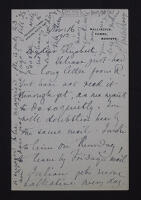
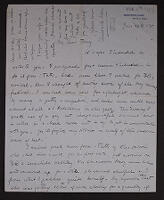
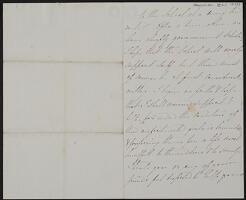
St. Saviour's Road, St. Helier, Jersey. - 'Letters cost nothing nowadays', so he will write and let Milnes know how they have been since they left England. Mrs Fenton is much better; he bought her a New Forest pony and now she 'never rides less then 12 or 14 miles a day'; the children also 'grow fat' and do very well. St Helier's is 'the most beautiful place I ever saw'; housing is dear, but 'Every Article of Food is 30 per cent cheaper than in England except Bread'. Does not understand this, as he is sure more corn has been brought to the island since he came there than would be needed for everyone on it for a year; has 'no doubt a great deal of it, finds its way into England as Jersey Meal - which is exported for Seed to England'. Discusses the price of meat and wine, and the nature of the farming land. Attendance at church on Sunday 'set[s] us an example'.

Hopes Milnes' wife is better. His 'duty' may be done in four Sundays, and then he will return. Worth coming here if Milnes wants an 'excursion'; the Malanta [? - ship] from Southampton is 'like your own drawing Room, and a passage only of 10 or 11 hours'.

Letter from Edith Russell to Elizabeth Trevelyan
TRER/5/274 · Item · 28 Feb 1954
Parte de Papers of Robert Calverley Trevelyan and Elizabeth Trevelyan

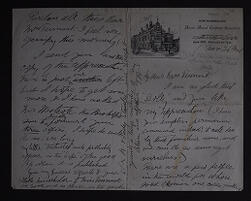
41 Queen's Road, Richmond, Surrey. - Apologises for not writing sooner; hopes Bessie saw the notice in the newspaper that Bertie had left hospital. He is very cheerful and getting stronger, though still thin; they walked a little way in Richmond Park yesterday. 'It is heavenly to be together again and alone'.

Letter from Edith Russell to Elizabeth Trevelyan
TRER/5/273 · Item · 15 Feb 1954
Parte de Papers of Robert Calverley Trevelyan and Elizabeth Trevelyan

41 Queen's Road, Richmond, Surrey. - Bertie's fever seems to have been caused by an infected stitch; he has no temperature tonight for the first time in a week. He had an x-ray to check whether the organs disturbed during his [prostate] operation were causing trouble, but everything was normal. He should be able to go home soon, and they are both very happy.

Letter from Edith Russell to Elizabeth Trevelyan
TRER/5/272 · Item · 9 Feb 1954
Parte de Papers of Robert Calverley Trevelyan and Elizabeth Trevelyan

41 Queen's Road, Richmond, Surrey. - Thanks Bessie very much for offering to take in the Russells, but the workmen have finished at the Richmond house. However, Bertie has developed a slight fever, and must stay in hospital until it goes; she feels quite anxious, as the cause is not known, though the doctors insist there is no need to worry.

Letter from Edith Russell to Elizabeth Trevelyan
TRER/5/271 · Item · 1 Feb 1954
Parte de Papers of Robert Calverley Trevelyan and Elizabeth Trevelyan

41 Queen's Road, Richmond, Surrey. - Bertie is getting on very well [after his prostate operation]: 'looks like himself again - except painfully thin - and smokes his pipe like billy-o.' Has told him about Bessie's letter, and the excerpt from Dr [Karl] Bluth's letter; he was very pleased. He can only read light thrillers at the moment, but thanks Bessie for offering to send the "Persian Adventure". Will probably be able to go home in a week; their ceilings fell down just before Bertie's operation, so the house is 'full of builders and plastic and dust'. Is sorry to hear that the glare of the sun on the snow pains Bessie's eyes.

Letter from Edith Russell to Elizabeth Trevelyan
TRER/5/270 · Item · 22 Jan 1954
Parte de Papers of Robert Calverley Trevelyan and Elizabeth Trevelyan

41 Queen's Road, Richmond, Surrey. - Bertie's operation yesterday was successful, according to the doctors, and he has made good progress. There were some complications, so the operation was 'frighteningly serious and took a long time'. He will probably be in hospital for about three weeks. Will give him Bessie's letter to read when the 'haze of drugs and pain' has gone.

Letter from Edith Russell to Elizabeth Trevelyan
TRER/5/269 · Item · 24 Oct 1953
Parte de Papers of Robert Calverley Trevelyan and Elizabeth Trevelyan

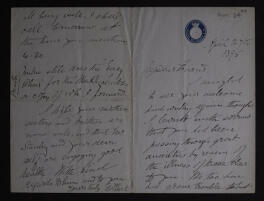
41 Queen's Road, Richmond, Surrey. - The day she and Bertie spent at the Shiffolds was 'quite perfect'; apologises for not writing sooner to say so. Hopes to see Bessie in town, but much looks forward to 'the promised repeat expedition' when the days are warmer and longer again. Is most grateful to Bessie for welcoming her so warmly. Asks to be remembered to Miss Jones, who did much to make them happy, and 'the other ladies' as well if they are still there.

Letter from Peter Russell to Elizabeth Trevelyan
TRER/5/268 · Item · 2 Apr 1949
Parte de Papers of Robert Calverley Trevelyan and Elizabeth Trevelyan

Casa Cuseni, Taormina, Sicily. - Julian seems very contented, works all day, talks and laughs a lot in the evening, and they find him 'very charming'. This is an ideal place for him; the house is full of people, all 'very friendly and companionable'. Knows it is hard to guess how people are really feeling, but it seems he is being 'soothed and rested'. She came out here without the doctors' permission and is feeling better than she has for months.

Letter from Peter Russell to Elizabeth Trevelyan
TRER/5/267 · Item · 15 May 1937
Parte de Papers of Robert Calverley Trevelyan and Elizabeth Trevelyan

Telegraph House, Harting, Petersfield. - Apologises for not thanking her sooner for the face-towels; 'sick-room routine' seemed to take up all her time when she was in bed, and she has been looking after Conrad for the last week which seems 'almost a whole-time job'; though now she is getting used to it and enjoying it. Is pleased because he seems to do better with her than the nurse. Sorry she was 'so distraught' when Bessie visited; the nurse was 'cross and rather negligent' because of something in her private life, but once she was soothed down they got on well. Found her 'stories of East End midwifery' fascinating, but her methods 'not quite adequate for Conrad'. Conrad's additional names are Sebastian, after Bach, and Robert.

TRER/5/266 · Item · 16 Mar 1937
Parte de Papers of Robert Calverley Trevelyan and Elizabeth Trevelyan

Telegraph House, Harting, Petersfield. - Peter Russell hanks Bessie for the little jackets; was short of these, and since she plans to knit a large shawl was worried about not getting enough done. It is 'very warming and encouraging to have the baby welcomed like this'; Bessie is already being as kind to it as she always has to John and Kate. The children are 'both so grown up' and have been making things for the baby.

Bertrand Russell adds that it would suit him to bring John and Kate to visit on April 9, as long as the baby does not come then. Is not going to Holland this spring, though this was talked of. Is glad she agrees with what he said to the Lords.

Letter from Elizabeth Palgrave to Dawson Turner
TURN III/A/21/25 · Item · 29 Oct. 1823
Parte de Correspondence of Dawson Turner, Sir Francis Palgrave, and Hudson Gurney

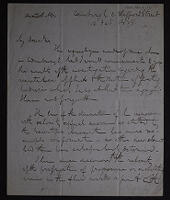
22 Parliament Street, (London).—(29th.) Has been with her husband to call on Murray, where she read parts of Byron’s manuscript memoirs. Discusses the contents and her negative view of Byron’s character. Describes a boat journey to the Tower, and a visit to the White Tower.—(29th.) Has received his letter. Her husband has gone to the Tower again.

——————————

Transcript

22 Parliament Street Oct. 29. 1823.

My dear Papa /

Since you were kind enough to wish to hear from me whenever I should meet with any matter of interest to communicate, I will not close this day, which has afforded me some respite from my late engrossing household cares, without setting down what I have been able to remember, however little it may be, which may interest you to hear. My husband went this morning to the Chapter-House {1} in order to initiate his youngest Clerk into the mystery of decyphering the Rolls in that office, and as his morning was thus broken into, he devoted the remainder of it to assisting Mr Bayley {2} in procuring a publisher for his intended history of the City of London. For this purpose he went to Murray’s, and he was kind enough to take me with him. Mr Murray seems inclined to enter into Mr Bayley’s proposal—While he and Frank were talking of the expence etc. of the work, he was so obliging as to put into my hands the MS. of Lord Byron’s memoirs of his own life, which, with those of his other poems including the 2 first cantos of Don Juan, are carefully preserved in a coffre-fort in Mr Murray’s private room. I opened the pages accidentally at that part of his Lordship’s life which mentions his marriage, and I read it with the utmost interest and avidity. Lord Byron prefaces this portion of his MS. by professing his design of hurrying over it, as it is of all the most painful to record. He then, in the most cold-blooded and heartless manner, declares his little attachment to his wife at any time—not that he married her for her fortune, which in possession was small though in prospect large, while he settled his own more lavishly upon her—but he was snowed-up for a month in the country without another creature to whom he could make love in his way. It is grievous to read his declaration of indifference to his wife and of aversion to her mother, whom he never mentions but by the most opprobrious epithets. Nor does he ever call his wife by any name but that of “Miss Milbanke”.

I wonder that Mr Murray should allow these papers to be seen so freely. They contain the most severe remarks, not only on Sir Ralph Milbanke’s family, mode of life etc,—but all the families in the neighbourhood whom his Lordship met, are mentioned by name and classed in the wittiest but most cruel manner. Lord Byron evidently set his mind to evil—he takes delight in recording his own wickedness, and in the most perverted of all feelings—that of exposing and degrading his wife. A leading trait in his memoirs, is the extreme pleasure he takes in levelling, as far as he can, those who are eminent for virtue to his own standard. Some unworthy anecdotes of Dr Paley, he records with evident delight. Throughout the whole he seeks to harden his own heart. Even when relating his wife’s confinement he barely mentions her or his child with interest, but dwells on every annoyance from her mother and the detested Mrs Clermont, {3} and on every offensive and degrading circumstance. As far as good can be compared with evil, I should say that Lord Byron’s mode of writing bears great resemblance to Mr Hudson Gurney’s, for strength, clearness and quaintness.—But all the power of his mind seems forcibly turned to do evil only. And if bad passions unrestrained can account for his conduct, yet in committing such a testimony of himself to the world, he must have been actuated by motives so perverted as to be really unaccountable.

Mr Murray begged me to thank you for a present of game which he had received.

From his house we went to Gifford’s, {4} but he was too unwell to see any one. The next Quarterly will be published in December. We then took boat and went down to the Tower to acquaint Mr Bayley with Murray’s communication. This ease of going by water is very agreeable to us. The distance is lessened, the conveyance is cheap, and the views on the river would make it a pleasure to go thus, were it merely to look at them. Then the bridges too are such noble features. I think Westminster and Blackfriars are both very elegant, and old London bridge with its broken and time-stained piers and its immense feet through which the water struggles and dashes, is well contrasted with its new cast iron neighbour, which, though ugly enough from its materials, yet has a peculiar character of lightness as it crosses the Thames in three great strides. But the level top of Waterloo bridge, and its admirable granite fabric set it far above all the rest.—We landed at London bridge and went in front of the new Custom house—where the view, with that noble building, the concourse and variety of people, of goods and shipping, is more what we imagine of Venice than of an English capital. We looked at the front of St Magnus’ church. The tower, originally solid, has been excavated to allow of a current for the stream of population which throng before and through it. The operation has been beautifully performed. They found, when considering its practicability, that Sir Christopher Wren, in building the Church, had foreseen the possible desireability of such an alteration, and had set the massy Tower so firmly on four piers connected above by a vaulted roof, that the edifice stood steady and uninjured when the walls were removed. I think this gives a noble idea of Sir Christopher Wren’s mind.

Just within the Tower-walls, we met Mr Petrie, who congratulated us both very kindly. He is recovering, but he is much shrunk. After talking with Mr Bayley, we went over the White Tower and looked at the curious Norman chapel occupying the 2nd and 3d story. As the only entirely unaltered building of the date in England, it is very interesting. There is so much resemblance in the columns and capitals to Gournay and St. Georges, that it almost seems as if the same workmen had been employed. By the bye, I need not make a marvel of this, for Mr Bayley in his history of the Tower, says that a monk from the abbey of Bec was employed in building this chapel.

Oct. 30. The post this morning has just brought me your very kind letter, dear Papa. I do thank you sincerely for it. The pleasure it has given me is indeed very great, and more than doubled by your saying that you found it “a comfort” to write to me. Pray do not think, employed as I know you are, of returning my letters, whenever it may be inconvenient to you. Frank desired I would remember him most kindly to all before he started for the Tower this morning. He is gone in a dismal pouring rain, with only the chance of meeting with a coach. In this weather there is certainly “enough of water” without going on the river. I am very sorry that he is obliged to take these long daily excursions, especially since he cannot return till past 5 o’clock, when it is just dark. But unless he goes, he loses not only his own work but that of his 2nd Clerk, who is not trusted at present with the Rolls except under his master’s eye.

I am sorry not to be able to procure a frank. I should have liked to write to Mamma and the dear girls. My husband called yesterday on Mr Wynne, {5} intending to ask him for a cover, but he is not in London. I have received a beautiful present of ornamental china {6} from Mr Gunn, with a very kind letter. If I cannot write sooner, I will send our thanks by Barclay’s parcel.

Again, my dear Papa, I beg you to accept my thanks for your letter. It is very good of my family to write so often—and the receiving and answering their dear letters, is quite a happiness to me in my morning solitude. My best love to all.

Your very affectionate child,
E. Palgrave.

Mr Dibdin and Mrs Douce called yesterday while we were out. I shall be exceedingly glad to receive Mamma’s letter and advice.

[Superscription:] Oct 29. 1823. | To / | Dawson Turner Esqre | Yarmouth | Norfolk
[Postmark:] OC | X 20 | 1823
[Postal fee:] 11

——————————

{1} The chapter-house of Westminster Abbey, a repository of state records till 1863.

{2} John Bayley, chief clerk of the Record Office in the Tower. His History and Antiquities of the Tower of London was published by T. Cadell in two parts in 1821 and 1825.

{3} Claire Clairmont.

{4} 6 St James’s Street, the home of William Gifford, editor of the Quarterly Review.

{5} Charles Williams-Wynn

{6} A wedding present.

Notebook and journal of Sir Arthur Stanley Eddington
Add. MS b/48 · Item · 1906-1944
Parte de Additional Manuscripts b

The book contains various autobiographical lists and a journal, of varying detail, describing Eddington’s activities in the years from 1905 to 1914. The first inscriptions in it were evidently made in 1905, though it includes some information from earlier years. See the separate descriptions of the individual inscriptions and inserted material.

Sem título
BABN/48/9 · Item · Jan 1882
Parte de Papers of the Babington family of Rothley Temple

Signed by candidates: Henry Babington Smith: Grace M. Macaulay (née Conybeare): Edith Oldham: Margaret Smith; Ada Currey; H. Gardiner; George Edward Smith; Mary Susan Duff (née Smith); Katharine Diana Ellis; Jane A. H. Ellis; Agnes J. Gardiner; Bertha Ellis; Margaret F. Ellis.

Copy letter from Marian C. Harrison to J. G. Frazer
Add. MS b/36/32 · Item · c 1947-c 1955
Parte de Additional Manuscripts b

Peile Hall, Newnham College. Dated August 7, 1911 - In the courtyard to the Sanctuary of Monte S. Angelo was an old oak tree on which pilgrims used to hang stones with holes, asks if he knows of other similar trees; encloses a postcard of the 'Grotta Della Chiesa Di S. Michele' [original present] and a transcript of two references to the oak tree.

Letter from Dora Russell to Elizabeth Trevelyan
TRER/5/265 · Item · 12 Nov 1932
Parte de Papers of Robert Calverley Trevelyan and Elizabeth Trevelyan

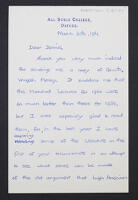
Beacon Hill School, Harting, Petersfield. - Was very glad to show Bessie's friends over the school and hear some news of her. Sees very few people, since the school 'takes up so much thought and time' and she does not dare leave it for too long or go far away. Always remembers the day they first met, since it was also the first time she met Bertie; they all thought then that the world would be better after the war. Supposes no-one will now see a 'cheerful and up-and-coming world' like the one she grew up in; at least they can take care of some young people. Having four children and a school makes her 'feel quite aged'. Asks if they see anything of Bertie these days.

Letter from Francis Hugh Adam Marshall to W. W. Rouse Ball
O./6.6/45 · Item · 11 Jan. 1919
Parte de Manuscripts in Wren Class O

Christ's College, Cambridge. - Thanks Rouse Ball for his 'kind offer of the copy of the Donkey Row picture'; is sure the college would like it for the Library; knows there are copies about but the college doesn't seem to have one. Believes E. S. Thompson is one of those in the picture, and will be able to supply the names of the others from [Archibald?] Liversidge who was up at the time of the race.

O./6.6/43 · Item · [1874-1876?]
Parte de Manuscripts in Wren Class O

Assemblage of figures in which the faces of various Cambridge personalities are spliced into incongruous scenes. The accompanying printed key explains that, for example Neptune in his chariot has the face of John Couch Adams, since 'The learned Professor was the first to discover the above mentioned planet; the Vice-Chancellor [1874-1876], Samuel Phear, 'did his best to suppress the "wooden spoon"' so his face is superimposed upon one. A scene of three figures balancing on a beam in front of the fountain in Trinity Great Court is labelled 'The Pantomime', and the figures are identified as 'The Author of Supernatural Religion [W. R. Cassels], 'Prof. Lightfoot' and 'Prof, Westcott', with a brief account of the controversy following the anonymous publication of that work in 1874. A tug of war competition is labelled 'Classics v. Mathematics'; a coxed four are labelled 'Ye Antient Mariners'.

Hard to decipher pencil annotations on back, which includes 'Bradford, Camb.' [probably the seller, see O.6.6/47].

Comic photomontage of Cambridge personalities, with key
O./6.6/42 · Item · [19th cent.]
Parte de Manuscripts in Wren Class O

Photomontage in mount: assemblage of figures in which the faces of various Cambridge personalities [as well as 'Jowett (of Oxford)'] are spliced onto incongruous costumes or animals' bodies, given wings etc, With tracing paper to fit over image and number each individual; copy of numbers on separate sheet of paper; key with names for most numbers.