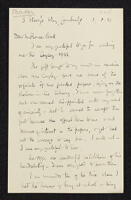
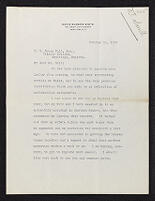
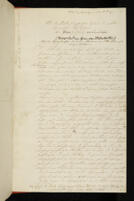
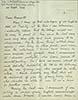
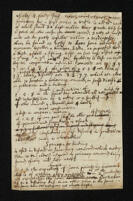
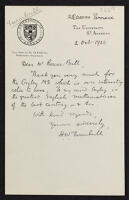
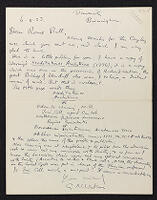
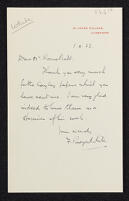
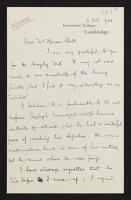
3 Storey's Way, Cambridge. - Thanks Rouse Ball for sending him the Cayley MSS, which he is very glad to have. Was at school with Cayley's son Henry; remembers doing Latin prose with him, and the 'various mathematical adventures' they had together; regrets not hearing of his later life.
The Master's Lodge, St. John's College, Cambridge. - Thanks Rouse Ball for sending him the letters from Sylvester to Cayley; has 'only as yet just opened the parcel but it is clear that there is a good deal of matter in them'.
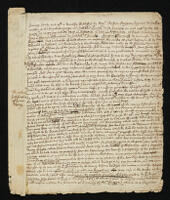
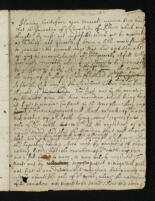
Note about James Duport pasted to the inside front cover. Notes headed 'G. E. H. Grigson Esq., Pelynt, Looe, Cornwall' tipped in at beginning of book: 'A commonplace book in a late 17th cent: hand or early 18th, by an undergrad: or fellow of Trinity College...', records extent and condition of book before listing contents. Note at the bottom [in the hand of A. F. Scholfield, Librarian?]: 'Bought for £1. ? Apr. 1927'.
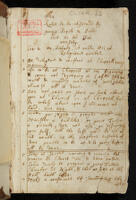
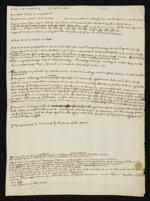
pp. 1-15 (pp. 5-6 excised): 'Rules to be observed by young Pupils & Schollers in the University', concluding 'The End of Mr Duports Rules. Ann. dom. 1660'
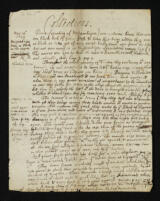
pp. 16-18: 'Animadversions upon the Election of Fellowes in Trin: Coll. Ann dom: 1656.' English verses.
pp. 18-22: 'In electionem Socioru[m] Trin: Coll.Anno 1658.' Latin verses on the election of fellows to Trinity.
pp. 22[-23 or 24]: 'A Relation of a Quaker, that to the shame of his profession attempted to bugger a mare neere Colchester Anno 1658.' English verses. Most of the tile, from 'to the shame' to 'Anno', crossed out in later hand. Four verses only; the leaf containing the rest has been excised.
pp. 25-28: 'Verses made upon the election of Fellows T.C. 1659.' English verses.
pp. 31-33: 'The hunting of the Hare.' English verses.
pp. 33-49: 'Oratio M[agist]ri Linnet, habita in Collegio SStae & Individuae Trinit: cu[m] Primarij lectoris officiu[m] exorsus est.' Latin prose. Text of oration delivered by William Lynnet at Trinity at the beginning of his term as Head Lecturer, Oct. 1656.
pp. 50-73: 'Oratio habita in Collegio SStae Trin Cantab: circa annum 1654 die quinto Novembris in conspirationem Anglicanam. Authore M[agist]ro Ramsy ejusde[m] Collegii quonda[m] Socio.' Latin prose. Oration delivered by John Ramsey c 1654, ' about the Anglican [English] conspiracy of the fifth day of November [the Gunpowder Plot].
p. 74: Transcription of lines from Isaac Watt's 'How does the little busy bee...', published 1715, in childish hand.
'Walter Godfrey's' written in pencil on last page; there is a discussion in Preston & Oswald (2011) as to whether the original owner may have been Walter Godfrey, matriculated 1661 but did not graduate.
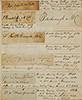
The title on the front free endpaper is 'Autographs | Collected by | Henry Coggin | Trinity College, Cambridge'.
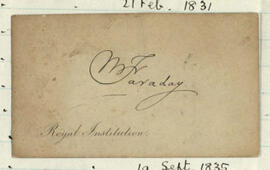
Pasted to the leaves of the book are about 120 signatures cut from letters or other documents and 6 letters. The first group of signatures (f. 1r) are those of all the Masters of the College from Robert Smith (Master, 1742–68) to W. H. Thompson (Master, 1866–86) except William Lort Mansel, the space where the latter would go being occupied by the pencil note, ‘Have not yet got this Autograph’. The autograph of Henry Montagu Butler, who succeeded Thompson as Master, appears later in the book, as Coggin had already obtained it when Butler was a Fellow.
The Masters’ signatures are followed by those of various senior and notable members of the College, including Fellows, noblemen, prize-winners, high-achieving graduates, and sportsmen. They include the signature of the Marquess of Lorne, who later married Queen Victoria’s daughter Princess Louise, and who, Coggin notes, was ‘One of last of the Fellow Commoners, who wore blue gowns with silver lace & were allowed to dine at the Fellows table’, and a few pages later is the autograph of I. J. Jermy, admitted in 1840, who Coggin notes was ‘Murdered with his Father at Stanfield Hall Norfolk Nov[embe]r 28th 1848 by James Blomfield Rush who was hung at Norwich April 21st 1849’. Below this is the only autograph of a female in the book, that of Eliza Chasteney, identified as ‘Lady’s Maid to Mrs Jermy Sen[io]r who in attempting to save her Mistress’s Life from the Murderous designs of the villian [sic] Rush was wounded in several parts of the body.’
The signatures are followed on ff. 9r-11r by five complete letters. Inside the front cover is a letter to the College Librarian from the donor. See the individual descriptions for details.
Sem título501 West 130th Street, New York City. - Good to receive Ball's letter this morning, read his article on Euler, and to see 'the very generous contribution which you made to my collection of mathematical autographs' [items selected from the papers of Arthur Cayley]. Hoped to see Ball in England last year but he and his wife had a car accident in France from which his wife has still not recovered; is hoping to get to England next summer. His History of Elementary Mathematics should come out this winter; will ensure Ball gets a copy.
Many thanks for sending the autograph material; has 'several thousand autograph letters of mathematicians, about a thousand of them being from people really worth while'; has tried to secure this material, with 'a great deal of Orientalia' in mathematics, for future historians of the subject; intends to leave it to his university and have it catalogued. Postcript: has noted on the Cayley letters that they came to him 'through [Ball's] kindness'.
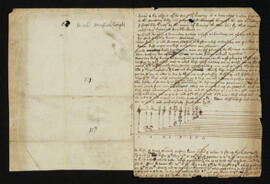
The sheet labelled '11A' has the annotations 'Hook's Musick Scripts', '101', and 'NP'.
Letterpress copying book, with copies of letters from Image to students and their families, as well as to other members of the College and University on tutorial business. Letter from Florence Image to the Master [G. M. Trevelyan], 4 Jun. 1948, originally accompanying the book when given to Trinity, which mentions that she has 'another volume of this date, a year or two earlier, to go through... I believe of less import in the College Annals' found loose inside front cover; this is presumably now O.11.19a.
Sem títuloIn Hertz's own hand. 'III' written in blue crayon on front original flyleaf. Hertz's address given in the margin of the first page of the paper: 'Prof. Dr. Hertz, Wadstr. 33, Karlsruhe'. Several annotations and corrections throughout the text of the paper, including to the title. First subtitle crossed out, another below in brackets: 'Aus den Sitzungsberichten der Berliner Akadamie vom 2 Feb. 1888, mit einigen Zusätzen' [as appeared in the paper's second publication in Annalen der Physik und Chemie vol. 34].
Sem títuloThe full title is ‘A | Descriptive Catalogue | of Manuscripts | written in the English Language | to the year 1500 | preserved in the Library of | Trinity College, Camb. | compiled by W. W. Greg | sometime Librarian | between 1907 & 1914’.
Standlands, River, Petworth, Sussex.—Refers to his catalogue of English manuscripts in the Library of Trinity College (see O.11.5), and to his plan—long since abandoned—of compiling a corpus of all English manuscript works down to 1500.
—————
Transcript
Standlands, River, Petworth, Sussex
25 Sept. 1944
Dear Bennett
When I drew up that catalogue of 100 English MSS at Trinity, at the time I was librarian, I naturally hoped that the College might see its way to print it. Then came the last war and any idea of the sort had of course to be abandoned. By the time things settled down again I was busy in other fields, and moreover the catalogue I knew had become in some respects out of date. Had I examined it I should probably also have found it unsatisfactory. So I did no more about it and finally deposited the MS in the Library for the use of any one who might be interested. I need hardly say that it is at the disposal of you or of any body else who should be able to use it as a basis for further work.
During the last war I dreamed of compiling a corpus of all English manuscript works down to 1500. It would have been a big undertaking. I estimated, on a very rough basis, that there [are] some 5000 MSS surviving, exclusive of legal and diplomatic documents, private letters, and collections of recipes. I envisaged the work in three parts. (1) A catalogue, possibly roughly chronological, of the actuall† MSS, with full bibliographical descriptions, giving particular attention to the make-up and growth of the MSS when these were not written all at one time. (2) A catalogue of the works they contained, giving the MSS of each and such information as was possible concerning the relation of the MSS. (3) An atlas containing some hundreds of facsimiles of pages from the manuscripts, especially the dated or datable ones, with transcripts and palaeographical notes. I also had in mind a catalogue of all works to 1500 giving a brief literary account of each with and† specimen of some 50 lines transcribed exactly from the oldest or most authentic MS. An ambitious project! which I need not say I have long since abandoned.
Best wishes
Yours
W. W. Greg
—————
Marked at the head in pencil, ‘Letter to H S Bennett, Emmanuel College, given by H S Bennett to Trinity College Library.’
Leaf from a copy of Aristotle, Categoriae in Latin translation by Boethius with fragment of Themistius, De decem categoriis. Label on what was once spine of cover, 'Epis[tol]a Sacra'; 'N29' in what appears to be the same ink; '85' in another ink. 8 small slits made around former spine for the purpose of fastening.
2 Queen's Terrace [on headed notepaper, University of St Andrews]. - Thanks Rouse Ball very much for the Cayley MS; 'To my mind Cayley is the greatest English mathematician of the last century - and this'.
University, Birmingham. - Thanks Rouse Ball for the Cayley MSS, which he is very glad to have. Has a copy of Waring's Meditationes Analyticae (1776) once in the possession of Richard Watson, Bishop of Llandaff; the title page of this edition states that Waring was at Trinity, but Watson can find no suggestion that either Waring or the Lucasian chair had any connection with the college; asks if this is a misprint.
St John's College, Cambridge - Thanks Rouse Ball for the Cayley papers; is very glad to have them as a specimen of his work.
Emmanuel College, Cambridge - Thanks Rouse Ball for the Cayley MS; it 'may not add much to our knowledge of the binary quintic, but I find it very interesting as an "exhibit"'. Believes it 'fashionable to try and despise Cayley's downright sledge hammer methods of attack; but he had a wonderful power of reaching his objective. He was a mathematical tank in some of his methods, but he knew where he was going'. Has always regretted that Cayley died before he came up. Likes to think of himself as a 'sort of grandson' since he learned geometry from G. T. Bennett, who learnt it from Cayley.
Endorsed 'Dr Hooks Proposals to the K[ing] for his watches with 2 Balances finding Longitude' (A-N) and 'first Proposals abt the Longitude' (P-T).
Autograph manuscript of a talk broadcast by the BBC Home Service on 23 Dec. 1954. Russell has put the incorrect date 'December 23, 1955' at the end.
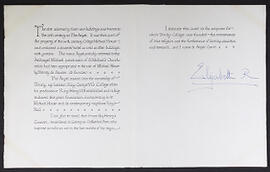
Sem títuloWith the signature of Queen Elizabeth the Queen Mother, 'Elizabeth R'. Note on pasted to inside back of case 'This slip case was made by A. Halcrow, Sub-Librarian, at 24 hours notice'.
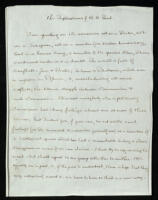
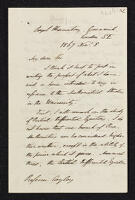
Royal Observatory, Greenwich, London S. E. - Thinks it 'best to put in writing the purport of what I have said or have intended to say in reference to the Mathematical Studies in the University'; comments first on the study of partial differential equations, which 'are very useful and therefore stand very high., as far as the Second Order. They apply... to the great problems of nature concerning time, and infinite division of matter, and space.. Beyond that Order they apply to nothing'.
Discusses 'what I may call the moral part' of mathematical studies: thinks a 'heavy responsibility' lies on those responsible for the course of education in the University to direct it 'in the way in which it will be most useful to the students' by 'disciplining their powers and habits' and 'giving them scientific knowledge of the highest and most accurate order (applying to the phenomena of nature) such as will be useful to them through life'; does not think that the 'mere personal taste of a teacher is sufficient justification for a special course' unless these aspects are taken into consideration.
Has for some years inspected the examination papers, and considers that except for the very best students there is currently 'a prodigious loss of time without any permanent good whatever', since only a very few such as Adams and Stokes retain their study of abstract analytical geometry. Believes that in contrast a 'careful selection of physical subjects would enable the University to communicate to its students a vast amount of information; of accurate kind and requiring the most logical treatment; but so bearing upon the natural phenomena which are constantly before us that it would be felt by every student to possess a real value' and therefore remain in the mind and 'raise the national character'.
Is 'old enough to remember the time of more geometrical processes' and believes that 'for the cultivation of accurate mental discipline they were far superior to the operations in vogue at the present day. There is no subject in the world more favourable to logical habit than the Differential Calculus in all its branches...'; thinks a return to study of it would be 'far more advantageous... than the simple applications to Pure Equations and Pure Algebraical Geometry now occupying so much attention'.
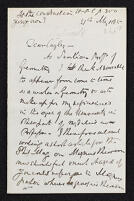
'As Savilian Prof[esso]r of Geometry I think it desirable to appear from time to time as a worker on Geometry so as to make up for my deficiencies in the eyes of the University in other parts of my duties as Professor'; intends to write a short article for the Philosophical Magazine on Magnus' theorem and asks Cayley to refer him to Magnus' original paper; 'I can apply my equations to obtain the motion required to bring the two schemes onto perspective relation very simply - ie I can get what you call the kinetic matrix'. Further discussion of this, in relation to Cayley's work.
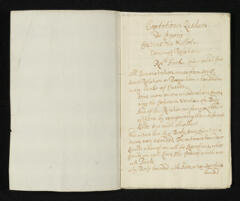
Headed 'Cogitationes Quaedam De Corporis Extensione & Motu Eorumq[ue] Relatione. Rob[er]t Hook. Inter sched. Juv.' Remainder of text in English.