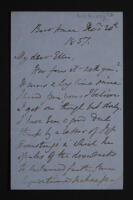
3 St. Edmund’s Terrace, Regent’s Park, N.W. Thanks him for his kind letter of sympathy after the death of his wife. Is now preparing Gabriel's family letters for publication. Notes that Theodore Watts volunteered to write a memoir, but nothing has happened, so William is likely to do it himself. Accompanied by a printed letter of thanks for the sympathy on the death of Lucy Rossetti.
(The salutation is ‘My own dearests’. The letter is directed to Mrs D. Turner.)
On Athenaeum headed notepaper. Bearer unidentified.
The Mill House, Westcot [sic: Westcott], Dorking. - Is writing in the 'little room' he hopes will be hers; the fire burns well and it is warm and looks 'quite nice' now he has sent the Insley furniture to the spare room. Thinks he has thought of a way to improve his play and is happier about it now. Is reading Mériméee's "Les Cosaques D'Autrefois ", which is 'stunning'. Will write to the Insleys about their furniture; there is plenty of room for her books. Has not seen the Frys since Sunday; he [Roger Fry] understood about distempering the bedroom since they do not like the paper, though he probably thinks they are making a mistake. Has nearly finished "Arne" [by Bjørnstjerne Bjørnson?]; discusses why he does not 'take to it altogether'. Encloses a letter from his Aunt Meg [Price]; he knows nothing about pianos so she should tell him what to say. Someone suggested by [Julius Engelbert] Röntgen might help them choose; does not know whether his aunt's 'professional friend' is to be trusted. One day they will have room for a big piano, but expects this would have to be an upright.
Finishes the letter next morning. Is sorry her aunt is not as much stronger as she first thought; hopes that the finer weather will help. Expects it is right for her to sell the land; she would know better than he where to put the money. Very glad her uncle and aunt think Whitsuntide will do [for the wedding]; someone like [Abraham?] Bredius would probably be best as the witness; her uncle once suggested the consul at Rotterdam, if he were Dutch. Doubts if any of his friends will come; thinks he will not ask. Was stupid to leave Luzac's bill in London; has asked it to be sent to him.
11 Greenhill Terrace, Edinburgh. - She, Mollie Grierson, and Donald [Tovey]'s doctor are seeking help in getting Donald 'out of a very precarious situation which she cannot describe now; hopes that Bessie is at the Shiffolds and might be able to see her next week when she will be at Englefield Green again; asks her to telegraph. Donald 'practically well, and could have been convalescent and on his feet before June was out'; they are not anxious about his health.
23 St John's Wood Park, N.W. - His application has been refused, and he will be interned in a few days; his wife and children will stay here as they are 'perfectly safe & well looked after'; expects they will get permission to stay though they have heard nothing yet. Has advised his solicitor to do nothing for the moment and 'accept the inevitable'; if Trevelyan could find out whether a petition to Sir John Simon in a month or two might be worthwhile, he should let his secretary Frank Standfield know. By 'papers & excitement may have calmed down', especially if England has had some 'big success' in the war, such as the fall of the Dardanelles, and the department may be less overworked. Knows he could get 'many artists, composers & friends besides 200 employees to sign a petition', and has 'worked a great deal in the interest of music in this country', with 'many poor artists' dependant on him. Standfield and his solicitor are well informed on all these points, but anything that can be done must be done quietly and kept out of the papers, as his 'competitors would counteract it if possible'. Donald [Tovey] might also help to get some signatures or introductions if needed, but for the moment thinks it 'wisest to keep quiet'. Thanks Trevelyan warmly for all the support and help he has given in the past. Adds a postscript that he has not yet written to Tovey but will do so if he has time; asks Trevelyan to pass on his regards if he is interned before he has chance
110 Banbury Road, Oxford.—Sends a cheque for Smith's work on the translation and transcription [of the Hypnerotomachia], which he hopes to post to Round on Monday. Discusses two points of detail in the text.
c/o A. Waterfield, La Fortezza, Aulla, Lunigiana. - Thanks his father for his 'very kind letter' [12/93], and for the 'most generous arrangement on making good the income tax' on his allowance, which the previous arrangement was enough to cover; he and Bessie wish to thank his parents 'for this and other constant kindnesses of the same kind'. Wonders whether the Chancellor [Asquith] will 'introduce a graduated tax of some kind': the debate would 'give Charles an opportunity, as it is one of his subjects'. Thinks Theodore [Llewelyn Davies] 'was in favour of graduation in principle, though admitting the practical difficulties'; it is at times like this that he will be much missed. Robert used to get him to 'discuss politics at great length' about once a year, usually at their Cambridge Easter parties.
There has been 'thick snow' which has kept them in for several days, but it is beginning to disappear today and they are all going out: Robert by himself, the others [Bessie and the Waterfields] visiting the country villa of the Admiral who is 'the head of the arsenals at Spezzia [La Spezia]'. Last week they went to Lerici and saw Shelley's villa; the outside has recently been 'spoiled with hideous decorations' but the interior is 'very interesting and even beautiful'; some of the furniture is quite old and might well be from Shelley's time.
Today news has come in the Italian newspapers that Balfour has '"surprised the world by surrendering himself con armi e bagagli to his great amico nemico [friend enemy] Chamberlain'". It is a pretty end to the whole story'. Hopes a few of the 'late Balfourians will have the courage to stand out and... form the nucleus of a Conservative free-trade party'. Discusses the Pervergilium Veneris, a 'curious poem' for which he has 'always had a weakness'.
Apologises for not replying sooner, due to flu. Hopes that Trevelyan is recovering well after his operation, and that 'excellent friends', as well as his wife' are helping time pass pleasantly. Hopes to go to Rome after Easter. [John] Walker is coming, with Alda and Cecil. Hopes to come to England. Has sent word to Florence that Trevelyan's subscription to "Pègaso" should be paid. The Berensons left in uncertain weather and had a bad journey, but they seem to be much enjoying Tunis. Encourages Trevelyan to write an epistle to his doctor.
14, rue Nungesser et Coli, Paris XVIe. - Reached Europe about three weeks ago: received a letter on his arrival at Marseille from his Swedish friend Amelie Brazdova, whom Trevelyan once met, inviting him to visit her at Plascassier in Provence. Has been a week in Paris; his friends [Germanova and Kalitinsky] have grown old and Rex [the dog] is very fat, and getting blind; there is a sense of things passing away, at home, and in the streets. No great disorder as yet, but workmen with red flags singing the Internationale and driving through the town in lorries reminds him of the time when the Provisional Government had begun to weaken in Russia. Hopes he will be able to come next month to England, and asks to know Trevelyan's summer plans.
MS notes on 'Quadratic Construction'.
Was disappointed by a visit to Jerusalem, has been hospitalised for a short while.
40 Weymouth Street - dividends on stocks, consols left for heirs, Frederick Donne repaying his debts to Donne, Petumber "kicked out of the Bombay Rialto", annual survey of 35 theatres, death of a man caused by falling down theatre stairs
Heavily corrected first proof, 16 pp. + 3 figs., marked 'Rec. May 16 1958'.
Brief correspondence with N.F. Mott re publication of article in Phil.Mag.
This is based on one of Thomson's research papers prepared for, or related to, work on thermonuclear power at A.E.I./Harwell.
Announces that they are going to stay a night in London, and are only passing through. States that he will go up early and see Myers between 12 and 1, before lunching with Nora. Suggests Albemarle or elsewhere, and asks if this would suit. States that he wants much 'audire et [ ] voce[s]'.
Part 1: Lunteren. Dutch Society of Immunology Symposium: 'Vaccination, But How?', 3–4 March, 1988, Lunteren
Part 2: Amsterdam. Twelfth International Congress for Tropical Medicine and Malaria, 18–23 September 1988
Part 3: Amsterdam. Royal Society Delegation to Royal Netherlands Academy of Arts and Sciences, William and Mary Celebratory Meeting, 28–30 September 1988
WW guessed right about Parliament: 'I have a report on hand and am ordered to get a bill drawn (not about tithes but copy holds) which occupy me much - I shall be glad to launch this new piece of law for I think it will be a useful and creditable thing done - but I am getting weary of my bureau life and lament sometimes over my lazy young days'. If RJ can get a day or two he will visit Cambridge before WW leaves for Lowestoft.
In reply to his letter concerning obtaining a church and a burial ground near the Turnpike on the Chesterton road.
Trinity College - WW has 'a vehement zeal to illuminate McCulloch [J. R. McCulloch] and his tribe. I have got Smith [Cambridge University Press] to sort permission to have your second volume printed which was granted without hesitation'.
Staying at Rugby, "awful" Old Rugbeians regarded as "idiots" by Robert B Mayor, Shakespeare readings: Rugby
Albemarle Club, 37 Dover Street, W.1. Dated 27 Dec. 1918 - Saw [Arthur] Keith at the Athenaeum, who explained the delay with the expedition committee [of the Royal Society] is that Walter Long wants to head it but has to wait until the election to see if he is Colonial Secretary; Keith will see that funds are available after Lilly explained to him that at the Army & Navy Stores it is necessary to pay when giving an order; had a good view of the King and President Wilson driving to the palace.