
THMG/G/115
·
File
·
1959
Part of Papers of Sir George Paget Thomson
4478 results with digital objects
Show results with digital objects
Add. MS a/206/115
·
Item
·
26 Mar. [1840]
Part of Additional Manuscripts a
'Its perusal [WW's Philosophy of the Inductive Sciences, Founded upon their History?] gives me to understand better what you mean by the Idea of Organization, though I confess I still do not quite like the phrase, as standing in close column with the Ideas of Space, Time and Resemblance, - the instant and inevitable product of sensation - but probably there are reasons for it given in the first volume, which have not at first occurred to me. You will understand that it is chiefly the word organization which I object to in this use, as most apparently expressing the most radical form of the idea, which I presume you to have in view'.
FRAZ/33/115
·
Item
·
22 Jan. 1937
Part of Papers of Sir James Frazer
Pilgrims Place House, N.W.3 - Hopes to visit; encloses a prospectus for his book [not present]; publisher has declined [her?] 'Petites Comédies'; he is facing the same situation for his 'Première Année'.
TRER/4/115
·
Item
·
22 Nov 1940
Part of Papers of Robert Calverley Trevelyan and Elizabeth Trevelyan
1490260 Cadet Luce JM, N troop D Battery, 124 OCTU, Llandrindod Wells. - Thanks Trevelyan for the long letter and news of his parents; hopes his father will go to America. Is in his second month of training and still learning 'infantry stuff': will not begin real anti-aircraft training till next month. Got leave last weekend with two of his friends, met Joan [Allen?] and climbed Snowden; then showed her the camp at Llandrindod before she left for Cardiff. Has received a letter from Dick Bosanquet, who is very sad about the death of his cousin Wendy. Glad to hear of Julian's success; hopes he will enjoy Army life [with the Royal Engineers]. Asks if there is any news of Tet Htoot.
TRER/2/115
·
Item
·
4 Aug [1921]
Part of Papers of Robert Calverley Trevelyan and Elizabeth Trevelyan
Kings Coll Camb. - Sends an enclosure, which is his only copy so he asks Bessie to be careful with it. Expects he will never be able to do anything with it, but would like to have her views: so far she is the only woman who has seen it. Is feeling 'rather useless and depressed', but hopes it is the weather rather than old age.
FRAZ/25/115
·
Item
·
Apr. 1932
Part of Papers of Sir James Frazer
7 page list of Frazer friends and acquaintances, primarily from Glasgow.
TRER/13/115
·
Item
·
26 Mar 1910 [postmark]
Part of Papers of Robert Calverley Trevelyan and Elizabeth Trevelyan
Rapallo. - He and Janet are very glad to hear that Julian has put on eight ounces. They are having good weather and walks here by themselves, before 'going on south to join the Hammonds' [John and Barbara]. Thanks Bessie for sending 'Madame Scocco's letter' [sic: Irene Zocco]; fears he will not be able to go to Palermo again; would have called on her last month if he had known she was there.
TRER/14/115
·
Item
·
27 June 1928
Part of Papers of Robert Calverley Trevelyan and Elizabeth Trevelyan
Garden Corner, West Road, Cambridge. - Originally enclosing a letter from Charles, which 'induces' him to send a cheque for £182.2.6. He and Mary had a 'delightful as well as useful time at Welcombe'; thanks Bob and Bessie for their 'hospitality and kindness'.
DAVT/C/115
·
Item
·
1962–63
Part of Papers of Harold Davenport
'Analytic methods for Diophantine equations and Diophantine inequalities', 1963.
Bound photocopy of a course of lectures given at Michigan in the Fall Semester, 1962.
Folder includes letter from publishers, 30 July 1963, outlining publication agreement.
MAYR/D/6/115
·
Item
·
[17 Oct] 1846
Part of Mayor Papers
Situation of the house at Leamington is thought unhealthy, unable to find a suitable house near Rugby, Dr Arnold's move from Rugby to Cambridge
O./18.4/115
·
Item
·
21 Oct. 1859
Part of Manuscripts in Wren Class O
TREJ/30/115
·
Item
·
[n.d.]
Part of Papers of Julian Trevelyan
Add. MS b/35/115
·
Item
·
c 1947-c 1955
Part of Additional Manuscripts b
Gordon, N.S.W. Dated Dec. 14 1910 - Is reading 'Totemism and Exogamy' and disagrees about the origin of Totemism; a missionary from Choiseul in the Solomon Islands says there are no exogamous groups there.
MACR/3/115
·
Item
·
[1968]
Part of Papers of Dame Rose Macaulay
MUNB/115
·
Item
·
1860s-70s
Part of Papers of A. J. Munby and Hannah Cullwick
SRAF/D/3/11/115
·
File
·
1938
Part of Papers of Piero Sraffa
WITT/MS/115
·
Item
·
14 Dec 1933 - Aug 1936
Part of Papers of Ludwig Wittgenstein
Notebook containing two distinct texts, the first is a continuation of Ms 114. The second, beginning on page 118 and entitled 'Philosophische Untersuchungen, Versuch einer Umarbeitung' is an attempt to revise the Brown Book in German. pp 95-100 consist mostly of pasted-in typescript.
CORN/C/1/115
·
Item
·
19 Oct 1898
Part of Papers of F. M. Cornford
Greendale House, Nottingham - teaching work is fairly interesting and the other masters pleasant, attended a concert by Richter Orchestra.
MONT II/A/1/115
·
Item
·
30 Apr. 1915
Part of Papers of Edwin Montagu, Part II
In the train (from London to Alderley).—Is travelling with the Prime Minister, who is more cheerful now, but she does not think the party will be a success. Discusses Montagu’s behaviour and feelings towards her, and reflects on the prospects of their future together. Discusses arrangements for meeting.
—————
Transcript
April 30th 1915. In train {1}.
Darling I wish I felt the faintest inspiration, but this infernal train shakes so that I find it impossible to concentrate either my mind or my pen. Opposite me sits the P.M in a more cheerful frame of mind I think, but I’ve a feeling in my bones that this party isnt going to be a success, I feel I shall quarrel with Bongie, be odious to the P.M, & have to avoid Violets questions, if she bothers to ask them. Why were you so transparent? Diana & I settled last night that “if & when” we were ever engaged we would never, once it was announced, go out together, because one can so easily see how supremely ridiculous it makes people. I dont know what is the right attitude to adopt. What do you think? I saw Katharine this morning & she asked me if we’d had a good drive as she thought you were preparing to be rather crusty to me. So you were werent you, but we had great fun in spite of it. I think she was quite right to tell you that I was “queer”. I’m sure I am! & if we keep our minds fixed on that we shall be quite all right. But please darling dont be too ready at once to think that because I dont see you every day, & can contemplate going to Boulogne, that I dont any longer like you. I’ve told you over & over again that I’m no fun to be in love with, that my supply of emotion is a thin & meagre one, but such as it is, had in quantity & quality its yours.
And you mustnt always be examining it under a microscope or subjecting it to severe tests because it wont stand it!
We can have such fun together and are & I’m sure could be so really happy, & if that cant be made a good basis for marriage I dont know that I shall ever find a better. We’ve both I’m bound to say always put ourselves before the other in the most unprepossessing terms. You take every opportunity of telling me that nothing that I want will ever make you alter your mode of life, & I am always impressing on you the fact that I’m completely & cold bloodedly detached from all interest in my own life. It doesnt sound good on paper. And yet I’m simply longing for you to be here, & miss you horribly. Its again such a lovely day & we should have been so happy. I was an idiot not to make you come, & to risk you being cross with me because I talked too much to the P.M, & his thinking I was spending more time than I need with you.
Winston was much touched at yr letter, I’m glad you wrote. God how bored I feel, how glorious one’s life ought to be & how bloody it is. But I was happy yesterday thank you so much.
Lets have a Diana Raymond party on Friday {2}, arrange this with Diana, & I’ll dine with you Tuesday either alone or go to the Tree play {3}. But Friday we’ll have a buffy. I hope this isnt a horrible letter. I’m never sure.
Love
Venetia
—————
Letter-head of 8 Little College Street, Westminster, the home of Francis and Barbara McLaren, where Venetia had been staying.
{1} Venetia and the Prime Minister were travelling from London to Alderley for the weekend. Cf. H. H. Asquith: Letters to Venetia Stanley, p. 562.
{2} 7 May.
{3} The Right to Kill, a melodrama adapted from the French by Gilbert Cannan and Frances Keyzer, produced by Sir Herbert Tree at His Majesty’s Theatre on 4 May. Tree also took one of the leading parts. There appears to have only been one performance.
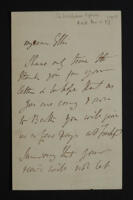
Add. MS c/67/115
·
Item
·
[6 Apr. 184-]
Part of Additional Manuscripts c
HOUG/37/115
·
Item
·
[21 May?] 1857
Part of Papers of Richard Monckton Milnes, Lord Houghton
On Athenaeum headed notepaper. Bearer unidentified.
Add. MS a/208/115
·
Item
·
5 Dec. 1831
Part of Additional Manuscripts a
CL intends to launch 'the 300 pages which you have' ['Principles of Geology', volume 2, 1832] next week. Murray [John Murray - publisher] will see Lockhart [John Gibson Lockhart] to secure a place in the next number of the Q. R. for WW's review of his work. CL has 'tried to leave the reader in suspense about the whole theory of successive creation...I think it will relieve you of one great difficulty to say that as the question of 'whether organic beings have come in gradually, or by batches', is completely one to be decided in geological evidence it is premature to discuss it...I wish to keep back the theory which I believe to flow irresistibly from the facts now established by the succession of species in the fossils of the tertiary strata'.
HOUG/224/115
·
Item
·
26 Feb. 1872
Part of Papers of Richard Monckton Milnes, Lord Houghton

PETH/4/115
·
Item
·
12 Sept. 1961
Part of Pethick-Lawrence Papers
HOUG/34/115
·
Item
·
14 Oct. 1866
Part of Papers of Richard Monckton Milnes, Lord Houghton
Add. MS a/202/115
·
Item
·
19 Oct. 1849
Part of Additional Manuscripts a
7 Camden St. & T. - Thanks WW for his paper on curves: 'It is a clear addition to our means of expression'. ADM is surprised at 'the arcs which become negative in turning a cusp'. How does WW know that his solution is the correct one? - there 'may possibly be an infinite no. of solutions'. Sketches his pen, and describes how the ink is added at one end, and the other end is merely capillary, sees that with improvements it will mean a pen with no dipping needed, and no blots.
TURN III/A/21/115
·
Item
·
3–4 Nov. 1830
Part of Correspondence of Dawson Turner, Sir Francis Palgrave, and Hudson Gurney
(The body of the letter is by Elizabeth Palgrave, but there is a short postcript from her husband.)
TURN III/A/8/115
·
Item
·
24 Feb. 1843
Part of Correspondence of Dawson Turner, Sir Francis Palgrave, and Hudson Gurney
(The salutation is ‘My own dearests’. The letter is directed to Mrs D. Turner.)
CHIL/2/115
·
Item
·
16 Jun. 1910
Part of Papers of Erskine Childers