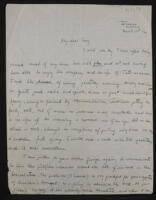
WW gives his criticisms of RJ's manuscript sheets ['An Essay on the Distribution of Wealth, and on the Sources of Taxation: Part 1. - Rent', 1831]: 'one or two parts are possibly of too sustained a tone'.
Explains that his silence is due to his having 'a great number of letters to write of a semi-political character.' Is glad to hear her favourable account of his uncle [John Crofts?]. Asks her to send his greetings to everyone. Discusses Miss [Matilda?] Tootal's questions; states that the association [the board formed by Oxford and Cambridge fellows for the examination of governesses and schoolmistresses] is only voluntary and therefore may be dissolved at any moment with more ease than if it was a chartered body. Claims however that when its work is done the distinction will not be very important, and that if the scheme fails to obtain the support of those for whom it is intended, they [Sidgwick and others] 'can dissolve without the slightest trouble and with the sense of having done [their] part towards the improvement of female education.' Explains the consequences of one's name appearing on the list of the association, i.e., that that person takes some responsibility for the arrangement of the scheme of examination and for the appointment of examiners. Refers to 'the "prestige" of a university diploma', what it represents, and what theirs will represent.
States that the scheme of the University of London 'is as yet undetermined', but that if it proves to be successful 'then there will be two schemes of examination for women, just as there are now Oxford middleclass examinations and Cambridge ditto.' Warns that if they do not get enough candidates the association will dissolve. Hopes that, by their example, they will encourage 'the Universities' to follow the same line, and that they may arouse the interest of a large number of the influential members of both Universities in the cause of the higher education of women. They intend to 'meet an existing need and to continue [their] operations as long as [they] get a sufficient number of candidates, unless superseded by corporate action on the part of either Cambridge or Oxford.' Hopes to come to visit his mother for Passion Week, and asks if he may invite Seeley to come.
RS does not mind the college losing Fellows to marriage. He hopes Cordelia Whewell 'is reasonably well, which I fear is the superior limit in her case'.
Congratulations on result in the Classics Tripos
Concerning a MS he is considering as the subject of a Roxburghe Club reproduction.
(Place of writing not indicated.)—Thanks him for writing immediately, and for his unfailing love.
Yondercott, Budleigh Salterton, South Devon.—Cites readings from a copy of Nahum Tate’s King Lear.
54 Bateman Street, Cambridge - Offers congratulations for his 'Pausanias', and mentions two that he may not realise are admirers: [J. E. C.] Welldon of Harrow and [W. G.] Rutherford of Westminster.
1952, 1954-1955, 1991
1954-1955 material is request to write book review (declined); 1991 material includes correspondence re possible translation of E.M. Senchenkova's biography of M.S. Tsvet
Bridge of Allou, Stirling - Mr and Mrs Forbes are hoping to go to Germany in a fortnight for two months. They will return sometime prior to the BAAS meeting in Edinburgh. They 'are very anxious' that WW and Mrs Whewell will 'favour us with your company at that time' (31 July to 7 August). JDF read WW last 'little book you sent me [Of a Liberal Education in General...2. Discussions and Changes 1840-1850, 1850]: and I can well believe that your judicious desire for a pause, in order to let your arrangements work themselves out - will not be particularly gratified by Lord John's [John Russell] most unexpected announcement of his Royal Commission [of inquiry into University reform]: but this ministry is not famous for carrying out its proposals'.
Pavilion Hotel, Folkestone - BCB would like WW to be present at a Council meeting of the Royal Society next Thursday.
Writes to express his sympathy with her on the death of Henry Sidgwick. Recalls a previous visit paid by the Sidgwicks to him [and his wife], which he describes as 'a sweet and precious memory now.' Declares that on that occasion Henry 'was so tender, so entirely his old lofty yet simple and child-like self.' Declares that it is difficult for him to realise 'the loss of a friendship extending, with never so much as a cloud, over 40 years....' States that he has been reading over old letters from Henry to him. Expresses how much he loved him, and claims that although their paths in life 'parted widely...the old Trinity affection was deep and strong....'
Young, Edward Mallet (1839-1900), headmaster49 Marina, St Leonards. Encloses M 3/1/93, congratulated H M Butler on another prize.
Trinity College Cambridge - Lodgings for Mary Emma Cornford in Cambridge, almost certain not to get Cardiff professorship and is happy to stay in Cambridge, article on forthcoming Greek Play for Review.
Typed copy. Union Club, Malta. To leave for Egypt, description of Birkin who has played for Notts 2nd XI, has been reading 19th cent womens' literature.
Sends Sidgwick 'a little book' [not included], at the end of which is to be found 'the text of the present Map.' Also sends 'a rough [Mass]', which he prepared the previous year, with a view to ascertain if he could '[ ] how far the modern map shows traces of the view formerly held about the Eucharist.' States that his only materials were 'the Map itself and Palmer's O[riginal] Liturgica'. Tells Sidgwick not to trouble to read more of the [Mass] than he feels inclined to, or to write to him about it, but tells him that he can send it back with the book, at his convenience.
Lushington, Sir Godfrey (1832-1907), Knight, civil servantBalliol College, Oxford. - Account of Dindorf's proposals for the publication of a manuscript by Uranius which was subsequently found to be a forgery by C. Simonides. 'Pertz's information is very curious'; asks if it is 'all an abstract of entries made at the time, since it differs in some respects from Scott's recollection of what was said at the time. Discusses his own recollections, mentioning Bekker, Böckh, Magnus, Lepsius, Bunsen, Ehrenberg, Tischendorf, and Humboldt. Dindorf tells him that Sir T. Phillipps has, amongst other things purchased from Simonides, an extract from Homer 'with an extract purporting that "the Archon of Chios gave this to Hipparchus, son of Peisistratus"; and another of Hesiod, written βουστροφηδόν - !'.
Copy in hand of W. Aldis Wright.