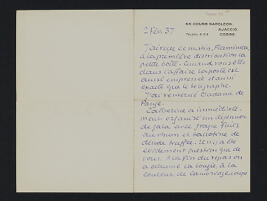
54 Cours Napoléon, Ajaccio, Corse - He is pleased things are going well for her; is working with maps of Corsica, and some have Dutch text he cannot read (Jan. 19); he thanks her for various things she has sent in the post: the 'Times', with its coverage of Edward VIII (Jan. 28), an issue of 'Punch', with an image [?] of Canon [Alexander] Nairne at Windsor (3 Feb.) and pictures for Martine [Giamarchi]. He has sent a parcel of responses to the questionnaire to Varagnac; is happy they had a good evening with Wickham Steed (16 Feb.).
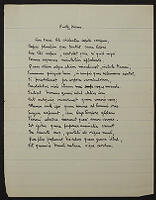
54 Cours Napoléon, Ajaccio, Corse - In the letter of 18 May, he is worried about her silence after she announced her trip to Switzerland; is putting out a new survey for the Encyclopédia Française for Varagnac; their questionnaires have attracted the notice of ethologists and folklorists; he is not making as much progress in his map work as he could like; Varagnac asked for news and told him of the admiration of all his friends for 'Fear [of the Dead]' III. In the letter of 31 May, he says he will quote from the preface to 'Fear' III, to encourage his volunteers to embrace errors and not doubt their abilities, as his humility should be an example; his plans to go to the country are delayed; Martine [Giamarchi, his great niece] is very happy to have the picture magazine. In the letter of 9 June, he thanks her for her card pointing out that it has been 57 years since the composition of 'Plato’s Ideal' in 1879, and used the preface to 'Crainte' in speaking to his Normaliennes who are working on the ethnological and folklore surveys; he has written to Geuthner; there are two translations of Condorcet, Chouville and Mme de Pange.
54 Cours Napoléon Ajaccio (Corse) - Thanks her for the cake from the birthday party; Martine [Giamarchi, a great niece] is reading the history of M. Blanc and 'Le Rameau d’or'.
54 Cours Napoléon, Ajaccio (Corse) - Doesn't know why she is complaining of heat when the papers show London flooded, while in Corsica they are pining for water for their gardens and vines; writes of Martine [Giamarchi, a great niece] who is staying with him; reacts to the change from Baba to Pascha [for 'Pasha the Pom'].
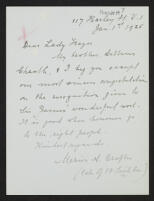
117 Harley St. W.1. - Offers congratulations on behalf of her brother Arthur Cheatle and herself.
Transcript
Grand Hôtel des Bergues, Genève
3. Jan 1898.
Dear Mrs. Eddington,
I sent you just one bit of my ideas abt. Stanley as soon as he left us. The rest must follow now.
His presence has been a great pleasure to us. You have got a boy mixed of most kindly elements, as perhaps Shakspeare might say {1}. His rapidly and clearly working mind has not in the least spoiled his character. I don’t know when I have had to do with so modest and gentlemanly a boy. It is a testimony to day schools and home training, (not, I am afraid, my favourite theory.)
His youth has, of course, been just a little against his making friends, but has not been fatal to it. In Clayton, & in Wood & Brown he has nice associates; but he seems more contented alone than most boys are.
His work is all that I expected, & more: & I feel altogether that he is “a precious youth” committed to my charge. I can realise to some extent what Margaret would feel like if she were left alone to bring up our own little Richard.
I remain
Your friend sincerely
John W. Graham
—————
The writing-paper is engraved with illustrations of the hotel, etc. The year is wrong, as Eddington did not enter Owen’s College till October 1898 (see his Notebook).
{1} Graham evidently had in mind Antony’s encomium on Brutus at the end of Julius Caesar: ‘His life was gentle, and the elements | So mix’d in him that Nature might stand up | And say to all the world “This was a man!”’
Transcript
1912 Sept 3. 11.a.m.
R.M.S.P. Arlanza {1}
My very dear Mother,
We are now on our way between Lisbon and Madeira, and are due at the latter about noon tomorrow; after that the long period away from land begins. I did not hear from you at Lisbon, so fear that the mail must have gone before you posted. I hope you got on all right and are having better weather.
We have had glorious weather the whole way so far. Southampton {2} gave us a parting shower and then the sun came out brightly and has never deserted us since. We had a pretty view of the Needles and Isle of Wight and reached Cherbourg about 6 o’clock where we took on a lot of passengers. We sailed again about 10 o’clock. Before breakfast next morning we were passing Ushant and entered the Bay of Biscay. It was quite smooth, though not exactly glassy; very different from last time I crossed it. The day was bright but not hot. The next morning (Sunday) we were across the Bay[,] and passing C. Finisterre and the end of the Pyrenees the coast looked very pretty with the hills (not very high) well wooded and little villages by the shore. It was now very hot but there has always been a fresh wind. We called at Vigo but did not go ashore; however I visited it well with my opera glasses and took some photographs; the town itself is small, primitive, and not very interesting but the Estuary is fine. We go a little way up the river (I dont know its name) and there are some islands at the mouth which make it very pretty. We took on a tremendous crowd of Spanish emigrants here. They are packed close but seem very happy and lively.
I was up early on Monday morning for the sail up the Tagus to Lisbon. The misty morning light made it very delightful. We went ashore after breakfast (Davidson and J. Atkinson {3} did not land) and stayed until 4 o’clock. You hardly realise Lisbon is a capital city; it seems more a sort of market town. It was very interesting looking round[;] we spent most of the time (which passed very quickly) doing the markets and so on. We went round the Cathedral however, which has a fine high dome and saw many interesting things including the mummy of a saint. We lunched off fruit[—]grapes, apricots and figs[,] which were very nice and wonderfully cheap (very nice tasted {4} purple grapes at a penny a pound)[.] We sailed back to the ship in a sailing boat. We spent altogether 2685 reis which sounds ruinous but is about 9/6.
The ship did not sail till about midnight. Today is I think a little cooler and the sea is not so smooth; but our boat is not much disturbed by it. It is a lovely blue sea with brilliant sunshine.
I have a deck-chair up on the observation deck so get plenty of sun and air. I dont read much more than I did in Norway. This boat is just like the Avon {5} so I know my way about well and, as I told you, we have the same captain {6}.
We are at the Captain’s table but he is not coming to meals until we leave Madeira[.] The other occupants are Mr, Mrs & Miss Unwin; Mr. is some man of importance in S. Amer. but we dont know what. Atkinson tells me he (Unwin) is a radical speaker (A. being a Conservative orator). The only other occupant, my neighbour, is Lady Macpherson-Grant {7}. I am afraid she is going to be rather a bore. However we get plenty of fun with Atkinson. Atkinson who is 67 is a wonderful old chap, as hard as nails; he has been everywhere almost and seems to know everybody. He is always bubbling over with mischief. He is a barrister but has given up practising, breeds and runs racehorses, used to play cricket for Yorkshire, has invented a number of mechanical contrivances which have had great success and directs or manages a number of companies. He is a very keen educationalist on the Northampton County Council and was telling me about their scholarships “but . .” he said {8} “we have n’t done like Somerset yet, I always hold up Somerset to them; they got a Senior Wrangler”[.] I had to enlighten him, as he [had] no idea I was a Somerset Scholar {9}.
I had a good long talk with the Chief Officer last night who knew something of Christina. It seems to be a nice place and the climate and weather prospects first rate.
Of course, we eat tremendously, the meals being much like those on the Avon. I have my bath at 7∙30 so get a little exercise before breakfast at 9. Lunch is at 12∙30, tea at 4, and dinner at 7. They have rather more of a gymnasium here than on the Avon; one very good arrangement is an apparatus for rowing, it feels exactly like real rowing.
I shall have to send with this my best wishes for many happy returns of the day; 60 this time isn’t it? I shall have to give a joint birthday and Christmas present when I get back.
Please give my love to Uncle A. Aunt F. and Arthur; I hope you are not in trouble with the floods, but have heard no English news, whatever.
With very dear love to Winnie & yourself from your affectionate son
Stanley
—————
Letter-head of the Royal Mail Steam Packet Company.
{1} ‘R.M.S.P.’ is printed. The Arlanza, a sister-ship of the Titanic, was built in Belfast by Harland & Wolff for the Southampton–River Plate service. She was launched on 23 November 1911 and came into service in April the following year. She was capable of carrying 400 first-class, 230 second-class, and 760 third-class passengers.
{2} The ship left Southampton on Friday, 30 August.
{3} ‘(Assistant)’ has been added below ‘Davidson’ and ‘(Amateur Astron gone with them)’ above Atkinson, all in the same unidentified hand.
{4} A slip for ‘tasting’.
{5} The R.M.S.P. Avon, of 11,073 tons, was built in Belfast by Harland & Wolf in 1907.
{6} Captain Pope.
{7} Either Frances Elizabeth, the widow of Sir George Macpherson-Grant, 3rd Bt, or Mary (d. 1914), the wife of Sir John Macpherson-Grant, 4th Bt.
{8} This word, which is at the end of a line, is followed by superfluous inverted commas.
{9} Eddington won a Somerset County Council Scholarship in 1898. See Douglas, p. 4.

Transcript
1912 Sept 15
R.M.S.P. Arlanza {1}
My very dear Mother
It is now the last day on the steamer, and we are to reach Rio at about 7 o’clock tonight; I do not think we shall land until tomorrow morning.
We did not go on shore either at Pernambuco or Bahia as they are neither of them very healthy places. At Pernambuco there is no real harbour and we anchor someway out at at† sea but Bahia is a magnificent bay. The land is very low all the way between them; and the coast (which we keep in sight) is monotonous, only there is a curious white sand all the way along which makes it look like chalk cliffs.
The most interesting thing is seeing the whales, which are quite numerous. You see them spouting frequently and sometimes catch a glimpse of the whale itself. We left Bahia on Friday, and yesterday (Saturday) the rain came down in torrents; it was the first time we had had anything more than the slightest showers. In the evening the rain stopped, and the wind got up, and we really pitched quite a lot it was quite pleasant for a change. Today is a perfect day again, clear, and with brilliant sunshine. It is quite cool again and I am wearing my usual English clothes.
I know all the Officers now pretty well; the Chief Officer is a very nice man and a great favourite with the passengers.
I had a letter from Rio at Pernambuco which was very satisfactory; Lee {2} has visited all possible sites. I rather think we shall go to Alfenas further inland than Christina but do not know yet. The Brazilian government is going to do us well. I have met several passengers who know the country well. They say we are sure to have fine weather, and the country is a regular health resort, where the inhabitants all live to be centenarians.
Some of the passengers bought little marmoset monkeys at Bahia; they are sweet little things that you could put in your pocket but I was not tempted to go in for one.
I will not add more as there is a fine bit of coast outside that I want to see and then I must get my packing done.
With very dear love from
your affectionate son
Stanley
—————
Letter-head of the Royal Mail Steam Packet Company. Numbered ‘4’ at the head in pencil.
{1} ‘R.M.S.P.’ is printed.
{2} ‘the Interpreter’ has been interlined above a caret, in an unidentified hand. The person referred to is T. N. Lee, an Englishman deputed by the Brazilian Government to as-sist the expedition. See The Observatory, xxxv (1912), 410.
† Sic.
Transcript
Passa Quatro | Minas Geraes
1912 Sept 26
My very dear Mother
I was very glad to have your letter of Sept 5, which reached me here yesterday afternoon. It was a long time to be without news of you. We spent Friday & Saturday last week pretty quietly in Rio; our baggage (instruments) at last departed on Friday midnight. We left at 9∙30 p.m. on the São Paulo express for Cruxeiro with Lee and Worthington; it was a very comfortable train and we reached Cruxeiro at 2∙30 a.m. Our plan was to sleep in the waiting room and superintend the transfer of the instruments to the narrow-guage† line as soon as it was light; but on arrival we found the instruments had only got a little way and would not reach Cruxeiro until the next day. The waiting room was rather crowded, so I slept very comfortably on my trunk on the platform. We caused much amusement to the porters.
We breakfasted off black coffee, bread and bananas; and Davidson & I had a good walk. It was rather cold cloudy weather, but the country was very wild & beautiful. We left Cruxeiro by a goods train (on to which however they put a saloon car for our benefit). It took nearly 3 hours to do the 20 miles to Passa Quatro, but there was a steep climb all the way. We wound up a very remarkably engineered track and it was a most enjoyable journey with splendid mountains all round.
At Passa Quatro we have a clean and comfortable inn kept by M. Rénier who is in charge of the government meteorological station here. He and his family take meals with us. The other occupants of the inn are de Souza and his wife who is (until Morize arrives) in charge of the Brazilian party’s arrangements; and Stephanik†, and his assistant, who form an official French expedition sent by the Bureau des Longitudes. They are all very nice people; but we very much dislike Lee and Worthington (especially the latter) and it is hard work to avoid a regular rumpus.
Our eclipse camps are about a mile away at a Fazenda near the railway. This site seems a very good one though it is rather surrounded by hills. Since the first day we have had splendid weather—clear blue skies with hot sun but cold in the shade and freezing at night. There are no mosquitoes snakes bugs or cockroaches so far. The Brazilian butterflies are very fine; but they are not very numerous as it is too early for them. I have seen some very large ones.
We have a special engine on which we go to and fro to the Fazenda. It takes us down at 8 am, brings us back to déjeuner at 11; takes us down again at 1 and brings us back at 6. The meals are quite good but rather French in style—all sorts of little meat courses. We have various weird vegetables and concoctions—no black beans as yet. One speciality here is fruit-cheeses, which we have at lunch every day.
We started the building of the piers for the instruments on Monday and they were ready for use today. Our baggage turned up on Monday night and was dumped by the side of the railway opposite the Fazenda. It took us practically all Tuesday afternoon to convey it (in bullock carts drawn by 6 oxen) to the actual field of operations; and it was pretty heavy work loading the carts and unloading them.
These last two days we have been hard at it, erecting huts and getting out a few instruments. I daresay it will be a week before we can slacken off our efforts. We have one boy engaged to assist us but he is not very much use.
The Argentine & Chilean expeditions were going to Christina about 50 miles further on. The former (Perrine & his 3 assistants) came to dinner with us at our hotel in Rio on the Thursday evening and we had a very jolly time I hope to have time to visit their camp at Christina before the eclipse.
I find my helmet very useful but have not worn my drill suit. It is really wonderfully cool weather and one could hardly imagine we are in the tropics. The country here is lovely.
With very dear love to both
ever your affectionate son
Stanley
I hope Winnie had a good trip.
—————
Numbered ‘6’ at the head in pencil.
† Sic.
Transcript
Savoy-Hotel, Hauptbahnhof, Hamburg
5 Aug. 1913 {1}
My very dear Mother
Dyson and I travelled here together by the night train from Bonn, and arrived here about 7∙30 this (Tuesday) morning. The two conferences overlap by one day, so we miss the last day of the Bonn meetings. I have been enjoying the affair immensely, and had no idea it would be such a jolly and lively time. There were about 100 astronomers there, many with wives, etc; and I got to know most of them. Schwarzschild was staying at our hotel & we saw a good deal of him. The meetings were mainly devoted to business (not papers), and as there was very little to do we had not too much work—in fact it was rather an excuse for a picnic; but one learns a lot by seeing and talking to the different people. The weather has been glorious and very hot every day except Saturday (which was overcast but fine). We had two municipal banquets, viz at Bonn & Cologne—both very enjoyable. At Cologne a most splendid band played during the meal one of the best I have heard; and the Gürzenich, where the meal was, is a beautiful old hall with Gothic roof. Whilst at Cologne we had a good look round the Cathedral and saw the treasure chamber with the skulls of the three Magi. On Sunday we left Bonn before 9 a.m. by electric tram, and had a ten mile walk through the woods of the Siebengebirge ending up at the Drachenfels castle, and returned in a launch by the river. About 30 of us went (the rest going a motor trip) practically all the English Astronomers went the walk, only one American, Schwa[r]zschild, Hertzsprung[,] Jules Baillaud and a number of miscellaneous nationalities. Two ladies Miss Hills & Mrs Hertzsprung (late Miss Kapteyn) went with us. As we had all day we did not have to hurry much; the views were very fine. We had a good deal of amusement—including a race. “Schwarzschild & five mad Englishmen” (the latter including Dyson & myself) got photographed at one of those places where they give you them finished in five minutes, posed in a motor-car and with a wooden donkey—it makes an amusing group. One afternoon Sampson Stratton Hubrecht & I went on {2} the river to Strandbad, a bathing place and had a very enjoyable bathe—it was a very hot afternoon. We have also bathed two or three times in a covered place at Bonn. There was a very nicely arranged garden party at the Observatory at Bonn (Küstner’s place) on Friday.
I got to know two Russian astronomers Backlund & Belopolski who are most delightful men—Backlund in particular is very good company[.] He reminds one a bit of Atkinson, but he is quite a first-rate astronomer. He has often been to England but somehow I have always missed him. The meeting of the Astronomische Gesellschaft here will be larger, less select and probably more serious; I do not think it will be quite so lively, but there are a number of excursions & entertainments planned.12 The Goldener Stern at Bonn was an excellent Hotel[;] this one here is not so good; but they were very slow over serving meals everywhere in Bonn; lunch although, {3} only 3 courses, always took about 2 hours to serve.
With very dear love from
your affectionate son
Stanley.
The cigars here are excellent & very cheap.
—————
The letter has been docketed ‘Bonn 1913 | Hamburg’.
{1} The first two figures of the year are printed.
{2} This is probably the intended word, though, perhaps as the result of an alteration, what is written resembles ‘top’.
{3} The comma ought to precede the word.
Transcript
(copy)
Royal Observatory, Greenwich, London, S.E.
1909 Nov. 15
Dear Dr. Schuster
You will, I am sure, not be surprised that I have delayed a little replying to your important letter. I had not at all thought of such a change, and it was a matter requiring very careful consideration. Whilst the idea of returning to Physics, and perhaps especially to academic work, was in many respects attractive, I have however decided that it is best for me not to leave my present work. I need not trouble you with the reasons that have led me to this difficult decision; rightly or wrongly I have concluded that the suggestion and opportunities that I meet with in a large observatory are more likely to lead to good research work on my part {1} than any I could hope for elsewhere.
With many thanks
yours sincerely
A. S. Eddington
—————
The letter is headed ‘copy’ but, since it contains a correction, it is probably a draft.
{1} ‘the suggestion …. on my part’ has been altered from ‘the suggestion and opportunities of research work that I meet with in a large observatory are more likely to lead to good results on my part’.
Groningen. Discusses Mr Gordon and his advisers, ceremonials of the Dutch, subject of previous letter (undisclosed), request to be addressed without clerical titles "for I am a downright layman"
Edinburgh. Ferguson is reading AS's work and is complimentary but the work has provoked the Church, the University, the merchants and the militia, illness of Hume
Edinburgh: scheme to improve the fishing trade in Scotland
Acknowledges receipt of the last two volumes of his history of the Italian Republic
Discusses John Horner's health, the excellent harvest and Lord William Bentinck's forces
London. Death of Mr Wilson